



International Thermonuclear Experimental Reactor project, France – update

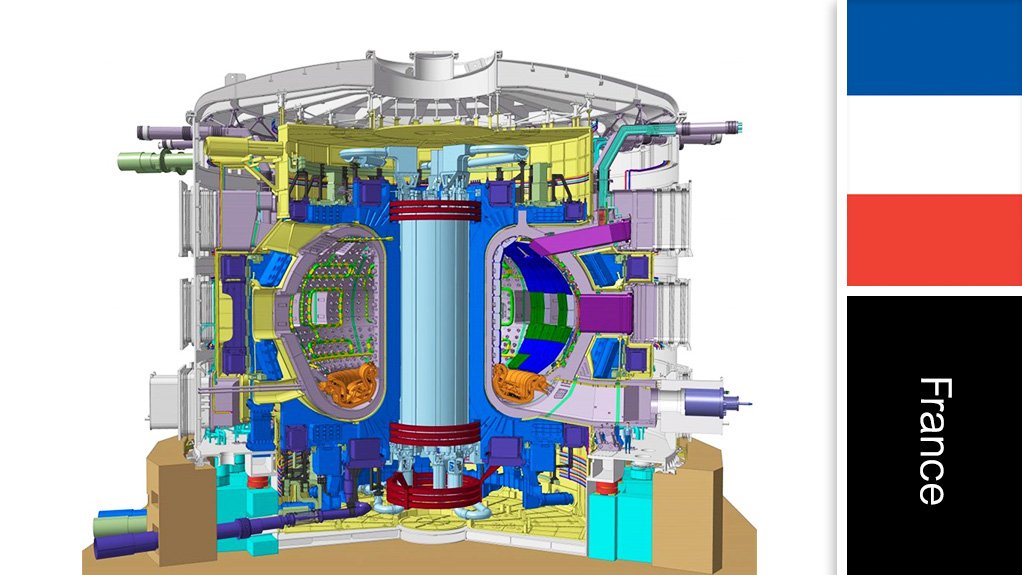


Name of the Project
International Thermonuclear Experimental Reactor (ITER) project.
Location
Saint-Paul-lez-Durance, France.
Project Owner/s
The ITER Organization, which includes China, the European Union (EU), India, Japan, Korea, Russia and the US.
Project Description
The ITER project is a large-scale scientific experiment that aims to demonstrate that it is possible to produce commercial energy from fusion. It is based on the tokamak concept of magnetic confinement, in which the plasma is contained in a doughnut-shaped vacuum vessel. The fuel for the reactor will be a mixture of two isotopes of hydrogen, deuterium and tritium, which will be heated to temperatures higher than 150-million degrees centigrade, forming the hot plasma.
The project entails the construction of the Tokamak complex – a 360 000 t building that comprises the tokamak, diagnostic and tritium buildings – in Cadarache, north of Marseille, in southern France. It will have an estimated generating capacity of 500 MW.
The complex will be 80 m high, 120 m long and 80 m wide. Its footprint will be bigger than that of a football stadium.
It will rely on 493 plinths, equipped with antiseismic bearings. The plinths can sustain the overall weight of the reactor – about 23 000 t – almost three times the weight of the Eiffel Tower.
The complex will host 100 heavy nuclear and confinement doors. The major doors will be 4 m high, 4 m long and 35 cm thick. Each door will be about 40 t and they will be remotely operated.
Almost 3 000 t of superconducting magnets will be connected by 200 km of superconducting cables, all kept at -269 ºC by the world’s largest cryogenic plant.
Potential Job Creation
Not stated.
Capital Expenditure
The project is valued at €23.6-billion. Members of the ITER Organization will bear the cost of the project through its ten-year construction phase and its 20-year operational phase before decommissioning. The project is mainly funded by the European Union (45.6%), with China, India, Japan, Korea, Russia and the US contributing 9.1% each.
Planned Start/End Date
First plasma is scheduled for November 2025 and full deuterium/tritium operation is scheduled for 2035. The ITER Organization and domestic agencies schedule milestones leading up to these dates, which are reviewed monthly, with strategies developed to make up for lost time, where necessary.
Latest Developments
Publication Nuclear Engineering International has reported that the first project of China’s helium-cooled ceramic breeder test blanket system (HCCB TBS) for the ITER at the Nuclear Institute of Science and Technology (NIST), in China, has been launched, signalling the beginning of China's implementation phase of tritium breeding technology in the ITER.
A tritium breeding blanket is a core component for future fusion reactors to achieve tritium breeding self-sufficiency; electricity generation and is one of the key technical problems that need to be resolved urgently for future fusion reactors. The HCCB TBS system is a vital part of China's participation in the ITER.
NIST has led the completion of the preliminary pre-development and design of the system, and is responsible for the engineering design and system research and development, as well as testing tasks assigned by China. NIST has also established a nuclear safety and quality guarantee system that meets the requirements of ITER, and has formulated a detailed implementation plan.
China has participated in the ITER project since 2003 and has actively participated in the ITER test blanket programme, proposing and developing the concept of HCCB TBS. In 2014, ITER’s China Domestic Agency signed a contract with the ITER Organisation for China to independently design and manufacture HCCB TBS and conduct experimental tests in ITER.
Construction of the ITER reactor at Cadarache in France is funded mainly by the European Union (45.6%), with the remainder shared equally by China, India, Japan, Korea, Russia and the USA (9.1% each). ITER is on schedule to begin first plasma operations in 2025.
Key Contracts, Suppliers and Consultants
The VFR consortium, comprising Vinci Construction Grands Projets, Razel-Bec, Dodin Campenon Bernard, Campenon Bernard Sud-Est, GTM Sud, Chantiers Modernes Sud, Ferrovial Agroman and Assystem (final design Phase 1 and prototype testing of the diverter remote handling system); QST and MHI (toroidal field coils); Italian Fincantieri Consortium, comprising Fincantieri, Fincantieri SI, Delta-ti Impianti and Comes (TCC1 assembly contract); and META SNC, comprising France's Ponticelli Freres SAS and Spain's Cobra Instalaciones y Servicios SA and Empresarios Agrupados Internacional (TCC2 assembly contract); NIST (preliminary predevelopment and design of the HCCB TBS).
Contact Details for Project Information
ITER Organization communications Laban Coblentz, tel +33 6 14 16 40 85 or email Laban.Coblentz@iter.org.
Article Enquiry
Email Article
Save Article
To advertise email advertising@creamermedia.co.za or click here
Research Reports

Projects


Latest Multimedia


Showroom
For over 15 years, Lilak Aluminium, a trusted leader in architectural extrusion supply, has delivered excellence to businesses like yours.
VISIT SHOWROOM
Virtual Gas Network supplies compressed natural gas via a virtual gas distribution network.
VISIT SHOWROOM



Announcements
What's On
Subscribe to improve your user experience...
Option 1 (equivalent of R125 a month):
Receive a weekly copy of Creamer Media's Engineering News & Mining Weekly magazine
(print copy for those in South Africa and e-magazine for those outside of South Africa)
Receive daily email newsletters
Access to full search results
Access archive of magazine back copies
Access to Projects in Progress
Access to ONE Research Report of your choice in PDF format
Option 2 (equivalent of R375 a month):
All benefits from Option 1
PLUS
Access to Creamer Media's Research Channel Africa for ALL Research Reports, in PDF format, on various industrial and mining sectors
including Electricity; Water; Energy Transition; Hydrogen; Roads, Rail and Ports; Coal; Gold; Platinum; Battery Metals; etc.
Already a subscriber?
Forgotten your password?
Receive weekly copy of Creamer Media's Engineering News & Mining Weekly magazine (print copy for those in South Africa and e-magazine for those outside of South Africa)
➕
Recieve daily email newsletters
➕
Access to full search results
➕
Access archive of magazine back copies
➕
Access to Projects in Progress
➕
Access to ONE Research Report of your choice in PDF format
RESEARCH CHANNEL AFRICA
R4500 (equivalent of R375 a month)
SUBSCRIBEAll benefits from Option 1
➕
Access to Creamer Media's Research Channel Africa for ALL Research Reports on various industrial and mining sectors, in PDF format, including on:
Electricity
➕
Water
➕
Energy Transition
➕
Hydrogen
➕
Roads, Rail and Ports
➕
Coal
➕
Gold
➕
Platinum
➕
Battery Metals
➕
etc.
Receive all benefits from Option 1 or Option 2 delivered to numerous people at your company
➕
Multiple User names and Passwords for simultaneous log-ins
➕
Intranet integration access to all in your organisation
