



African economies a mixed bag in 2023 - Allianz


Trade credit insurance company Allianz Trade forecasts gross domestic product (GDP) of 2.7% for Africa for 2023, compared with 3.2% this year. It also expects South Africa’s GDP to drop to 1.5% in 2023, from 1.8% in 2022, while Nigeria’s GDP grow is expected to remain unchanged at 2.3%, and Ghana’s at 2.5%.
Kenya’s GDP is, however, expected to grow by 4.4% in 2023, compared with 4.9% in 2022.
Allianz says energy rationing, and logistical bottlenecks, aggravated by flood damage to the Port of Durban in April, are hampering growth, while, in Nigeria, the oil sector continues to struggle.
Additionally, inflation is set to continue rising, driven by costlier food and fuel prices, with Africa’s inflation forecast to finish 2022 averaging 14.7% and then 9.6% in 2023. Nigeria is expected to experience 18% inflation in 2022 and 15% in 2023, while South Africa’s inflation will average 6.8% this year and 5% in 2023. Ghana can expect 31.3% average inflation in 2022 and 20.3% the following year, and Kenya will see inflation of 6.5% this year and 5.5% in 2023.
"Further, [there are] heightened food security risks in North Africa and many parts of sub-Saharan Africa where the role of agriculture and the tendency to rely on imported food products makes the countries particularly vulnerable to the agricultural shock caused by the geopolitical conflict," the company says.
COUNTRY INSIGHTS
"Evidence that South Africa's economy is faltering has continued to build. June hard activity data came in well below consensus expectations with retail sales as well as manufacturing and mining production dropping back in month-on-month terms. We expect the economy to have contracted sharply in the second quarter as the hit to output from severe flooding was probably not recouped and as load-shedding intensified once again," Allianz says.
More timely indicators suggest that activity has remained weak in the third quarter. Scarce energy availability has continued to weigh on energy-intensive sectors, and the manufacturing Purchasing Managers Index declined from 52.2 in June to a one-year low of 47.6 in July. Successive falls in consumer confidence also probably dampened retail sales further with elevated inflation taking its toll, it notes.
Inflation in South Arica rose from 7.4% year-on-year in June to a 13-year-high of 7.8% in July, on the back of mounting fuel and food price pressures. Further, core inflation, at 4.6%, remained close to the midpoint of the 3% to 6% target band.
"Uncomfortably high inflation, currency weakness and US Federal Reserve tightening will probably keep monetary policymakers in a hawkish mood, even as the economy struggles," Allianz notes.
Further, Nigeria's economy expanded by a better-than-expected 3.5% in the second quarter, up from 3.1% in the previous quarter. The pick-up in headline growth was largely owing to the contraction in the oil sector easing, while growth in the non-oil economy held up well. Additionally, in seasonally-adjusted terms, GDP rose by about 0.9% quarter-on-quarter.
"More timely indicators suggest that activity picked up further at the start of quarter. The manufacturing index rose from 50.9 in June to 53.2 in July. Private sector credit growth reached 21.3% in July. However, production in the key oil sector remained very low, essentially unchanged from June at 1.18-million barrels a day in July," Allianz says.
Meanwhile, Nigeria's currency weakened against the dollar, both on the Nafex exchange rate and the black market. Inflation jumped from 18.6% in June to 19.6% in July, which is the highest since September 2005.
The main driver behind the increase in the headline rate was another sharp rise in food inflation, although price pressures rose in other categories too. Elevated inflation is likely to push policymakers to continue raising interest rates, the company says.
In Kenya, uncertainty surrounding elections held earlier in August has continued to linger. A challenge of the results in the courts reversed some of the gains in Kenya’s sovereign dollar bonds since the start of September. Nonetheless, the Supreme Court ruled the election was free and fair.
"Shoring up the economy is likely to be a key priority for the new President. The public debt burden stood at 67% of GDP, as of June. The external position is also in a poor state, as, in May, the trade deficit was the widest since at least 2000, as imports surged by more than exports grew. Activity probably deteriorated further since; the Purchasing Managers' Index dropped from 46.8 in June to 46.3 in July."
Meanwhile, the currency has continued to weaken, dropping 6% against the dollar as of mid-September. This has contributed to the rise in price pressures, and headline inflation increased to a five-year high of 8.3% in July, above the central bank’s inflation target range. After keeping interest rates unchanged in July, the central bank is likely to tighten again before long.
"We have pencilled in an increase of 150 basis points increase in the benchmark rate, to 9%, by year-end," Allianz says.
Meanwhile, Ghana entered talks with international finance organisation the International Monetary Fund (IMF) in July, but this has failed to soothe investors 'concerns about public finances. Sovereign dollar spreads have continued to widen, and the cedi has fallen further, currently down by 37% against the dollar year-to-date.
"Given the large amount of sovereign foreign exchange debt, the fall in the cedi will only make the job of putting the debt position on a sustainable footing more difficult. Two credit rating agencies lowered Ghana’s long-term foreign currency rating further into junk territory.
"A sovereign default is by no means imminent given that the foreign exchange debt repayment schedule is light over the next couple of years. However, an IMF deal, including a firm commitment to fiscal consolidation, will need to be secured soon to soothe investors’ concerns," Allianz states.
Meanwhile, the weaker cedi will add fuel to inflation, which came in at a stronger-than-expected 31.7% in July, which is close to a 19-year high. All of this prompted the central bank to call an emergency meeting and hike interest rates by 300 basis points, to 22%, in September.
"Against this backdrop, economic activity is suffering. GDP growth slowed to just 3.3% in the first quarter and more timely indicators show that both business and consumer confidence have slumped. The risks to our below-consensus forecast for Ghana’s economy to expand by 3% this year lie firmly to the downside," the company noted.
Article Enquiry
Email Article
Save Article
Feedback
To advertise email advertising@creamermedia.co.za or click here
Research Reports

Projects

Latest Multimedia
Latest News

Showroom
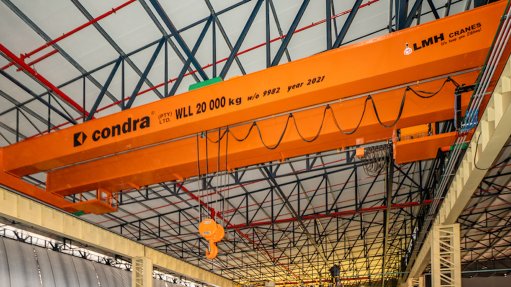
ISO-certified Condra manufactures overhead cranes, portal cranes, cantilever cranes and crane components: hoists, drives, end-carriages, brakes and...
VISIT SHOWROOM
Columbus Stainless, based in Middelburg, Mpumalanga, is Africa’s only producer of stainless steel flat products. In addition, Columbus is the only...
VISIT SHOWROOM



Press Office
Announcements
What's On
Subscribe to improve your user experience...
Option 1 (equivalent of R125 a month):
Receive a weekly copy of Creamer Media's Engineering News & Mining Weekly magazine
(print copy for those in South Africa and e-magazine for those outside of South Africa)
Receive daily email newsletters
Access to full search results
Access archive of magazine back copies
Access to Projects in Progress
Access to ONE Research Report of your choice in PDF format
Option 2 (equivalent of R375 a month):
All benefits from Option 1
PLUS
Access to Creamer Media's Research Channel Africa for ALL Research Reports, in PDF format, on various industrial and mining sectors
including Electricity; Water; Energy Transition; Hydrogen; Roads, Rail and Ports; Coal; Gold; Platinum; Battery Metals; etc.
Already a subscriber?
Forgotten your password?
Receive weekly copy of Creamer Media's Engineering News & Mining Weekly magazine (print copy for those in South Africa and e-magazine for those outside of South Africa)
➕
Recieve daily email newsletters
➕
Access to full search results
➕
Access archive of magazine back copies
➕
Access to Projects in Progress
➕
Access to ONE Research Report of your choice in PDF format
RESEARCH CHANNEL AFRICA
R4500 (equivalent of R375 a month)
SUBSCRIBEAll benefits from Option 1
➕
Access to Creamer Media's Research Channel Africa for ALL Research Reports on various industrial and mining sectors, in PDF format, including on:
Electricity
➕
Water
➕
Energy Transition
➕
Hydrogen
➕
Roads, Rail and Ports
➕
Coal
➕
Gold
➕
Platinum
➕
Battery Metals
➕
etc.
Receive all benefits from Option 1 or Option 2 delivered to numerous people at your company
➕
Multiple User names and Passwords for simultaneous log-ins
➕
Intranet integration access to all in your organisation
