



Climate projections again point to dangerous 2.7 ºC rise by 2100

Projections for global temperature increase by 2100 above preindustrial levels based on targets and announcements from COP27.
Photo by Bloomberg/Climate Action Tracker


The research partnership Climate Action Tracker (CAT) has released its latest projections of how greenhouse-gas emissions may dangerously raise the global average temperature. The result is similar to last year’s – a troubling 2.7 ºC increase above preindustrial levels if policies don’t improve – but a different point of comparison adds a new dimension to the finding.
The following are the key numbers in the updated projections:
If current policies remain in place, the world will heat up by an average of 2.7 °C by 2100. That’s very, very deep into the danger zone.
• If 2030 targets are implemented, that figure drops to 2.4 ºC – the same as the CAT’s estimate last year.
If countries pursue their stated, more aggressive carbon-cutting targets, it falls to 2 ºC, which still fails the Paris Agreement test of “well below” that very mark.
• In an optimistic scenario, where everything that can possibly go right goes right, warming is limited to 1.8 ºC. But that’s a figure that Inger Andersen, United Nations (UN) Environment Programme executive director, recently described as “not currently credible.”
The estimates are in line with a UN report released last month projecting a 2.5 ºC end-of-century average temperature rise if countries meet only their current commitments.
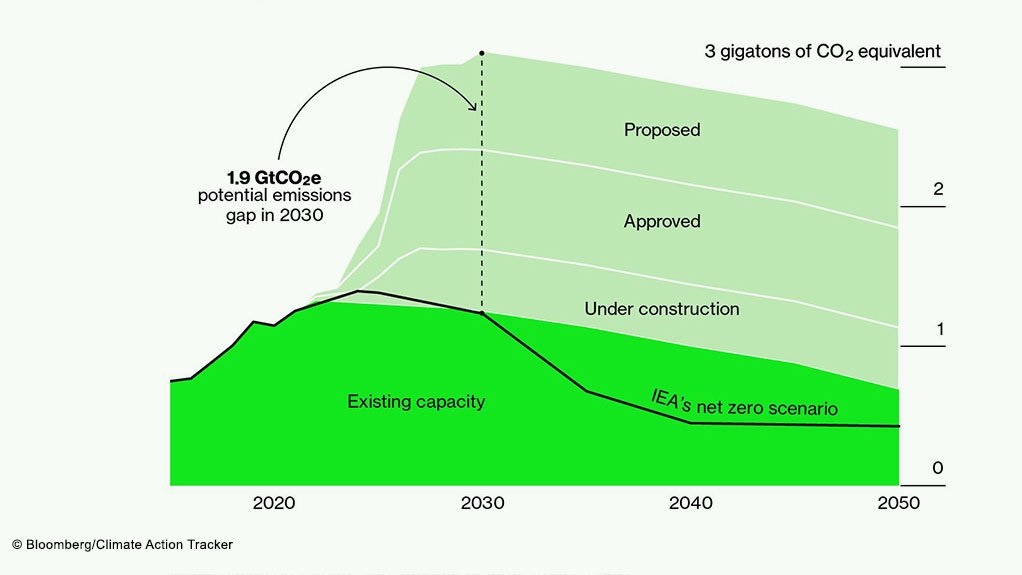
In a report detailing the projections, CAT researchers also document how Russia’s invasion of Ukraine continues to accelerate a global rush for gas. There is more gas infrastructure proposed, approved or under construction than can likely exist without the world exceeding the Paris Agreement warming limit of 1.5 ºC. Existing gas infrastructure alone pushes the world off the International Energy Agency’s “net-zero emissions” pathway by 2030. As it stands, gas use by 2030 needs to be at least 30% below 2021 levels.
“If this were only about replac√ing the Russian gas, we are totally overdoing it,” said Niklas Höhne, a climate policy scientist at Germany’s New Climate Institute, who contributes to the CAT. “And that is not good news.”
The report lays down a stark dilemma: either the gas building boom will put lower levels of global heating out of reach, or countries are rushing to construct assets that they will just as soon abandon.
Some efforts by industry to curb methane emissions may be too little, too late from the standpoint of carbon accounting, according to the report. Efforts to reduce “fugitive emissions”, or infrastructure leaks, are common in many national plans, “but this misses the real challenge: to move beyond coal, oil and gas by phasing out production”, the CAT authors write. “Just as there is no such thing as ‘clean coal’, there is also no ‘clean oil’ nor ‘clean gas.’ ”
The focus on gas and its potential to thwart climate goals puts a grimmer focus on the situation than the International Energy Agency’s recent World Energy Outlook, which cited Russia’s invasion of Ukraine as a turning point in the race towards clean energy “not just for the time being, but for decades to come”, according to IEA executive director Fatih Birol.
A clear move away from gas has taken hold in places as renewable energy continues to expand, Höhne said. “These are two competing trends,” he said. “And for us, we would say it’s a bit too early to say which one will win.”
The CAT numbers are further sharpened by the hard reality that 1.2 ºC of warming – the current level – is already bringing worse impacts than expected, he said.
Yet viewed from another perspective, the 2022 numbers are less grim – they are a vast improvement over the best-case scenario at COP15 in Copenhagen, where the CAT released its first projections.
The year 2009 was a long-distance sprint for diplomats, scientists, activists and business leaders expecting that the annual UN talks would finally pay off in an agreement. Barack Obama, then in the first year of his Presidency, was so eager for a deal that he flew to Copenhagen for the final, disastrous days. Small-island nations and like-minded developing countries went to Denmark pushing an aggressive temperature goal – 1.5 ºC above the preindustrial average – that might give them a fighting chance of survival.
That didn’t happen until six years later, in Paris. But near the close of the COP15 talks a consortium of researchers calling themselves the Climate Action Tracker released a briefing paper with sobering news. The most aggressive targets that developed countries were then offering would leave the world at roughly 3.2 ºC of warming by century’s end. The less ambitious goals might bring about 3.5 ºC of warming – and utter catastrophe.
From the standpoint of the 2009 Copenhagen COP, then, the fourteenth year of the CAT is rather incredible.
“It’s 1.5 °C better than in 2009. That’s, I think, remarkable,” said Höhne, who was the lead author of the 2009 CAT analysis. “And it’s something that motivates me to keep doing this, because you have so much bad news. This is the good news.”
Article Enquiry
Email Article
Save Article
Feedback
To advertise email advertising@creamermedia.co.za or click here
Research Reports

Projects


Latest Multimedia


Latest News

Showroom

The Beneficiation Academy is a certified training institution that follows all compliance legislation and is accredited with various Sector...
VISIT SHOWROOM
The SAIMM started as a learned society in 1894 after the invention of the cyanide process that saved the South African gold mining industry of the...
VISIT SHOWROOM



Announcements
What's On
Subscribe to improve your user experience...
Option 1 (equivalent of R125 a month):
Receive a weekly copy of Creamer Media's Engineering News & Mining Weekly magazine
(print copy for those in South Africa and e-magazine for those outside of South Africa)
Receive daily email newsletters
Access to full search results
Access archive of magazine back copies
Access to Projects in Progress
Access to ONE Research Report of your choice in PDF format
Option 2 (equivalent of R375 a month):
All benefits from Option 1
PLUS
Access to Creamer Media's Research Channel Africa for ALL Research Reports, in PDF format, on various industrial and mining sectors
including Electricity; Water; Energy Transition; Hydrogen; Roads, Rail and Ports; Coal; Gold; Platinum; Battery Metals; etc.
Already a subscriber?
Forgotten your password?
Receive weekly copy of Creamer Media's Engineering News & Mining Weekly magazine (print copy for those in South Africa and e-magazine for those outside of South Africa)
➕
Recieve daily email newsletters
➕
Access to full search results
➕
Access archive of magazine back copies
➕
Access to Projects in Progress
➕
Access to ONE Research Report of your choice in PDF format
RESEARCH CHANNEL AFRICA
R4500 (equivalent of R375 a month)
SUBSCRIBEAll benefits from Option 1
➕
Access to Creamer Media's Research Channel Africa for ALL Research Reports on various industrial and mining sectors, in PDF format, including on:
Electricity
➕
Water
➕
Energy Transition
➕
Hydrogen
➕
Roads, Rail and Ports
➕
Coal
➕
Gold
➕
Platinum
➕
Battery Metals
➕
etc.
Receive all benefits from Option 1 or Option 2 delivered to numerous people at your company
➕
Multiple User names and Passwords for simultaneous log-ins
➕
Intranet integration access to all in your organisation
