



Persistent built-environment transformation barriers under spotlight

CBE CEO Priscilla Mdlalose talks about how transformation in the built environment has not progressed as fast as needed. Video: Kutlwano Matlala; Editing: Nicholas Boyd.
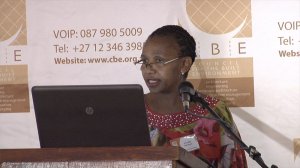


Council for the Built Environment (CBE) acting chairperson Maphefo Mogodi says the built environment industry is plagued by barriers to transformation and that government and industry have not done enough to change the situation.
“The inability of small and medium businesses to prosper economically in the built environment, poor implementation of policies and a lack of policy reforms have contributed to the slow transformation of the sector.”
The
CBE hosted its third national Transformation Indaba, in Pretoria, last week, under the theme ‘Breaking the Barriers’, which relates to economic transformation and job creation.
Participants at the gathering discussed the various regulatory barriers that had led to the exclusion of smaller service providers from projects.
Delegates also discussed retaining registered professionals and the CBE skills pipeline model, which guides transformation dialogues and interventions by the sector, based on the career value chain.
The CBE’s first Transformation Indaba focused on gaining commitment from all stakeholders in the sector to participate and collaborate in the drive towards transformation. The second Indaba was themed ‘Igniting the Possibilities’ and focused on driving transformation through skills development.
CBE CEO Priscilla Mdlalose said that the number of previously disadvantaged individuals registered as professionals across the country was low, averaging 27%, while females averaged 11%.
“Legislation such as the Preferential Procurement Policy Framework Act and the Broad-Based Black Economic Empowerment Act, which were created to redress the imbalances of the past, have not yet yielded the desired outcomes for built environment professionals.”
Further, Mdlalose said the councils for built environment professions, particularly those with low registration numbers, were experiencing challenges in implementing their legislative mandate, as they did not generate sufficient revenue from registration fees to sustain themselves.
Noncompulsory registration for persons practising in the built environment contributes to low registration numbers and presented a challenge in the regulation of professionals. Mdlalose further noted that a lack of enforcement of the identification of work for the professions had resulted in professionals operating in an unregulated environment.
Mdlalose suggested that collaboration was key to making the built environment work for disadvantaged professionals, along with the improved management of stakeholder engagement, to which end the CBE would be launching an integrated electronic built environment system.
Meanwhile, Mdlalose said that a roster system for the built environment, introduced by the then Department of Public Works a while back, should have enabled black companies to be considered first for contracting. The roster also required developers to appoint at least three emerging businesses and one established business for projects over a certain value.
“However, we found that the course of implementation changed along the way.”
She said that, at present, the country had an untransformed construction sector and built environment industry, claiming there was never an intention to implement the policies that were set to transform the industry.
Gauteng Infrastructure Development and Property Management MEC Tasneem Motara agreed, stating that some progress had been made in the 25 years of South Africa’s democracy, but the built environment remained untransformed.
“With many barriers to entry, including optimal functioning of the regulatory environment, service providers from disadvantaged communities had been disadvantaged by regulations. We must use the tools at our disposal to enable these professionals and industry to transform. Change can occur in aspects including structure, culture, products and services, or simply doing things differently,” she said.
Motara added that the construction sector remained male dominated, with 89% of registered professionals being male.
“Legislation is not supposed to take back development, but rather enable development and transformation. Once we come up with solutions, [they] must [end] the struggles of small businesses, which are relied upon to create jobs and grow the economy.”
Commenting on the state of transformation in the industry, former Public Service and Administration Minister Advocate Ngaoko Ramathlodi said: “To win the transformation war, people in the industry have to better organise themselves.”
Article Enquiry
Email Article
Save Article
Feedback
To advertise email advertising@creamermedia.co.za or click here
Research Reports

Projects


Latest Multimedia


Latest News
Showroom

Established in 1933, EKATO is the world leader in agitation technology, supplying agitators for processes and applications such as chemicals and...
VISIT SHOWROOM
Multotec, recognised industry leaders in metallurgy and process engineering help mining houses across the world process minerals more efficiently,...
VISIT SHOWROOM



Press Office
Announcements
What's On
Subscribe to improve your user experience...
Option 1 (equivalent of R125 a month):
Receive a weekly copy of Creamer Media's Engineering News & Mining Weekly magazine
(print copy for those in South Africa and e-magazine for those outside of South Africa)
Receive daily email newsletters
Access to full search results
Access archive of magazine back copies
Access to Projects in Progress
Access to ONE Research Report of your choice in PDF format
Option 2 (equivalent of R375 a month):
All benefits from Option 1
PLUS
Access to Creamer Media's Research Channel Africa for ALL Research Reports, in PDF format, on various industrial and mining sectors
including Electricity; Water; Energy Transition; Hydrogen; Roads, Rail and Ports; Coal; Gold; Platinum; Battery Metals; etc.
Already a subscriber?
Forgotten your password?
Receive weekly copy of Creamer Media's Engineering News & Mining Weekly magazine (print copy for those in South Africa and e-magazine for those outside of South Africa)
➕
Recieve daily email newsletters
➕
Access to full search results
➕
Access archive of magazine back copies
➕
Access to Projects in Progress
➕
Access to ONE Research Report of your choice in PDF format
RESEARCH CHANNEL AFRICA
R4500 (equivalent of R375 a month)
SUBSCRIBEAll benefits from Option 1
➕
Access to Creamer Media's Research Channel Africa for ALL Research Reports on various industrial and mining sectors, in PDF format, including on:
Electricity
➕
Water
➕
Energy Transition
➕
Hydrogen
➕
Roads, Rail and Ports
➕
Coal
➕
Gold
➕
Platinum
➕
Battery Metals
➕
etc.
Receive all benefits from Option 1 or Option 2 delivered to numerous people at your company
➕
Multiple User names and Passwords for simultaneous log-ins
➕
Intranet integration access to all in your organisation
