



Business leader unpacks the ‘big five’ risks facing African firms


Given the fact that the world is marked by volatility, uncertainty, complexity and increasing ambiguity, retail property group Massmart chairperson Kuseni Dlamini has urged businesses to be “that much more aware and vigilant in terms of managing risks in the most appropriate way”.
In order to accomplish this, Dlamini advised delegates attending the recent Deloitte Africa Risk Conference, held in Gauteng, that businesses needed to be aware of and focus on what he called “the big five in terms of topical risk issues that businesses need to contend with and adapt and respond to”.
First among these, is the issue of technological risks, which confront all businesses and organisations.
These risks, while looming and an inescapable part of the operating landscape, include the issue of cybersecurity and attacks, which is an important aspect that businesses need to deal with.
“If [businesses] are not competent, or capable, of dealing with cybersecurity and attacks, they will most likely battle to quantify it,” he noted, adding that businesses still grappled with the issue of cyberattacks.
He advised that businesses look at how the organisation was “geared up” in terms of dealing with this risk.
“Businesses also need to be aware that, even at board level, a business’s leadership conversation needs to have the right mix of competences and skills to be able to inform company strategy, such that companies [are] able to respond appropriately to deal with the risk.”
Few, if any, companies, were currently able to respond appropriately, Dlamini lamented.
He highlighted that, according to the World Economic Forum, the cost of cyber-risks in 2017 was $1-trillion, compared with the cost of risk of natural disasters at $300-billion.
However, the risks of cybersecurity and attacks also present an opportunity for innovation in research and development, and for sustainable solutions and mechanisms to be unleashed in order to deal with it.
Equally important, Dlamini noted, was the issue of data fraud and data theft.
“It is equally important that companies, in dealing with this kind of challenge, . . . have a sense of [the] kind of information [that] is critical to the business, what kind of information must be protected and how to best protect it, while also making sure that it is secured, and having the resources to best protect the information,” he elaborated.
The Fourth Industrial Revolution (4IR), meanwhile, will have an adverse impact on technological advances, which, in itself, is a risk as businesses become more established and more entrenched in digitalisation.
In doing so, businesses were more exposed, he said.
While widely debated, Dlamini believes that 4IR provides both an opportunity and a risk, in the sense that, as the world transitions to the 4IR, disruption takes place.
“There are workers that are not equipped with the skills and competences to be able to [be] meaningful players in the 4IR [environment]. We, therefore, need proactive policies at national level to be able to retrain old workers, so that they can transition to the 4IR,” he highlighted.
More importantly, however, was the need to reconsider the curriculum currently being taught at schools and universities. Dlamini questioned whether the current curriculum was enabling young people to prepare themselves “for the jobs of the future”.
There is a sense of urgency to reposition South Africa’s approach to education and skills development in a way that allows the youth to develop adequately to become a part of the global knowledge-intensive economy of the future.
The other aspect of technological development is the risk of a collapse in crucial and key information infrastructure.
“We are more and more dependent on artificial intelligence, the Internet and digital platforms, and that dependence also makes us vulnerable,” Dlamini warned, stating that business would need to have a fit-for-purpose structure and mechanisms in place to deal with that vulnerability.
The second risk area spans economic risks.
In this regard, Dlamini pointed out that the local economy was being impacted on by the global trade war between China and the US.
He warned that, if the global trade war should escalate, other global industries could question whether South Africa would continue to retain its position in the African Growth and Opportunity Act, which allowed duty-free access into the US market for certain South African products.
A potential global financial crisis was on the horizon, Dlamini warned, which would impact directly on companies and economic growth and the ability to create value and execute global strategies.
Unemployment and underemployment were also issues that were becoming a global crisis. “It is really important to be agile, versatile and . . . responsive,” he stated.
The third area of risk was the issue of geopolitical risks, which included the issue of global terrorism.
“Governments are increasingly finding themselves having to face the challenge of asymmetric wars with invisible enemies,” he commented, adding that there was a risk of the collapse of the State.
This, he elaborated, exacerbated some of the risks and challenges that faced the world from a security point of view.
Additionally, there was the risk of the collapse of multilaterism, which was happening at regional and global levels.
“There is a global deficit in statesmanship, and, if the global financial crisis should happen, are we going to be able to work together and coordinate a global response?” Dlamini questioned.
The risk of the collapse of the national government was also not good for regional integration and national or global stability, he added.
Fourth among the risk areas was the increase of societal risks. Paired with this was the rise of xenophobia and anti-immigrant sentiments.
“Social instability increases business risk, and, in business, you need stability to run a viable business,” Dlamini said.
Linked to this was the issue of the global food and water crisis. In this regard, Dlamini suggested that businesses, and governments, would need to look at sustainable mechanisms to ensure that food and water were evenly distributed globally.
“That requires a shared view of the future, and a global sense of social solidarity across borders, cultures and classes, so that we are able to live side by side with one another,” he commented.
Lastly, Dlamini pointed out that environmental risks were becoming more pronounced, at the apex of which was the issue of climate change, as well as the risk of failure of adaptation and mitigation mechanisms.
“There is a need for global statesmanship on that front to provide leadership to unite the world, rather than divide the world. It is an issue that the world should not be divided on, as it presents an opportunity for unity and, hopefully, sense will prevail in terms of that,” he said.
There were other risks, Dlamini added, facing businesses and society, such as natural and man-made disasters.
“We need to be able to gear ourselves and have the right mechanisms, structures and processes to be able to respond effectively, especially with a focus on mitigating the adverse impact on the most vulnerable among us in society”.
Article Enquiry
Email Article
Save Article
Feedback
To advertise email advertising@creamermedia.co.za or click here
Research Reports

Projects


Latest Multimedia



Showroom
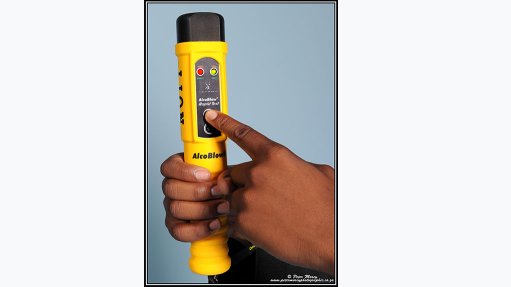
Developed to exceed the latest EN 15964 standards for police breathalysers proving that it will remain accurate and reliable for many years to come.
VISIT SHOWROOM
As a reticulator, Egoli Gas provides natural gas to homes and businesses via underground pipes.
VISIT SHOWROOM


Announcements
What's On
Subscribe to improve your user experience...
Option 1 (equivalent of R125 a month):
Receive a weekly copy of Creamer Media's Engineering News & Mining Weekly magazine
(print copy for those in South Africa and e-magazine for those outside of South Africa)
Receive daily email newsletters
Access to full search results
Access archive of magazine back copies
Access to Projects in Progress
Access to ONE Research Report of your choice in PDF format
Option 2 (equivalent of R375 a month):
All benefits from Option 1
PLUS
Access to Creamer Media's Research Channel Africa for ALL Research Reports, in PDF format, on various industrial and mining sectors
including Electricity; Water; Energy Transition; Hydrogen; Roads, Rail and Ports; Coal; Gold; Platinum; Battery Metals; etc.
Already a subscriber?
Forgotten your password?
Receive weekly copy of Creamer Media's Engineering News & Mining Weekly magazine (print copy for those in South Africa and e-magazine for those outside of South Africa)
➕
Recieve daily email newsletters
➕
Access to full search results
➕
Access archive of magazine back copies
➕
Access to Projects in Progress
➕
Access to ONE Research Report of your choice in PDF format
RESEARCH CHANNEL AFRICA
R4500 (equivalent of R375 a month)
SUBSCRIBEAll benefits from Option 1
➕
Access to Creamer Media's Research Channel Africa for ALL Research Reports on various industrial and mining sectors, in PDF format, including on:
Electricity
➕
Water
➕
Energy Transition
➕
Hydrogen
➕
Roads, Rail and Ports
➕
Coal
➕
Gold
➕
Platinum
➕
Battery Metals
➕
etc.
Receive all benefits from Option 1 or Option 2 delivered to numerous people at your company
➕
Multiple User names and Passwords for simultaneous log-ins
➕
Intranet integration access to all in your organisation
