



Bloodhound supersonic car project, UK



Name and Location
Bloodhound supersonic car (SSC) project, Bristol, UK.
Client
Founder sponsors include Swansea University, the Engineering and Sciences Research Council, the Serco group, University of the West England and STP.
Project Description
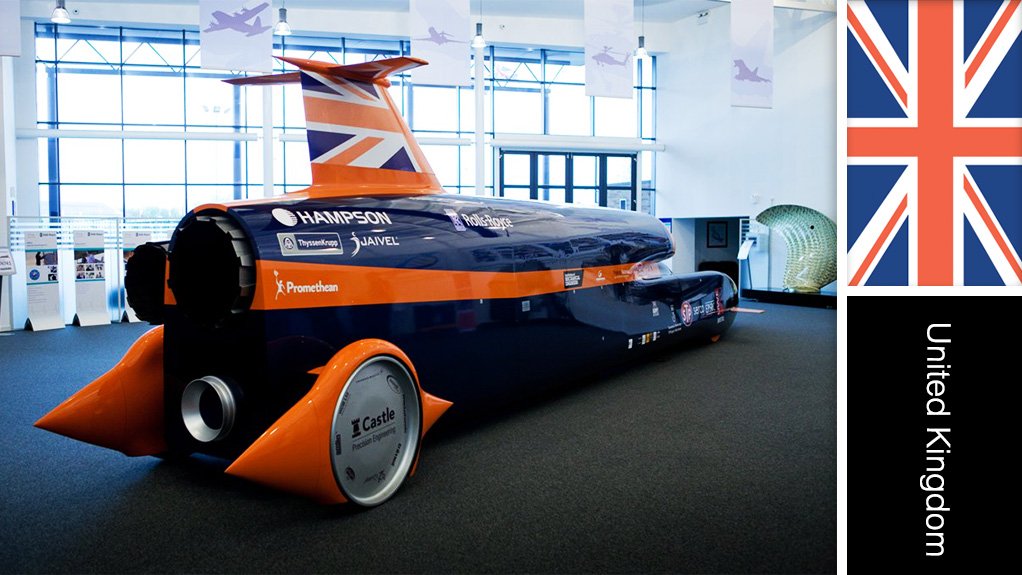
The Bloodhound project involves the construction of, possibly, the world’s fastest car.
The SSC is an amalgamation of car and aircraft technology, with the front half being a carbon-fibre monocoque, like that of a racing car, and the back half a metallic frame, with panels like an aircraft. It will weigh more than seven tonnes.
The Bloodhound will have a slender 14-m-long body, with two front wheels mounted within the body and two rear wheels mounted externally within wheel fairings.
Value
R515-million.
Duration
The timeframe for the 1 600 km/h run will be 2016.
Latest Developments
The timeframe for the actual 1 600 km/h run is currently 2016 and not 2015, as originally envisioned.
Bloodhound programme director Richard Noble says the SSC will start its test runs – some of which may already break the current 1 227.9 km/h land-speed record – at South Africa’s Hakskeen Pan, in the Northern Cape, only in the third quarter of 2015, with the main 1 600 km/h run slated for 2016.
Following doubts over whether the car would be ready in 2014 for the start of testing, Noble and his team decided rather to extend the R515-million programme by one year.
The Bloodhound is being assembled at the Bloodhound Technical Centre, in Avonmouth, Bristol, in the UK. The first metal for the manufacturing of components was cut in 2011.
Having moved to a new facility in Bristol, assembly is progressing well. The lower structure and monocoque will be completed and the upper structure will be built on the assembly fixture in the next few months.
The car has been designed so that the assembly is modular and, while the main structure is coming together, the suspension and rocket modules can also be worked on.
However, the biggest challenge in building the car is timing.
“We don’t have the luxury of completing the whole car design before parts are issued for manufacture; so, from now till the car rolls out in 2015, there is a challenge to balance the release of data for the long-lead manufacturing parts, and to keep the build team supplied with all the parts they need . . . in time to meet the plan,” says Bloodhound chief engineer Mark Chapman.
There are about 160 companies supplying parts to the Bloodhound project.
The first low-speed runs of the Bloodhound will be on a runway in the UK towards the end of the second quarter of 2015.
These runs will be limited to about 350 km/h and “are principally to perform a shakedown of the vehicle systems”, says Chapman.
Following the UK test runs, the car and its immediate support equipment will be shipped by air to Upington, in the Northern Cape.
The remainder of the technical camp will be shipped by sea and will be set up on Hakskeen Pan, awaiting the arrival of the car.
“There will be a series of low-speed runs, with speed increasing progressively during the third quarter of 2015 to achieve a new land-speed record . . . of 1 300 km/h,” says Chapman.
Thereafter, the team will spend the summer months analysing the data and updating the car to return in 2016 to take the record to 1 600 km/h.
The wheels on the SSC will be unlike anything seen before, as they have to hold up at 1 600 km/h.
To date, there have been two wheel-testing sessions at Hakskeen Pan.
The first was conducted in October 2012 with the sharp V-shaped profile, as originally planned. However, Chapman says, this showed significant damage, as it broke through the surface layer and ran on the hard subsurface.
The team returned after the pan had flooded again to redo the tests in June this year, but with two very different wheel profiles – one almost flat, and the other still V-shaped, but with a large blend radius, rather than being sharp.
Both wheels performed well, but the V-wheel was more progressive, and performed better in the lateral grip trials. Neither wheel broke through the surface or exhibited any damage, notes Chapman.
The wheel to be used for the first season will be a rounded V- profile, with a slightly narrower overall width than that which was tested by the Bloodhound team.
He says there will be no more wheel tests in the immediate future.
With Hakskeen Pan cleared of all stones for the record attempt, and the wheels tested, all that remains is to continuously assess surface conditions at the 2015 race track.
“We have a remote weather station on the pan and are gathering data on temperature, humidity, wind speed and rainfall. This gives us a very good basis of historic data when it comes to planning the timing of the campaign,” says Chapman.
“The surface condition of the pan is stunning and a huge credit to the team who have been clearing the 6 000 t of surface stones by hand,” he adds.
However, Chapman also notes that the section of causeway that ran across the centre could do with another year’s cycle of levelling and flooding.
“By the time we need the full length of the course for the 1 600 km/h runs, it will be outstanding,” he says.
Key Contracts and Suppliers
None stated.
On Budget and on Time?
Not stated.
Contact Details for Project Information
Mettle PR on behalf of Bloodhound, Jules Tipler, tel +44 7811 166 796 or email jules.tipler@mettlepr.com.
Article Enquiry
Email Article
Save Article
To advertise email advertising@creamermedia.co.za or click here
Research Reports

Projects


Latest Multimedia


Latest News

Showroom

Established in 1933, EKATO is the world leader in agitation technology, supplying agitators for processes and applications such as chemicals and...
VISIT SHOWROOM
From batteries for boats and jet skis, to batteries for cars and quad bikes, SABAT Batteries has positioned itself as the lifestyle battery of...
VISIT SHOWROOM



Announcements
What's On
Subscribe to improve your user experience...
Option 1 (equivalent of R125 a month):
Receive a weekly copy of Creamer Media's Engineering News & Mining Weekly magazine
(print copy for those in South Africa and e-magazine for those outside of South Africa)
Receive daily email newsletters
Access to full search results
Access archive of magazine back copies
Access to Projects in Progress
Access to ONE Research Report of your choice in PDF format
Option 2 (equivalent of R375 a month):
All benefits from Option 1
PLUS
Access to Creamer Media's Research Channel Africa for ALL Research Reports, in PDF format, on various industrial and mining sectors
including Electricity; Water; Energy Transition; Hydrogen; Roads, Rail and Ports; Coal; Gold; Platinum; Battery Metals; etc.
Already a subscriber?
Forgotten your password?
Receive weekly copy of Creamer Media's Engineering News & Mining Weekly magazine (print copy for those in South Africa and e-magazine for those outside of South Africa)
➕
Recieve daily email newsletters
➕
Access to full search results
➕
Access archive of magazine back copies
➕
Access to Projects in Progress
➕
Access to ONE Research Report of your choice in PDF format
RESEARCH CHANNEL AFRICA
R4500 (equivalent of R375 a month)
SUBSCRIBEAll benefits from Option 1
➕
Access to Creamer Media's Research Channel Africa for ALL Research Reports on various industrial and mining sectors, in PDF format, including on:
Electricity
➕
Water
➕
Energy Transition
➕
Hydrogen
➕
Roads, Rail and Ports
➕
Coal
➕
Gold
➕
Platinum
➕
Battery Metals
➕
etc.
Receive all benefits from Option 1 or Option 2 delivered to numerous people at your company
➕
Multiple User names and Passwords for simultaneous log-ins
➕
Intranet integration access to all in your organisation
