



Artemis II crewed Moon mission successfully launched

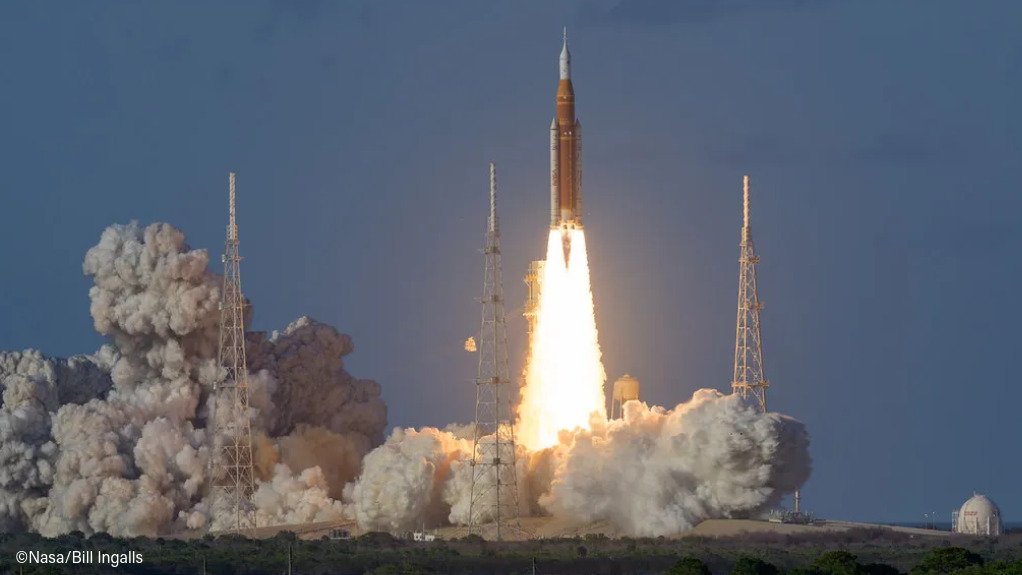
The SLS rocket carrying the Orion spacecraft and its service module lifting off
Photo by Nasa/Bill Ingalls


The first crewed mission to the Moon in more than 50 years, the US National Aeronautics and Space Administration’s (Nasa’s) Artemis II, successfully launched at 00:35 Thursday, South African time. The Space Launch System (SLS) rocket carrying the Orion spacecraft and its service module lifted off from the Kennedy Space Centre’s Launch Pad 39B, located in the state of Florida.
Artemis II is carrying a crew of four: commander Reid Wiseman, pilot Victor Glover, and mission specialists Christina Koch and Jeremy Hansen. Koch is the first woman, and Glover the first African-American, to head to the Moon, while Hansen is a Canadian (Canadian Space Agency), and so the first non-American on a Moon mission. Wiseman, Glover and Koch are all experienced astronauts, with Koch having accumulated the greatest time in space (just over 328.5 days, which is the women’s record). For Hansen, this is his first space flight.
Artemis II is a test flight and will not land on the Moon. Indeed, it will not enter lunar orbit, but loop around the Moon and be swung back towards Earth by lunar gravity, without any need to fire its engine or thrusters. This maneouvre, a safety measure, will see Artemis II travel further from Earth than any previous crewed spacecraft (the current record distance was set by Apollo 13).
“Artemis II is the start of something bigger than any one mission,” highlighted Nasa Administrator Jared Isaacman. “It marks our return to the Moon, not just to visit, but eventually to stay on our Moon Base, and lays the foundation for the next giant leaps ahead.”
The spacecraft is now in an elliptical orbit around the Earth, with an apogee (furthest distance) of 70 000 km. The solar panels on the European Space Agency-supplied service module have deployed. The crew are running preplanned checks and tests, as well as dealing with some glitches that occurred. These included the setting up the toilet (Orion, unlike the Apollo command module, does indeed have a toilet), and a brief communications failure, among others. All have been satisfactorily resolved.
The tests will include manoeuvreing the Orion around the upper stage of the SLS rocket, from which the spacecraft separated after it was placed in its current orbit. All being well, the crew will fire the service module-mounted engine of their spacecraft to leave Earth orbit and head for the Moon, probably very early on Friday morning, South African time.
“Artemis II is a test flight, and the test has just begun,” pointed out Nasa Associate Administrator Amit Kshatriya. “The team that built this vehicle, repaired it, and prepared it for flight has given our crew the machine they need to go prove what it can do. Over the next ten days, Reid, Victor, Christina, and Jeremy will put Orion through its paces so the crews who follow them can go to the Moon’s surface with confidence. We are one mission into a long campaign, and the work ahead of us is greater than the work behind us.”
Under Nasa’s revamped plans, the first mission to land on the Moon will now be Artemis IV, in early 2028. The agency concluded that the original plan, to land with Artemis III, was too aggressive and risky, and instead it has opted for a more cautious approach, with two crewed test flights, similar to the approach adopted by the Apollo programme.
Article Enquiry
Email Article
Save Article
Feedback
To advertise email advertising@creamermedia.co.za or click here
Research Reports

Projects


Latest Multimedia


Latest News

Showroom

The SAIMM started as a learned society in 1894 after the invention of the cyanide process that saved the South African gold mining industry of the...
VISIT SHOWROOM
Industrial Nozzles & Systems (Pty) Ltd (Est. 2000) exclusive representative in Southern Africa for LECHLER GmbH (Est. 1879) - Europe's leading...
VISIT SHOWROOM



Announcements
What's On
Subscribe to improve your user experience...
Option 1 (equivalent of R125 a month):
Receive a weekly copy of Creamer Media's Engineering News & Mining Weekly magazine
(print copy for those in South Africa and e-magazine for those outside of South Africa)
Receive daily email newsletters
Access to full search results
Access archive of magazine back copies
Access to Projects in Progress
Access to ONE Research Report of your choice in PDF format
Option 2 (equivalent of R375 a month):
All benefits from Option 1
PLUS
Access to Creamer Media's Research Channel Africa for ALL Research Reports, in PDF format, on various industrial and mining sectors
including Electricity; Water; Energy Transition; Hydrogen; Roads, Rail and Ports; Coal; Gold; Platinum; Battery Metals; etc.
Already a subscriber?
Forgotten your password?
Receive weekly copy of Creamer Media's Engineering News & Mining Weekly magazine (print copy for those in South Africa and e-magazine for those outside of South Africa)
➕
Recieve daily email newsletters
➕
Access to full search results
➕
Access archive of magazine back copies
➕
Access to Projects in Progress
➕
Access to ONE Research Report of your choice in PDF format
RESEARCH CHANNEL AFRICA
R4500 (equivalent of R375 a month)
SUBSCRIBEAll benefits from Option 1
➕
Access to Creamer Media's Research Channel Africa for ALL Research Reports on various industrial and mining sectors, in PDF format, including on:
Electricity
➕
Water
➕
Energy Transition
➕
Hydrogen
➕
Roads, Rail and Ports
➕
Coal
➕
Gold
➕
Platinum
➕
Battery Metals
➕
etc.
Receive all benefits from Option 1 or Option 2 delivered to numerous people at your company
➕
Multiple User names and Passwords for simultaneous log-ins
➕
Intranet integration access to all in your organisation
