The automation illusion: How misapplied pump controls destroy mechanical systems

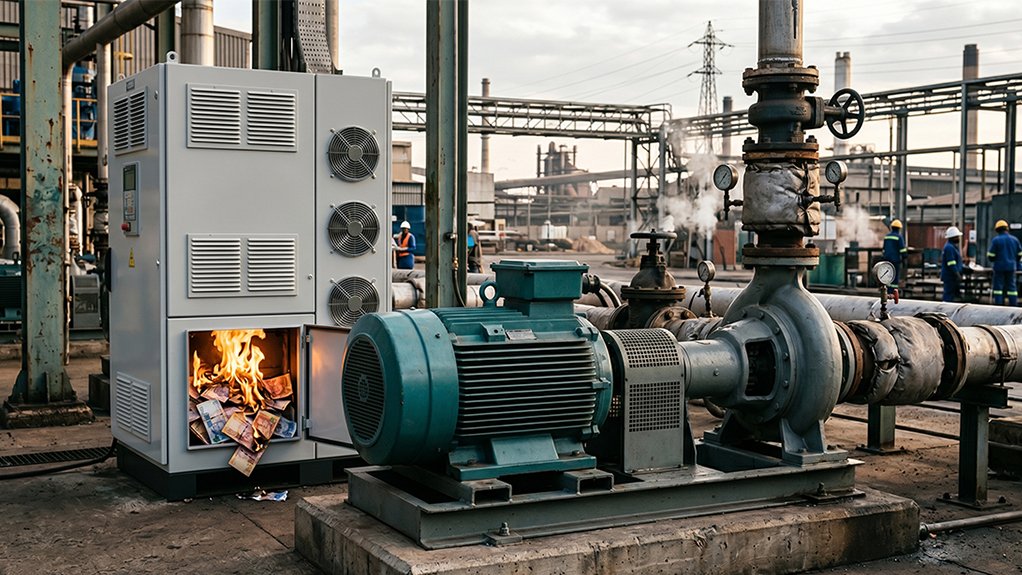
Stop burning money! Discover how incorrect VSD selection leads to wasted South African Rands in an industrial context.



South Africa’s industrial, mining and agricultural sectors are heavily focused on digital automation. In the pursuit of energy efficiency and grid independence, procurement departments are pouring millions of rands into high-tech electrical control panels. The prevailing assumption is that upgrading a system with a "smart" electronic controller will automatically optimise fluid delivery and slash electrical tariffs.
Let us be entirely clear: top-tier variable speed drives (VSDs or VFDs) are incredible pieces of technology. When correctly matched to a genuinely variable fluidic demand, they offer unparalleled energy savings and precise process control. But just as an IE3 premium efficiency motor cannot fix a bad system curve, a state-of-the-art control panel cannot fix a fundamentally flawed mechanical design. In fact, when misapplied, intelligent electronics often accelerate catastrophic mechanical failure.
We are witnessing a fixation where expensive electronic solutions are deployed to mask hydraulic problems. By treating variable frequency as a cure-all, facilities are destroying their drivetrains to save a fraction on their power bills.
VSDs vs Soft Starters
The industry has fallen into an over-engineering trap. It has become standard practice to procure complex electronic drives for virtually every new industrial pump installation. While incorporating VSD’s is critical for dynamic systems, installing them simply because they sound high-tech is pure financial waste.
If you are pumping fluid into a fixed static head—such as filling a bulk municipal reservoir or a constant-level storage tank—where the required flow rate never actually needs to vary, a VSD is the wrong tool for the job. If the fluidic demand is static, the drive should be static.
Consider the rands and cents. A facility might pay upwards of R100 000 for a heavy-duty inverter panel, plus the exorbitant cost of shielded VFD cables to mitigate electrical harmonics, and specialised grounding rings to prevent electric motor bearing fluting. They incur all these capital costs just to achieve a smooth ramp-up and eliminate water hammer—a result they could have easily achieved with a highly robust soft starter for a fraction of the price.
Further, in many constant-speed scenarios, mechanical controls often deemed "old-fashioned"—like a properly sized pressure sustaining valve—are simply superior and more reliable than trying to force a digital electronic solution onto a physical hydraulic reality.
At M Bond Pumps, we stock an extensive range of premium pump motor controls, encompassing everything from intelligent solar inverters to high-end drives. However, we are reluctant to sell a customer a VSD if we know the application is perfectly suited for a traditional star-delta starter or a solid-state soft starter. Procurement must align with the mechanical reality, not the latest electrical trend.
Destroying Pumps to Save Power
When a VSD is selected to vary flow, a dangerous misconception often takes over. Facility managers frequently inherit massively oversized pumps—originally bought "just in case" the site expanded. They assume they can simply attach a VSD to the oversized wet end, dial the frequency down to 30 Hz, restrict the flow, and instantly save money.
This is a fatal misunderstanding of fluid dynamics. Centrifugal pumps are not infinitely adjustable. They have a strict minimum continuous safe flow limit. When you use a VSD to slow a pump down too much, the fluid stops flowing smoothly through the casing, resulting in highly destructive turbulent flow and recirculation inside the volute.
The electrical meter might show that you are saving R5 000 a month in power consumption, but mechanically, you are causing massive shaft deflection. The hydraulic turbulence creates immense radial loads. Within six months, you will shatter a R30 000 mechanical seal and destroy the drive-end motor bearings. A VSD is an electrical controller; it is not a mechanical band-aid for an oversized wet end.
Intelligent Alternatives
Before jumping straight to variable frequency, engineers must evaluate the full spectrum of pump controllers. Modern digital control hardware offers far more than simple stop-and-start functionality without the complexities of frequency modulation.
Advanced digital pump controllers use Cos-Phi (power factor) and current-sensing technology to provide granular monitoring of the motor's electrical draw. They offer precision dry-run protection without the need to drop physical probes down a borehole, alongside auto-restart holiday modes and phase-loss protection. For many agricultural and commercial applications, perfectly sizing the pump to its best efficiency point (BEP) and running it at a fixed 50 Hz through an intelligent digital unit yields a significantly longer lifecycle and a higher return on investment than shoehorning an unnecessary VSD into the system.
PID Hunting and Water Hammer
Even when a VSD is the undisputed correct choice for a variable-demand system, the entire installation is often crippled by a single, overlooked component: the pressure transducer.
A state-of-the-art control panel is mathematically blind. It relies entirely on the 4-20mA signal from its sensor to understand the physical world. A common installation error is placing the pressure transducer directly next to a turbulent 90-degree pipe elbow, immediately after a discharging valve, or too close to the pump volute.
At M Bond Pumps, we enforce a strict mechanical rule for pipes under 300 mm: there must be at least five pipe diameters of straight, uninterrupted pipe on either side of the transducer to ensure a stable, fully developed flow profile.
In chaotic zones lacking this spacing, the sensor reads chaotic, split-second pressure spikes. The VSD’s Proportional-Integral-Derivative (PID) loop interprets this as massive system demand fluctuation. The controller starts "hunting"—violently ramping the motor up to 50 Hz and then slamming it down to 25 Hz every ten seconds as it desperately tries to find equilibrium.
This relentless hunting burns out the motor windings, spikes the maximum electrical demand, and generates severe, continuous water hammer. Eventually, the shockwaves fracture the PVC or steel pipework. In this scenario, a R100 000 VSD panel and a perfectly specified pump are destroyed by a R1 500 sensor installation error.
Engineering Must Lead Electronics
The transition to intelligent industrial automation in South Africa is necessary, but it must be governed by strict mechanical principles. Electronics must serve the mechanics, not the other way around.
You do not solve high energy bills by throwing electronic control panels at a bad system curve. You audit the fluidic demand. You specify the wet end to operate perfectly at its BEP. You select a prime mover that matches the load. Only then do you design the control logic.
At M Bond Pumps, we understand that true industrial efficiency is achieved only when the electrical controls and the mechanical hardware are in perfect harmony. Whether your facility requires an intelligent digital controller, a heavy-duty soft starter, or a precision variable speed drive, ensuring it matches the physical reality of your pipework is our primary metric for success.
This article is Part 3 of a four-part Industry Insights series. Next time, we conclude the series by discussing industrial valves—the critical mechanical gatekeepers of your pipework—and how an incorrect valve selection can throttle even the most perfectly engineered pump curve.
Written by Conrad Strehlau, the MD and lead engineer at M Bond Pumps. As a Professional Engineer, he provides ECSA fee-based system design and troubleshooting consulting services to industry, helping facilities accurately specify new installations and resolve existing mechanical and electrical failures at the source.
Article Enquiry
Email Article
Save Article
Feedback
To advertise email advertising@creamermedia.co.za or click here
Research Reports

Projects


Latest Multimedia


Latest News

Showroom
For over 60 years, VEGA has provided industry-leading products for the measurement of level, density, weight and pressure. As the inventor of the...
VISIT SHOWROOM
Stewarts & Lloyds is a leading steel, tube, and engineering product supplier in South Africa.
VISIT SHOWROOM


Announcements
What's On
Subscribe to improve your user experience...
Option 1 (equivalent of R125 a month):
Receive a weekly copy of Creamer Media's Engineering News & Mining Weekly magazine
(print copy for those in South Africa and e-magazine for those outside of South Africa)
Receive daily email newsletters
Access to full search results
Access archive of magazine back copies
Access to Projects in Progress
Access to ONE Research Report of your choice in PDF format
Option 2 (equivalent of R375 a month):
All benefits from Option 1
PLUS
Access to Creamer Media's Research Channel Africa for ALL Research Reports, in PDF format, on various industrial and mining sectors
including Electricity; Water; Energy Transition; Hydrogen; Roads, Rail and Ports; Coal; Gold; Platinum; Battery Metals; etc.
Already a subscriber?
Forgotten your password?
Receive weekly copy of Creamer Media's Engineering News & Mining Weekly magazine (print copy for those in South Africa and e-magazine for those outside of South Africa)
➕
Recieve daily email newsletters
➕
Access to full search results
➕
Access archive of magazine back copies
➕
Access to Projects in Progress
➕
Access to ONE Research Report of your choice in PDF format
RESEARCH CHANNEL AFRICA
R4500 (equivalent of R375 a month)
SUBSCRIBEAll benefits from Option 1
➕
Access to Creamer Media's Research Channel Africa for ALL Research Reports on various industrial and mining sectors, in PDF format, including on:
Electricity
➕
Water
➕
Energy Transition
➕
Hydrogen
➕
Roads, Rail and Ports
➕
Coal
➕
Gold
➕
Platinum
➕
Battery Metals
➕
etc.
Receive all benefits from Option 1 or Option 2 delivered to numerous people at your company
➕
Multiple User names and Passwords for simultaneous log-ins
➕
Intranet integration access to all in your organisation