Strong exploration system essential to mining’s future, Junior Indaba points out

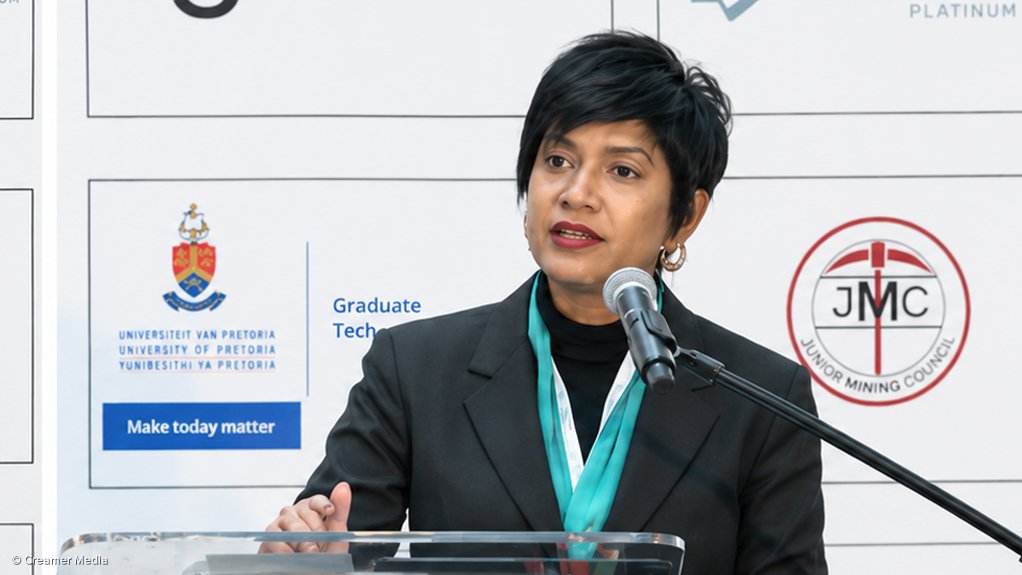
Anglo American senior VP corporate affairs South Africa Nevashnee Naicker.
Photo by Creamer Media


JOHANNESBURG (miningweekly.com) – A strong and vibrant exploration system is essential to the future of the mining sector, and to advancing transformation, inclusion, and long-term growth in South Africa.
In spelling this out at the Junior Indaba on Tuesday, June 9, Anglo American senior VP corporate affairs South Africa Nevashnee Naicker highlighted that every successful mining project created demand for infrastructure, energy, logistics, skills, supply, suppliers, and services, and in that sense, junior mining companies were not only discovering minerals, but often planting the first seeds of entirely new economic ecosystems.
“I sometimes think we undersell what junior mining really represents. Yes, it is about exploration. Yes, it is about discovering the next orebody, but it’s also about discovering the next economic opportunity,” Naicker pointed out at the event covered by Mining Weekly.
Research shows that junior mining companies often account for as much as 70% of new project discoveries, while larger established companies account for the remainder.
In many ways, junior mining companies are the pipeline of the industry, the risk-takers, the innovators, and often the first movers into new frontiers of opportunity against a background of facing constrained access to capital, regulatory bottlenecks, competing rights and administrative complexity.
For juniors to succeed, an environment that supports their growth needs to be created through deliberate, coordinated action.
“Governments, in particular, have a central role to play in creating a conducive environment for investment through policy certainty, regulatory efficiency and licensing processes that are transparent, predictable, and responsive.
“In a world where capital is mobile, countries that make investment easier to navigate will be better placed to attract exploration funding and build sustainable mining pipelines,” Naicker explained.
“South Africa has the mineral endowment, the institutional depth, and the industrial base to be highly competitive in mineral exploration, but to realise that potential, must continue to strengthen the systems that support investment and project development.
“A modern cadastral system will not solve every challenge our sector is facing, but neither can we build a globally competitive exploration industry without one.
“Investors can tolerate geological uncertainty. That is the true nature of exploration. What they struggle to tolerate is administrative uncertainty.
“The clearer, more transparent, and more efficient the licensing environment becomes, the more attractive South Africa becomes as a destination for exploration capital,” Naicker noted.
Countries such as Australia and Canada had, she said, demonstrated what was possible when juniors were supported through a combination of stable policy frameworks, efficient permitting systems, and well-developed capital markets that understand the inherent risk of exploration.
“There is no reason why South Africa, and indeed the continent more broadly, cannot achieve the same. Ultimately, this is about strengthening our competitiveness.
“We all have a collective role in shaping and safeguarding our sector and ultimately making it more competitive.
“We all suffer the long-standing perception that mining is dirty, dangerous, and environmentally damaging.
“Some of that criticism is rooted in history, but I also believe it presents one of the greatest opportunities for our industry.
“The future competitiveness of mining will not only be measured by what we extract, it will increasingly be measured by what we leave behind, and therein lies the real opportunity to redefine the narrative through stronger sustainability leadership.
“The strongest mining jurisdictions will be those that use mineral wealth to build broader economic resilience, creating industries, skills, and opportunities that endure long after the mine reaches its end of life,” Naicker added.
This is particularly relevant for juniors owing to today's exploration projects helping to shape tomorrow's economic landscape.
By building credible, ethical, and responsible mining businesses from the outset, junior mining companies have the opportunity to not only attract capital, but to redefine modern mining’s look and to reshape the perceptions of the mining industry.
“This is where I must also challenge my fellow majors. If we genuinely believe that junior miners have a critical role in South Africa's mining ecosystem and our development potential, then supporting them cannot be left to government investors or institutions alone.
“We also have a responsibility to transfer skills, share expertise, to mentor, and, where appropriate, to partner.
“Institutions like Minerals Council South Africa play a pivotal role, and I'm grateful for the work done through the Mineral Council’s Junior Mining Desk.
“But we need to be honest that the industry needs all of us in order for it to succeed, not just institutions like the Minerals Council.
“Equally, when even a junior miner fails, we all suffer the reputational and financial consequences, and this is especially important at a time when the global demand for critical minerals is accelerating, from copper and iron-ore to platinum group metals, and even coal, all of which remain essential for human development and economic progress.
“Quite simply, the world will require significantly more minerals to build the future we all aspire to.
“Projections suggest that demand for copper alone will grow by about 50% from current production levels by 2040.
“We will need more copper to electrify economies to enable the energy transition, support the rapid growth of artificial intelligence and data centre infrastructure, and to respond to evolving security needs.
“We will need even more iron-ore to build, and in some cases rebuild the infrastructure that underpins global development,” she said.
The International Energy Agency and the United Nations have indicated that the demand for critical minerals, such as lithium, cobalt, and nickel, could increase threefold by 2030 and fourfold by 2040.
“So, the message is clear. The world requires more mining, and in all likelihood, significantly more than we have seen in recent decades, and this is where junior mining companies will play an increasingly catalytic role.
“Juniors venture into unexplored regions, invest in geological knowledge, build early infrastructure, and create pathways for economic activity where little previously existed.
“That early-stage activity often lays the foundation for wider development, from job creation and local procurement to the stimulation of supporting industries and services.
“It brings in skills, capital, and technology, while also generating valuable data that improves the company's understanding of its resource base.
“Over time, this helps to derisk investment and creates a pipeline of projects that can ultimately become long-term operations.”
In this way, junior mining was not only about finding minerals but also about enabling countries to better position themselves within the global economy.
For many African countries, including South Africa, a vibrant exploration and junior mining sector could therefore act as a catalyst for inclusive growth.
Every producing mine was once a high-risk idea in someone's geological model and every mining district that today supports mining, which supports families, businesses, and communities, began with somebody willing to take a chance on possibility.
“That is why junior mining matters. If we want a mining sector that is competitive, resilient, and capable of delivering lasting value, then we must create an environment in which junior mining companies are not only able to participate but to succeed, and this requires continued alignment across the ecosystem, from government and regulators to investors, established mining companies, and industry partners.
“Junior mining thus deserves an enabling environment that gives it the best chance of success.
“Last year, Anglo American announced our commitment to invest R600-million into the Junior Mining Exploration Fund when our merger with Tech Resources completes.
The Junior Mining Exploration Fund was set up in 2024 by the Department of Minerals and Petroleum Resources (DMPR), Council for Geological Science (CGS), and the Industrial Development Corporation (IDC).
“Over the last several months, we have been collaborating very closely with the DMPR, the IDC, and CGS to help evolve this fund to its next natural phase.
“The goal is to create a platform that enables broader participation, not only from Anglo American or Anglo Tech, but from a wider ecosystem of partners and funders in supporting and advancing junior exploration across the country.
“At the end of it, through this and other vehicles, such as the Public Investment Corporation's early-stage mining fund, we hope to see more viable mines flourishing in this country.
“This, of course, improves our potential to partner with junior miners as equity participants and provide further technical expertise and mentoring as we work together to discover South Africa's next generation of world-class mines.
“This partnership builds on the important work we have already been doing for many decades through programmes like the Anglo Zimele Sifa Mine Fund, also in partnership with the IDC, which supported projects like the Prieska Copper Zinc Mine, owned by Orion Minerals, and Adelaide Ruiters Mining and Exploration. These are tangible examples of the role Anglo has historically played in helping develop capacity, broaden participation, and support the evolution of South Africa's mining industry.
“So, when we speak about supporting junior mining, we’re not speaking about short-term interventions but about a long-term commitment to the future competitiveness, resilience, and inclusivity of the sector.
During question time, Mining Weekly asked whether the funds given to junior mining companies would be made public, including money from Anglo American’s R600-million contribution.
“What is Anglo's stance on that?” Swanepoel asked.
Naicker: Let's maybe take a step back and say from our perspective and from everything we know, this fund launched in 2024 between the IDC and the DMPR, was a R400-million stake. I think it was intended to really put skin in the game for government, and to start the platform for this junior exploration. It was always intended, based on the discussions that we've had with government, for that fund to mature into a next phase, which would be more independent and have the kind of robust governance that would give any investor confidence, and that would then be able to attract the kinds of funders and investors from within South Africa and in our industry and beyond that. So, what we're talking about here is Phase 2 of the junior fund. Regarding Phase 1, I think the DG and others from the DMPR are better equipped to tell you how that's going - from our understanding pretty well - in terms of disbursing the funds, but there's quite a level of maturation and development on Phase 2 already, including creating a far more transparent platform for how juniors are selected, how the money is dispersed, but importantly, the support ecosystem, including financial management support, so the likes of Absa coming in, as an example, or the JSE, or others might really give this platform the kind of legitimacy it requires to build the confidence for all of us to participate.
ANGLO TECH
Naicker said the urban legend that Anglo was exiting South Africa “is simply not true. What is true is that our portfolio is evolving in line with our simplification strategy, and what is true is that we are merging with Tech Resources somewhere between September this year and March next year, which will make us one of the top five global copper producers in the world with a sizable iron-ore portfolio, including here in South Africa, through our world-class Kumba iron-ore, which remains a core part of our strategy globally. We know that a stronger, more focused company is a more resilient company, and that improves our sustainability. This evolution is not only good for our business, but it is also good for South Africa.
“For more than a century, since our founding here, Anglo American has been far more than just a mining company. We have been a partner in South Africa's progress, contributing to nation-building and standing alongside our stakeholders through periods of both growth and in moments of challenge.
“Like many institutions that have existed for more than a century, our history is complex and our future is evolving, and as we look ahead with great excitement to our proposed merger with Tech, one thing that has remained remarkably consistent is our belief in the long-term future of South Africa.
“As Anglo Tech, yes, our head office moves from London to Vancouver, but we will continue our listing on the JSE as a very much larger global company providing direct access for our substantial shareholder base in South Africa,
“Our commitment to South Africa remains unwavering, because despite the challenges often focused on, South Africa remains one of the world's most richly endowed mineral jurisdictions, with deep mining expertise, sophisticated industrial capability, and a long history of mining innovation.
“Now, Anglo has always been a major player in mining, but equally we have always been invested in building a thriving and sustainable mining industry as a whole in South Africa, and this includes support for South Africa's junior mining sector, which we all know is a critical lever in strengthening our country's mining industry,” Naicker emphasised.
Article Enquiry
Email Article
Save Article
Feedback
To advertise email advertising@creamermedia.co.za or click here
Research Reports

Projects
Latest News

Showroom
FLANDERS Southern Africa provides integrated solutions for mining and industrial operations, covering field services, automation, electrification,...
VISIT SHOWROOM
We partner growth of our select clients through our comprehensive and competitive integrated international logistics, trade finance and information...
VISIT SHOWROOM

Press Office
Announcements
What's On
Subscribe to improve your user experience...
Option 1 (equivalent of R125 a month):
Receive a weekly copy of Creamer Media's Engineering News & Mining Weekly magazine
(print copy for those in South Africa and e-magazine for those outside of South Africa)
Receive daily email newsletters
Access to full search results
Access archive of magazine back copies
Access to Projects in Progress
Access to ONE Research Report of your choice in PDF format
Option 2 (equivalent of R375 a month):
All benefits from Option 1
PLUS
Access to Creamer Media's Research Channel Africa for ALL Research Reports, in PDF format, on various industrial and mining sectors
including Electricity; Water; Energy Transition; Hydrogen; Roads, Rail and Ports; Coal; Gold; Platinum; Battery Metals; etc.
Already a subscriber?
Forgotten your password?
Receive weekly copy of Creamer Media's Engineering News & Mining Weekly magazine (print copy for those in South Africa and e-magazine for those outside of South Africa)
➕
Recieve daily email newsletters
➕
Access to full search results
➕
Access archive of magazine back copies
➕
Access to Projects in Progress
➕
Access to ONE Research Report of your choice in PDF format
RESEARCH CHANNEL AFRICA
R4500 (equivalent of R375 a month)
SUBSCRIBEAll benefits from Option 1
➕
Access to Creamer Media's Research Channel Africa for ALL Research Reports on various industrial and mining sectors, in PDF format, including on:
Electricity
➕
Water
➕
Energy Transition
➕
Hydrogen
➕
Roads, Rail and Ports
➕
Coal
➕
Gold
➕
Platinum
➕
Battery Metals
➕
etc.
Receive all benefits from Option 1 or Option 2 delivered to numerous people at your company
➕
Multiple User names and Passwords for simultaneous log-ins
➕
Intranet integration access to all in your organisation