Essential for PV plants to test for underperformance





This article has been supplied.
By: Jacqui Crozier McCleland - Operations and Technical Manager
South African and international data consistently shows that photovoltaic (PV) modules arriving at large-scale plants often underperform their nameplate ratings.
For utility-scale and commercial and industrial plant owners, developers and insurers, independent accredited testing is the only way to document actual performance at the point of delivery and create a baseline for delivery agreement and warranty recourse.
Where the plant is already up and running, it is equally important to test the modules while they are still under warranty to determine whether they are meeting the manufacturer’s specification over time.
The only SANAS-accredited mobile laboratory testing service in South Africa for field testing is PVinsight (Pty) Ltd. In November 2025 they took their mobile lab to an 80 MW plant on a platinum mine in Limpopo where they tested 600 modules. They are currently at a 120 MW utility-scale plant in De Aar in the Northern Cape where they are testing 900 modules.
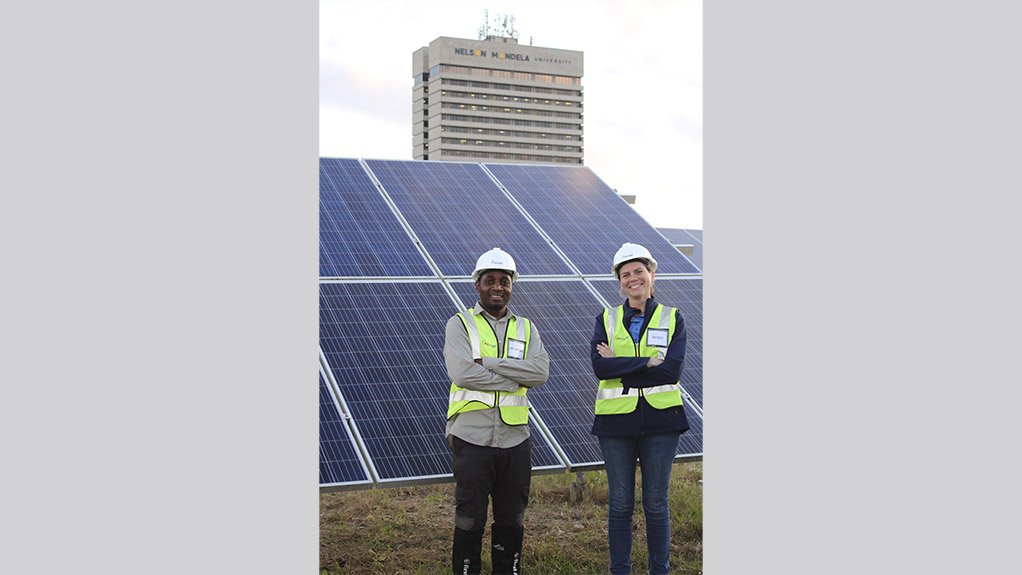
“The testing we are doing at large PV plants demonstrates that accredited mobile testing is now viable and operational at utility scale in this country,” says Dr Jacqui Crozier McCleland who has a PhD in physics and is the Operations and Technical Manager for PVinsight, an eleven-year-old company that is a spin-out of Nelson Mandla University’s Photovoltaics Research Group led by physicist Professor Ernest van Dyk - the CEO of PVinsight.
Crozier McCleland offers several examples of rating underperformance. The reference to
EU PVSEC below denotes the world’s leading forum for PV research and development, technologies and applications and the largest scientific conference on PV solar energy.
PVinsight / EU PVSEC 2025 (South Africa) Testing of 15 commercially sourced modules, purchased from local South African distributors in 2024 and 2025, showed that all 15 measured below nominal power, with deviations ranging from -1.9% to -2.7%.
Fraunhofer ISE (Germany): In 2024, average monocrystalline silicon module output was 1.2% below nameplate capacity. This is the eighth consecutive year that measured power has fallen short of stated capacity, across 70,000 modules from 15 major manufacturers tested since 2012. Source: PV Tech, March 12, 2025
PTB / EU PVSEC 2024 (Germany): Across 40 modules from 22 different types manufactured between 2021 and 2024, average measured power was 1.33% below nameplate. Nearly half of all module types showed deviations greater than -1.5%. Every single module in the study came in below its stated nameplate power. Source: DOI 10.4229/EUPVSEC2024/3AV.3.42
Odinspire (Netherlands): Of over 9,000 modules tested in 2024, 82% fell below nominal value and 30% fell below even the manufacturer's own margin of error. Only 18% met or exceeded nameplate ratings. The proportion falling below the error margin nearly doubled from 2023 to 2024. Source: Odinspire, April 2025
Crozier McCleland says the positive news is that EUPVSEC research completed by PVinsight further shows that utility-scale projects that included quality assurance testing in their agreement with the manufacturer, consistently achieved results where the modules are true to their ratings and remained above warranty thresholds after more than a decade of operation.
For investors, insurers and developers, this provides something that no amount of manufacturer documentation can replace: independently verified, accredited evidence of what the modules actually produce, tested at site on South African soil, under conditions that reflect the realities of local procurement and logistics.
“South Africa is blessed with a world-class solar resource, but its true value can only be realised when photovoltaic modules perform as intended,” says Prof van Dyk. Performance testing for early detection of underperformance is essential to safeguard energy yield, ensure financial viability, and build long-term confidence in solar as a cornerstone of the country’s energy future.”
Ideally the modules should be tested before they are installed to get the initial baseline results and then test them again on an annual basis, but if the modules are already installed they can be removed and tested. “All modules degrade over time and it’s important to test they are degrading as specified,” says Crozier McCleland. “If this has accelerated you want to pick it up as soon as possible while they are still under their product and performance warranty, usually 10 years for product and 25 - 30 years for performance.”
“The considerable advantage of mobile testing is the immediacy of the result,” says PVinsight’s Testing Services Manager, physicist Dr Monphias Vumbugwa. “As modules arrive on site, we can tell the client the actual power output and the condition of each module at cell level, using electroluminescence imaging to pick up any cracks and defects.”
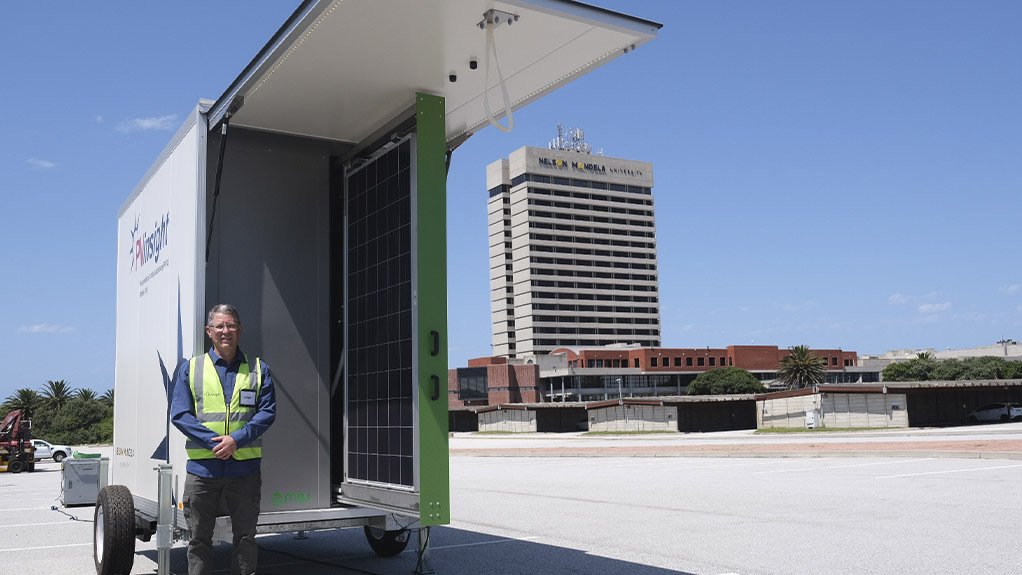
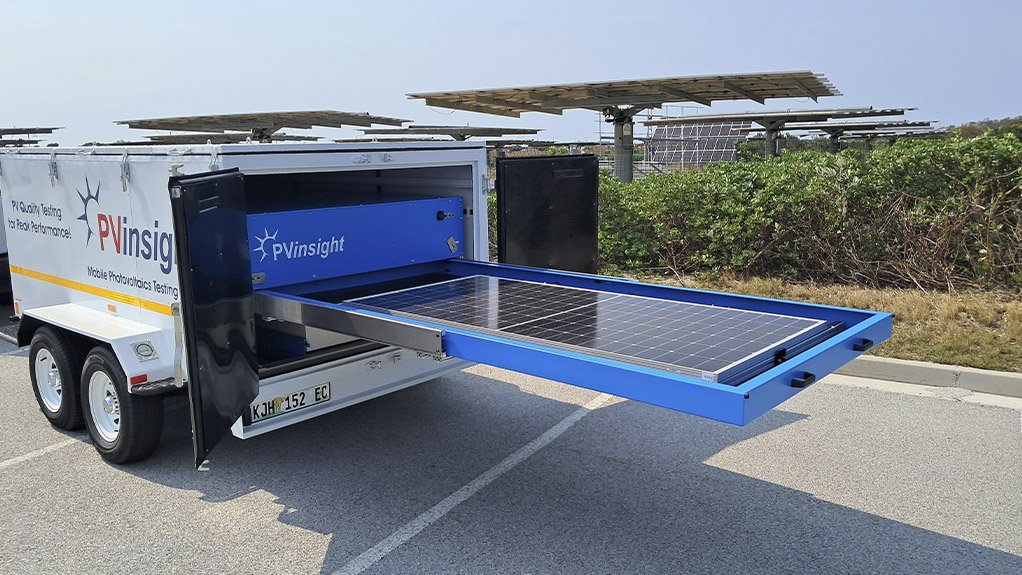
PVinsight has two mobile labs operating throughout the country, both manufactured by MBJ Solutions in Germany. “We test all module sizes and power ratings from those used at the utility scale that feed into the Eskom electricity grid to smaller plants that power industries, companies and communities,” says Crozier McCleland.
The newer of the two – the MBJ Mobile Lab 5.0 - is a fully integrated testing centre in a custom-built trailer, combining an A+A+A+-rated LED solar simulator with a high-resolution EL imaging system. It is transported directly to the plant, eliminating the cost and risk of transporting modules to a fixed laboratory and delivering accredited, IEC-standard results on site.
“The mobile service is done to the same standards and requirements as our fixed lab where we have tested over 27 000 modules to date,” says Crozier McCleland. “We continue to do a significant amount of testing at our lab, which is situated on the Ocean Science Campus at Nelson Mandela University” she explains, “but the immediacy of information from the mobile lab, delivered at the point of commissioning, is something no off-site test can replicate.”
Article Enquiry
Email Article
Save Article
Feedback
To advertise email advertising@creamermedia.co.za or click here
Research Reports

Projects

Latest Multimedia


Latest News


Showroom

The Beneficiation Academy is a certified training institution that follows all compliance legislation and is accredited with various Sector...
VISIT SHOWROOM
Established on 1 March, 2000, by Barries Barnard, Advanced Fire Suppression Technologies (AFST) and the Advanced Group stands as Sub-Saharan...
VISIT SHOWROOM



Announcements
What's On
Subscribe to improve your user experience...
Option 1 (equivalent of R125 a month):
Receive a weekly copy of Creamer Media's Engineering News & Mining Weekly magazine
(print copy for those in South Africa and e-magazine for those outside of South Africa)
Receive daily email newsletters
Access to full search results
Access archive of magazine back copies
Access to Projects in Progress
Access to ONE Research Report of your choice in PDF format
Option 2 (equivalent of R375 a month):
All benefits from Option 1
PLUS
Access to Creamer Media's Research Channel Africa for ALL Research Reports, in PDF format, on various industrial and mining sectors
including Electricity; Water; Energy Transition; Hydrogen; Roads, Rail and Ports; Coal; Gold; Platinum; Battery Metals; etc.
Already a subscriber?
Forgotten your password?
Receive weekly copy of Creamer Media's Engineering News & Mining Weekly magazine (print copy for those in South Africa and e-magazine for those outside of South Africa)
➕
Recieve daily email newsletters
➕
Access to full search results
➕
Access archive of magazine back copies
➕
Access to Projects in Progress
➕
Access to ONE Research Report of your choice in PDF format
RESEARCH CHANNEL AFRICA
R4500 (equivalent of R375 a month)
SUBSCRIBEAll benefits from Option 1
➕
Access to Creamer Media's Research Channel Africa for ALL Research Reports on various industrial and mining sectors, in PDF format, including on:
Electricity
➕
Water
➕
Energy Transition
➕
Hydrogen
➕
Roads, Rail and Ports
➕
Coal
➕
Gold
➕
Platinum
➕
Battery Metals
➕
etc.
Receive all benefits from Option 1 or Option 2 delivered to numerous people at your company
➕
Multiple User names and Passwords for simultaneous log-ins
➕
Intranet integration access to all in your organisation