Attributes of platinum group metals explicated at Mintek PGM Day

Mintek PGM Industry Day covered by Mining Weekly's Martin Creamer. Video: Creamer Media's Shadwyn Dickinson. Video Editing: Creamer Media's Nicholas Boyd.



JOHANNESBURG (miningweekly.com) – Platinum group metals (PGMs) have several properties that make them critical everyday-life minerals, Mintek supervisor applied chemical analysis Nehemiah Mukwevho explicated during his presentation at the Mintek PGM Industry Day, where South Africa's national mineral research organisation and one of the world's leading technology organisations specialising in mineral processing showcased its latest PGM-relevant services, research capabilities and innovations.
“Proper data is what keeps the whole industry moving,” he told the audience at the event covered by Mining Weekly. (Also watch attached Creamer Media video.)
Now in his twenty-second year at Mintek, Mukwevho expressed certainty that, in one way or another, audience members had, at some time or another, enjoyed the application of PGMs that are spread across autocatalysis, jewellery, chemicals, petroleum, electronics, electrical, medical and biomedical sectors.
He was one of a dozen Mintek managers, engineers and scientists who presented in the auditorium of this 92-year-old State-owned mineral research organisation, which is situated at 200 Malibongwe Drive in Randburg.
“The quantification of PGMs is very important because it guides all the plant processes,” Mukwevho emphasised during his outline of the occurrence, properties, applications and analytical determination of PGMs.
Hailed by Mukwevho was Mintek’s major PGM quantification library and revealed by him was the publication by the organisation of fire assay procedures to attract and retain personnel.
Mintek operates an analytical chemistry division that applies fire assay as a core technique for pre-concentrating and analysing PGMs in ores, concentrates, and geological samples and Mukwevho outlined what Mintek’s fire assay know-how offers in helping to understand PGM-bearing Merensky reef, upper group two (UG2) reef, Platreef, middle group reefs, chromites and sulphides.
Displayed were the overwhelmingly South Africa-based areas where PGM reserves are located.
Fire assay is viewed by Mukwevho as a bedrock PGM analysis method, and he outlined the information that must be provided prior to the commencement of PGM analysis for fire assay to be successful. He also spoke of incorrect estimates presenting challenges.
“This is one area where, over the years, we’ve had a lot of discussion,” he reported.
If the proper information is not provided, many hours of work result in “something you can't do anything with and you must redo the whole process again, but with the proper information given upfront, you’re able to make good decisions”.
“When we send quotations to the client, we send them with a table that gives them guidance about the amount of sample that we need, and then also why they must provide a grade estimate,” Mukwevho explained at the event covered by Mining Weekly.
Delay-avoidance pre-analysis information required embraces sample grade estimates and ore type disclosure.
To produce reliable results, Mintek complies with approved calibration standards. Its methods are accredited by South Africa’s national accreditation system, SANAS, and processes are monitored through quality control charts and internal and external audits.
Regarding the future of fire assay, several non-fire assay methods are being developed, “but fire assay for me is to remain . . . and we just need to keep on refining and improving it and then connecting it to other advanced instruments”.
Electric fire assay furnaces are giving way to gas furnaces, “because they do help a lot with the exposure to heat, because in fire assay, we work at around 1 200 oC”.
“With electric furnaces, you work very close to the furnace, but with the gas furnaces, you've got some distance, and then you've got control of the heat, because electric furnaces are left on at high temperatures. Gas furnaces are switched off, and then within 30 minutes the following day they’re up again.
Environmental challenges come in the form of considerable volumes of lead and nickel waste, “but in recent years, we've been involved a lot in the recovery of nickel and lead so that when we dump other waste, we don't dump it with a high level of lead, and we monitor our processes. We do a lot of research on environmental monitoring in the river sediment. We do check our rivers and we are able to see if maybe either through the landfills or where they dispose of the waste, we check the contamination in our environment through river pollution monitoring.
Regarding the shortage of skilled personnel, Mukwevho commented: “Every time you read about fire assay, they always talk about the skills issue, but the issue with fire assay is normally it's not taught. When students join, they experience fire assay for the first time.
“To enjoy fire assay, you have to have interest in it, and then have to endure whatever happens, the heat, the environmental control, and the safety procedures.
“You have to have an interest in understanding the chemistry, and to read more about fire assay, and to be interested in troubleshooting, because it involves a lot of ratios and comparing the samples to the ratio that you have to choose.
“Because of the heat, sometimes people are willing to work for a very short time and then go to other sections,” Mukwevho reported. (Also watch attached Creamer Media video.)
Article Enquiry
Email Article
Save Article
Feedback
To advertise email advertising@creamermedia.co.za or click here


Projects


Latest Multimedia
Latest News

Showroom
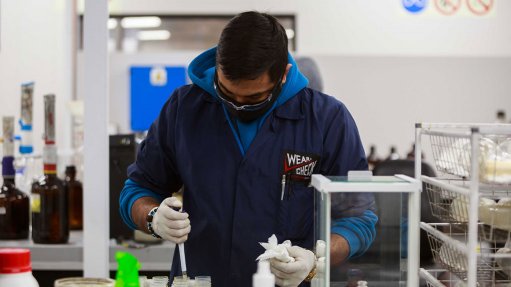
Leading condition monitoring specialists, WearCheck, help boost machinery lifespan and reduce catastrophic component failure through the scientific...
VISIT SHOWROOM
Established on 1 March, 2000, by Barries Barnard, Advanced Fire Suppression Technologies (AFST) and the Advanced Group stands as Sub-Saharan...
VISIT SHOWROOM


Press Office
Announcements
What's On
Subscribe to improve your user experience...
Option 1 (equivalent of R125 a month):
Receive a weekly copy of Creamer Media's Engineering News & Mining Weekly magazine
(print copy for those in South Africa and e-magazine for those outside of South Africa)
Receive daily email newsletters
Access to full search results
Access archive of magazine back copies
Access to Projects in Progress
Access to ONE Research Report of your choice in PDF format
Option 2 (equivalent of R375 a month):
All benefits from Option 1
PLUS
Access to Creamer Media's Research Channel Africa for ALL Research Reports, in PDF format, on various industrial and mining sectors
including Electricity; Water; Energy Transition; Hydrogen; Roads, Rail and Ports; Coal; Gold; Platinum; Battery Metals; etc.
Already a subscriber?
Forgotten your password?
Receive weekly copy of Creamer Media's Engineering News & Mining Weekly magazine (print copy for those in South Africa and e-magazine for those outside of South Africa)
➕
Recieve daily email newsletters
➕
Access to full search results
➕
Access archive of magazine back copies
➕
Access to Projects in Progress
➕
Access to ONE Research Report of your choice in PDF format
RESEARCH CHANNEL AFRICA
R4500 (equivalent of R375 a month)
SUBSCRIBEAll benefits from Option 1
➕
Access to Creamer Media's Research Channel Africa for ALL Research Reports on various industrial and mining sectors, in PDF format, including on:
Electricity
➕
Water
➕
Energy Transition
➕
Hydrogen
➕
Roads, Rail and Ports
➕
Coal
➕
Gold
➕
Platinum
➕
Battery Metals
➕
etc.
Receive all benefits from Option 1 or Option 2 delivered to numerous people at your company
➕
Multiple User names and Passwords for simultaneous log-ins
➕
Intranet integration access to all in your organisation