Why South Africa’s TVET system will continue to fail without industry at the helm

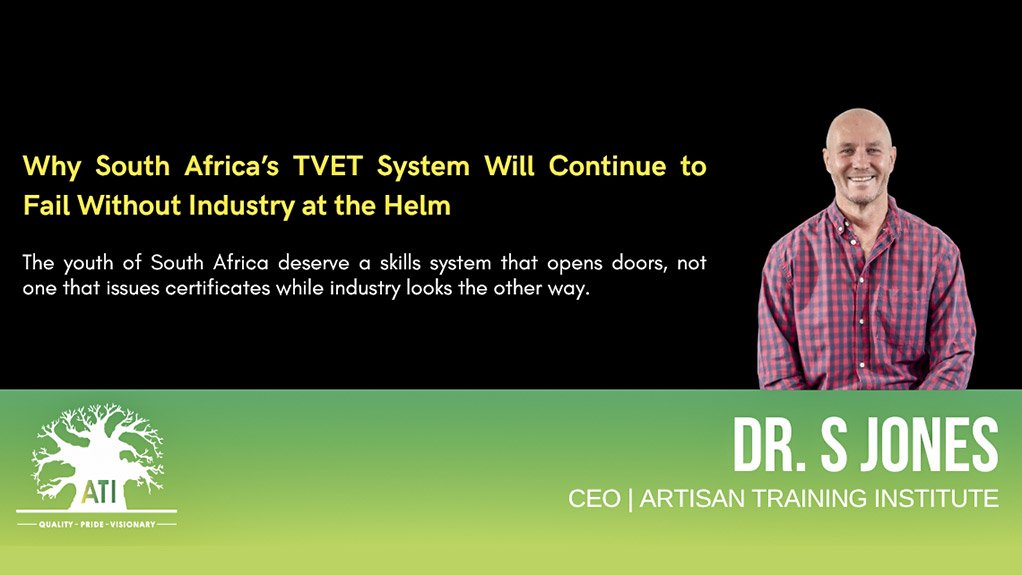



The recent Sunday Times article written by Isaak Mahlangu titled ‘Why TVETs are failing our youth’ paints a bleak predicament. The article paints a picture of a system desperately trying to find its footing with an 11% throughput rate, a pivot toward the German work-based model, and a minister appealing to industry for partnership. These are not new problems, and the proposed solutions, while well-intentioned, miss the most fundamental issue: the people designing, managing, and delivering technical and vocational education in South Africa largely have no meaningful industry experience.
As someone who has operated in accredited artisan and engineering trades training for many years, I want to offer a perspective that the article touches on but does not fully interrogate.
The consultation gap is structural, not incidental
The transition from legacy N-qualifications to Quality Council for Trades and Occupations (QCTO) occupational qualifications has generated genuine anxiety across the sector. Some of that anxiety is warranted. The accreditation pipeline for replacement qualifications has been slow. Replacement qualifications are, in some cases, not yet ready. And critically, there remains a significant disjoint between the QCTO and the National Artisan Moderation Body (NAMB), the two bodies that should be speaking with one voice on trades qualifications, but which frequently work at cross-purposes.
More concerning is what is being lost in the transition. The theoretical foundation that N-level TVET qualifications provided served as a structured entry pathway into apprenticeship training. Removing that theoretical base without a credible replacement risks weakening the pipeline of artisan candidates at exactly the moment South Africa needs more of them.
These are not problems that emerged from bad faith. They emerged from a system where the people making decisions are too far removed from the workshop floor.
Academics cannot run what they do not understand
With very few exceptions across the country, TVET colleges are managed by academics and administrators who have not spent meaningful time in industry. This is not a criticism of individuals; it is a structural failure. Technical and vocational education is not a scaled-down university. It requires people who understand production environments, employer expectations, trades competency standards, and the difference between a certificate and a competent artisan.
Industry does not need partners who can recite qualification frameworks. Industry needs partners who understand what a functional welding bay looks like, what a diesel mechanic needs to know before stepping onto a mine site, and what employers lose when a learner completes a programme but cannot perform under pressure.
Until TVET colleges are led and staffed by people who bring that lived experience, they will continue to lose relevance, not because of underfunding alone, but because they are institutionally disconnected from the world they are supposed to serve.
Employers are drowning in red tape, and patience is running out
South African employers, particularly in mining, construction, and engineering, are already navigating an extraordinary compliance burden. Skills development levies, Sector Education and Training Authority (SETA) reporting requirements, workplace approval processes, learnership administration - the administrative weight is significant. When government asks industry to partner with institutions that have a consistently poor track record of delivery, it is asking a great deal.
The risk here is not merely low partnership uptake. The risk is structural withdrawal. If the Department of Higher Education and Training (DHET) continues its current trajectory without placing genuine industry expertise at decision-making levels, within DHET itself, within NAMB, within the QCTO, within the SETAs, and within TVET college leadership, industry will progressively opt out of the formal skills development framework entirely.
What does that look like in practice? Employers training narrowly for their own immediate operational requirements. No pursuit of formal qualifications for the workforce. No broad artisan development. And a generation of young South Africans locked out of recognised credentials because the institutions meant to serve them could not earn the confidence of the employers who would have hired their graduates.
The solution is not another framework, it is the right people
South Africa has no shortage of qualification frameworks, policy documents, or reform agendas. What it has is a shortage of industry practitioners in roles that shape the skills development landscape.
The solution is straightforward, even if the implementation is not: place industry experts, people with verifiable, substantive experience in their trades and sectors, in all roles that touch skills development. This means DHET, NAMB, QCTO, the SETAs, and TVET college leadership.
People who have run training departments, managed apprenticeship programmes, and understood what employers need will make different decisions, better decisions, than those who have only ever operated within the education bureaucracy.
The youth of South Africa deserve a skills system that opens doors, not one that issues certificates while industry looks the other way.
Written by Dr S Jones (CEO | Artisan Training Institute)
Article Enquiry
Email Article
Save Article
Feedback
To advertise email advertising@creamermedia.co.za or click here
Research Reports

Projects


Latest Multimedia

Latest News


Showroom

The SAIMM started as a learned society in 1894 after the invention of the cyanide process that saved the South African gold mining industry of the...
VISIT SHOWROOM
From batteries for boats and jet skis, to batteries for cars and quad bikes, SABAT Batteries has positioned itself as the lifestyle battery of...
VISIT SHOWROOM



Announcements
What's On
Subscribe to improve your user experience...
Option 1 (equivalent of R125 a month):
Receive a weekly copy of Creamer Media's Engineering News & Mining Weekly magazine
(print copy for those in South Africa and e-magazine for those outside of South Africa)
Receive daily email newsletters
Access to full search results
Access archive of magazine back copies
Access to Projects in Progress
Access to ONE Research Report of your choice in PDF format
Option 2 (equivalent of R375 a month):
All benefits from Option 1
PLUS
Access to Creamer Media's Research Channel Africa for ALL Research Reports, in PDF format, on various industrial and mining sectors
including Electricity; Water; Energy Transition; Hydrogen; Roads, Rail and Ports; Coal; Gold; Platinum; Battery Metals; etc.
Already a subscriber?
Forgotten your password?
Receive weekly copy of Creamer Media's Engineering News & Mining Weekly magazine (print copy for those in South Africa and e-magazine for those outside of South Africa)
➕
Recieve daily email newsletters
➕
Access to full search results
➕
Access archive of magazine back copies
➕
Access to Projects in Progress
➕
Access to ONE Research Report of your choice in PDF format
RESEARCH CHANNEL AFRICA
R4500 (equivalent of R375 a month)
SUBSCRIBEAll benefits from Option 1
➕
Access to Creamer Media's Research Channel Africa for ALL Research Reports on various industrial and mining sectors, in PDF format, including on:
Electricity
➕
Water
➕
Energy Transition
➕
Hydrogen
➕
Roads, Rail and Ports
➕
Coal
➕
Gold
➕
Platinum
➕
Battery Metals
➕
etc.
Receive all benefits from Option 1 or Option 2 delivered to numerous people at your company
➕
Multiple User names and Passwords for simultaneous log-ins
➕
Intranet integration access to all in your organisation