Why incorrect valve selection destroys engineered pump systems

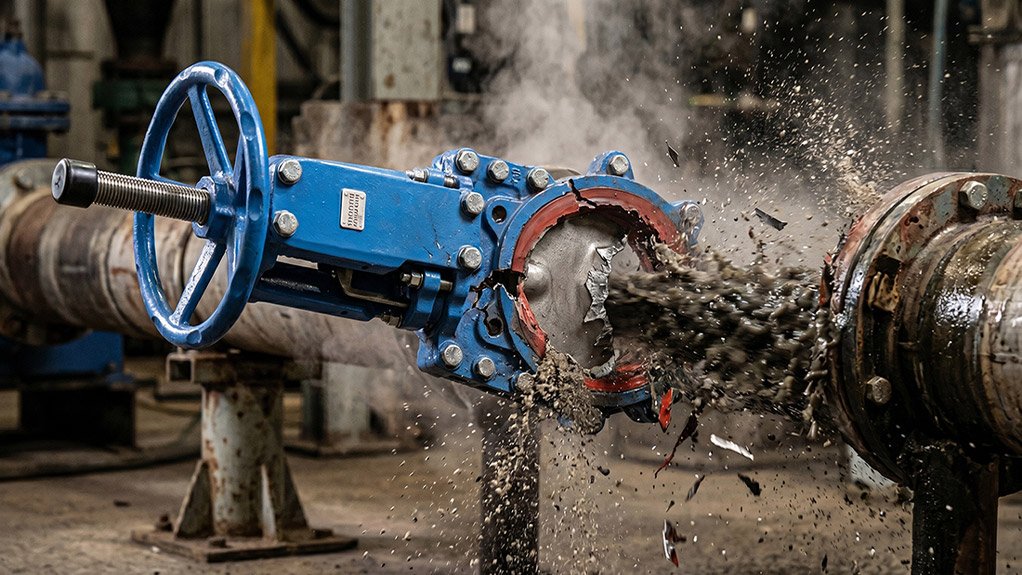

An industrial water valve violently rupturing under high pressure, spewing thick, abrasive slurry and debris across a concrete plant floor.
M Bond Pumps Industrial Valves Official Logo




If you read the latest engineering reports dissecting the failure of local municipal pump station upgrades or process plant refits across South Africa’s mining belts, you will notice a recurring theme: premature equipment failure. Facilities are pouring scarce capital expenditure (capex) into state-of-the-art IE3 motors, precision wet ends, and intelligent variable speed drives (VSD), only to have the system tear itself apart within months.
When the failure is investigated, the blame is often placed on the pump. However, as fluid dynamic engineers, we frequently trace the catastrophic root cause back to a much simpler, highly misunderstood component: the valve.
There is a pervasive "pipe-fitting fallacy" in industrial procurement. Project managers and buyers treat valves as static pieces of hardware—simple on/off switches bolted into the pipework. In reality, a valve is a highly active hydraulic component. It is the physical gatekeeper of your fluidic demand. If the pump is the heart of the system, the valves are the vascular network. Specify them incorrectly, and you will artificially choke the system curve, potentially induce cavitation, and destroy parts of the installation.
According to industry reliability studies and ANSI/Hydraulic Institute (HI) standards—which heavily inform our local SANS piping guidelines—up to 70% of centrifugal pump failures are initiated by poor suction conditions and adverse fluid dynamics, often directly resulting from improper valve application.
Below are the most common, destructive valve installation errors we encounter in the South African field, and the rand-and-cent reality of how they fail.
The Throttling Trap: Gate Valves
The standard gate valve is the undisputed workhorse of fluid isolation. It is designed for one specific purpose: to be fully open, offering zero obstruction to flow, or completely closed, providing a tight mechanical seal.
A frequent operational error occurs when plant operators use gate valves to throttle flow. When a facility installs a pump, and it happens to be oversized for the required duty, an operator will inevitably wind the discharge gate valve down to 40% open to restrict the output. This creates a high-velocity jet of water that shoots beneath the wedge. This phenomenon, known as "wire drawing," literally erodes the metal seating faces. Further, the unsupported wedge will chatter in the flow stream. Within weeks, the internal guides are prematurely worn, the valve will never seal properly again, and the operator is left with a severely compromised isolation point.
Ultimately, gate valves are designed for absolute isolation only. If operators are using them to regulate flow, the facility needs to reassess its pump sizing or install a VSD.
The Procurement Favourite: Butterfly Valves
Because they are exceptionally compact, lightweight and cheap, butterfly valves have become the default choice for modern pipework. They are excellent for low-pressure isolation in tight spaces.
Despite defying basic engineering logic, it is common to walk through almost any cramped municipal plant room or look at budget-constrained pump skids and see a wafer butterfly valve sandwiched directly against the suction flange of a centrifugal pump. Even when fully open, the central disc of a butterfly valve remains in the flow path. This splits the fluid, creating a turbulent "shadow" and an uneven, chaotic velocity profile immediately before the fluid enters the impeller eye. This turbulence induces severe asymmetrical radial loads on the pump shaft, vibrating the assembly until the mechanical seal and drive-end bearings are destroyed, or soon in need of premature replacement.
As a strict rule of thumb, always use a full-bore isolation valve on a pump suction. If a butterfly valve is unavoidable, adhere strictly to piping standards by ensuring there are at least eight- to ten-pipe diameters of straight, uninterrupted pipe between the valve and the pump inlet to allow the flow to normalise. Additionally, engineers must take absolute care when specifying the correct length of an eccentric reducer (installed flat side up) before the pump inlet to prevent air pocket formation.
The Hidden Head Loss: Globe Valves
When a system requires precise, sustained flow throttling, the globe valve is the correct mechanical choice. Its internal S-shaped flow path and plug design allow for microscopic adjustments without damaging the seating surfaces.
The inherent danger here is that because the fluid is forced to change direction multiple times inside a globe valve, it can generate an increased pressure drop (friction loss), even when fully open. Designers often select a globe valve for regulation but fail to account for its inherently low Flow Coefficient (Cv) and high Resistance Coefficient (K-value) when calculating the system curve. The pump ends up running short of head pressure, completely missing its Best Efficiency Point, and wasting electrical power just to overcome the valve's internal resistance.
To prevent this, engineers must always plot the fully-open resistance curve of a globe valve against the overall system curve during the design phase. Never treat it as "just another piece of pipe"—ensure you strictly account for the valve's specific K-value in your hydraulic modelling.
The Slurry Misdirection: Knife Gate Valves
In local mining operations, wastewater works and paper mills, standard valves clog instantly. Knife gate valves, featuring a sharpened blade that cuts through thick, abrasive media, are mandatory.
However, a surprising number of facilities ignore the directional casting of the valve. Many knife gate valves are strictly unidirectional. The upstream fluid pressure must push the blade tightly into the elastomeric seat to create the seal. If installed backwards, the hydraulic pressure pushes the blade away from the seat. This causes highly abrasive slurry to leak continuously out of the packing gland, spraying the plant floor and eroding the valve body from the outside in.
During installation, maintenance teams must look for the cast arrow on the valve body. In a unidirectional knife gate, this arrow must always point in the direction of the system pressure when the valve is closed.
The Chemical Alternative: Diaphragm Valves
When dealing with highly corrosive chemicals or abrasive sludges, exposing metal internal mechanisms to the fluid is a recipe for rapid failure. Diaphragm valves solve this by isolating all moving parts behind a flexible elastomer.
A catastrophic mistake is applying diaphragm valves in high-pressure systems. Because the sealing mechanism relies on physically compressing a rubber diaphragm against a weir, they have strict mechanical limitations. Exceed the pressure rating, and the diaphragm will rupture under the strain, instantly flooding the bonnet and spewing toxic or corrosive fluid into the environment.
Consequently, it is critical to remember that diaphragm valves are strictly low-to-medium pressure devices. Always verify that the system's maximum dead-head pressure does not exceed the elastomer's burst rating.
The Transient Trigger: Check Valves (Non-Return Valves)
Check valves are installed to prevent reverse flow and protect pumps from reversing (reverse rotation) when they switch off.
The first major error engineers make is sizing the check valve based on the pipe diameter rather than the actual fluid velocity. If a 150 mm swing check valve is installed simply because the pipe flange is 150 mm, but the fluid velocity is too low to keep the heavy internal disc fully pinned against the top of the casing, the disc will bounce in the flow stream. This incessant chattering will prematurely wear and eventually shear the hinge pin.
The second, highly destructive error relates to closure speed. It is a common misconception that check valves closing too quickly cause water hammer. In reality, the opposite is true. If an incorrectly selected check valve closes too slowly when the pump stops, the forward fluid flow has time to stop and completely reverse direction. This high-velocity backward flow catches the open disc and violently slams it shut. This sudden deceleration of the reversed fluid mass generates a catastrophic pressure transient—check valve "slam"—a force so violent it routinely splits aging municipal steel and asbestos-cement pipework wide open.
To avoid these destructive transients, size check valves for minimum flow velocity to ensure they stay fully open during operation. Further, if water hammer is a risk in long discharge lines, specify fast-acting, spring-assisted non-slam axial check valves (which close a fraction of a second before reverse flow initiates). Alternatively, large swing check valves fitted with external hydraulic dampeners or dashpots are readily available to decelerate the disc.
The Bottom Line
An industrial pipe network is a highly dynamic, pressurised environment governed by strict fluid mechanics. Every single industrial valve installed directly alters the friction loss, velocity and turbulence of the system.
Before spending capex upgrading prime movers to meet energy efficiency mandates, look closely at the mechanical gatekeepers of the pipework. Buying a cheap or incorrectly specified valve to save a few thousand rand will inevitably cost hundreds of thousands in destroyed pumps, shattered pipework, and crippling operational downtime.
This concludes the four-part Industry Insights series focusing on fluid dynamics, motor efficiency, and mechanical system design.
Written by M Bond Pumps MD Conrad Strehlau. M Bond Pumps is a premier industrial supplier specialising in comprehensive fluid handling solutions. The company specifies, supplies and supports a robust portfolio of industrial valves, engineered pumps, electric motors, and advanced electrical control panels for the mining, municipal and industrial sectors.
Article Enquiry
Email Article
Save Article
Feedback
To advertise email advertising@creamermedia.co.za or click here
Research Reports

Projects


Latest Multimedia


Latest News

Showroom

CMTS is a leading, well-established EC&I contractor with 37+ years of mining and industrial experience. We execute full-scope EC&I projects with...
VISIT SHOWROOM
Established in 1983, the ASTPM is an industry association and representative body of the welded carbon steel tube and pipe manufacturers of South...
VISIT SHOWROOM



Press Office
Announcements
What's On
Subscribe to improve your user experience...
Option 1 (equivalent of R125 a month):
Receive a weekly copy of Creamer Media's Engineering News & Mining Weekly magazine
(print copy for those in South Africa and e-magazine for those outside of South Africa)
Receive daily email newsletters
Access to full search results
Access archive of magazine back copies
Access to Projects in Progress
Access to ONE Research Report of your choice in PDF format
Option 2 (equivalent of R375 a month):
All benefits from Option 1
PLUS
Access to Creamer Media's Research Channel Africa for ALL Research Reports, in PDF format, on various industrial and mining sectors
including Electricity; Water; Energy Transition; Hydrogen; Roads, Rail and Ports; Coal; Gold; Platinum; Battery Metals; etc.
Already a subscriber?
Forgotten your password?
Receive weekly copy of Creamer Media's Engineering News & Mining Weekly magazine (print copy for those in South Africa and e-magazine for those outside of South Africa)
➕
Recieve daily email newsletters
➕
Access to full search results
➕
Access archive of magazine back copies
➕
Access to Projects in Progress
➕
Access to ONE Research Report of your choice in PDF format
RESEARCH CHANNEL AFRICA
R4500 (equivalent of R375 a month)
SUBSCRIBEAll benefits from Option 1
➕
Access to Creamer Media's Research Channel Africa for ALL Research Reports on various industrial and mining sectors, in PDF format, including on:
Electricity
➕
Water
➕
Energy Transition
➕
Hydrogen
➕
Roads, Rail and Ports
➕
Coal
➕
Gold
➕
Platinum
➕
Battery Metals
➕
etc.
Receive all benefits from Option 1 or Option 2 delivered to numerous people at your company
➕
Multiple User names and Passwords for simultaneous log-ins
➕
Intranet integration access to all in your organisation