South Africa’s Youth Should Look to Tooling to Break the Unemployment Cycle


This article has been supplied and will be available for a limited time only on this website.
By Tapiwa Samanga
Every June, South Africa observes Youth Month, a time to honour the courage and sacrifice of the generation of 1976. Five decades later, the struggle facing young people has changed. While political freedom has been secured, economic inclusion remains elusive. With youth unemployment still exceeding 45%, millions of young South Africans find themselves locked out of meaningful work, financial independence, and participation in the economy.
As we commemorate the legacy of 1976, we must confront a difficult reality: political liberation alone cannot fulfil the aspirations of a generation facing persistent economic exclusion. The challenge before us is to create practical pathways into sustainable employment and long-term prosperity.
For too long, the national conversation around career success has centred almost exclusively on university education. While higher education remains valuable, a growing disconnect exists between academic qualifications and labour market demand. Thousands of graduates leave university each year only to encounter a shortage of opportunities in their chosen fields.
If we are serious about addressing youth unemployment, we must broaden our definition of success, and expose young people to alternative career paths that offer genuine economic mobility. One such pathway lies within South Africa’s Tool, Die and Mould (TDM) making sector - commonly known as the tooling industry.
The importance of tooling is often overlooked, yet it sits at the heart of modern manufacturing. Every vehicle, household appliance, medical device, packaging product, and industrial component begins with a tool, die, or mould. Simply put, manufacturing cannot exist without tooling.
Globally, the world's leading industrial economies recognise this reality. Germany’s manufacturing strength is built on its highly specialised tooling sector, which forms the backbone of the renowned Mittelstand companies that drive exports and industrial innovation. China has similarly invested heavily in tooling and precision manufacturing, helping establish itself as a global manufacturing powerhouse. Emerging economies such as Brazil have also demonstrated how strong tooling ecosystems can support industrial growth, create skilled employment, and strengthen economic resilience.
South Africa has the opportunity to follow a similar path.
One reason many young people overlook tooling is because manufacturing careers are often mischaracterised as repetitive factory work. The reality is very different. Today's tooling industry is a sophisticated, technology-driven environment that combines engineering, digital design, automation, and advanced manufacturing.
The Fourth Industrial Revolution has transformed the modern workshop into a high-tech workplace where professionals work with Computer-Aided Design and Manufacturing (CAD/CAM) systems, industrial robotics, additive manufacturing technologies such as 3D printing, and advanced Computer Numerical Control (CNC) machinery. These are precisely the kinds of skills that will define the future of work.
The sector also offers a solution to one of the greatest frustrations facing young job seekers: the experience trap.
Many entry-level positions require years of prior work experience, creating a barrier that leaves young people unable to gain the very experience employers demand. The tooling industry addresses this challenge through structured apprenticeship programmes that combine classroom learning with practical workplace training.
Instead of spending years removed from the realities of industry, apprentices develop technical expertise while working in real production environments. By the time they qualify, they possess both the technical competence and workplace experience employers actively seek.
This approach not only improves employability but also creates a stronger alignment between training and industry needs.
At the same time, South Africa faces a growing shortage of qualified toolmakers. Many experienced professionals are approaching retirement, creating a significant skills gap that presents a unique opportunity for the next generation. For young people entering the field, this translates into stronger job security, faster career progression, and attractive earning potential.
The opportunities extend beyond South Africa’s borders. Precision manufacturing skills are globally transferable and highly sought after, opening doors to careers across Europe, Asia, the Americas, and other advanced industrial markets.
Equally important is the industry's commitment to transformation. Historically underrepresented groups - including Black youth and young women - are increasingly being encouraged and supported to pursue careers in precision manufacturing, engineering, and advanced technical fields. Expanding participation in these sectors is not only a matter of equity; it is essential for building a competitive and inclusive industrial economy.
True economic freedom for today’s youth will not be achieved through policy discussions alone. It will come from equipping young people with the skills needed to build, innovate, manufacture, and compete in a rapidly changing global economy.
The notion that a university degree is the only pathway to success is becoming increasingly outdated. Technical and vocational careers offer equally valuable opportunities for meaningful employment, financial stability, and professional growth.
South Africa's manufacturing sector already possesses the infrastructure, technology, and demand for skilled talent. What is needed now is greater awareness, stronger industry support, and a willingness among young people to explore opportunities beyond traditional career routes.
Tooling is more than a trade. It is a gateway to advanced technology, industrial innovation, and sustainable economic participation. For a generation seeking opportunity, it may well be one of the most practical and powerful tools available to build a better future.
Article Enquiry
Email Article
Save Article
Feedback
To advertise email advertising@creamermedia.co.za or click here
Research Reports

Projects

Latest Multimedia
Latest News


Showroom

Columbus Stainless, based in Middelburg, Mpumalanga, is Africa’s only producer of stainless steel flat products. In addition, Columbus is the only...
VISIT SHOWROOM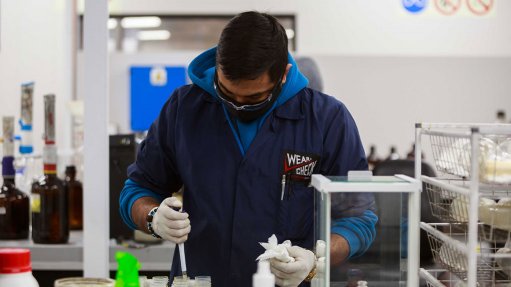
Leading condition monitoring specialists, WearCheck, help boost machinery lifespan and reduce catastrophic component failure through the scientific...
VISIT SHOWROOM

Press Office
Announcements
What's On
Subscribe to improve your user experience...
Option 1 (equivalent of R125 a month):
Receive a weekly copy of Creamer Media's Engineering News & Mining Weekly magazine
(print copy for those in South Africa and e-magazine for those outside of South Africa)
Receive daily email newsletters
Access to full search results
Access archive of magazine back copies
Access to Projects in Progress
Access to ONE Research Report of your choice in PDF format
Option 2 (equivalent of R375 a month):
All benefits from Option 1
PLUS
Access to Creamer Media's Research Channel Africa for ALL Research Reports, in PDF format, on various industrial and mining sectors
including Electricity; Water; Energy Transition; Hydrogen; Roads, Rail and Ports; Coal; Gold; Platinum; Battery Metals; etc.
Already a subscriber?
Forgotten your password?
Receive weekly copy of Creamer Media's Engineering News & Mining Weekly magazine (print copy for those in South Africa and e-magazine for those outside of South Africa)
➕
Recieve daily email newsletters
➕
Access to full search results
➕
Access archive of magazine back copies
➕
Access to Projects in Progress
➕
Access to ONE Research Report of your choice in PDF format
RESEARCH CHANNEL AFRICA
R4500 (equivalent of R375 a month)
SUBSCRIBEAll benefits from Option 1
➕
Access to Creamer Media's Research Channel Africa for ALL Research Reports on various industrial and mining sectors, in PDF format, including on:
Electricity
➕
Water
➕
Energy Transition
➕
Hydrogen
➕
Roads, Rail and Ports
➕
Coal
➕
Gold
➕
Platinum
➕
Battery Metals
➕
etc.
Receive all benefits from Option 1 or Option 2 delivered to numerous people at your company
➕
Multiple User names and Passwords for simultaneous log-ins
➕
Intranet integration access to all in your organisation