Rooibos seeds to be sent into space


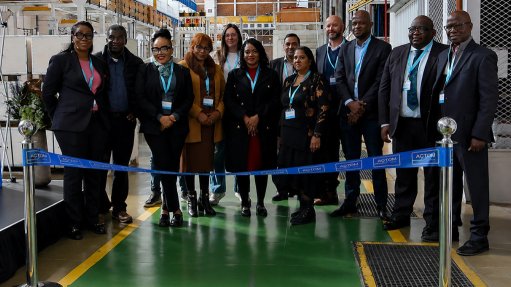
Representatives from the organisations behind South Africa’s pioneering Rooibos in Space initiative gathered to mark the launch of this landmark collaboration. From left: MaxIQ Space founder and director Judi Sandrock; Western Cape Education Department deputy director-general: curriculum and assessment management Bertram Loriston; SARAO postdoctoral fellow Dr Kelebogile Gasealahwe; a participant dressed in a replica Apollo 11 astronaut suit, holding the NanoLab in which the Rooibos seeds will be housed aboard the International Space Station; SANSA science engagement manager Thandile Vuntu; South African Rooibos Council director Dawie de Villiers; and City of Cape Town Economic Growth MMC Alderman James Vos.
Photo by Patrick King



In an initiative developed by the South African Rooibos Council (SARC), which is the representative and promotion body for rooibos processors, packers and brand owners, seeds from the rooibos plant will be sent into space, to the International Space Station (ISS), in October. The seeds will be housed in a “nanolab” during the mission, which will last several weeks, before they return to Earth. The initiative has been dubbed Rooibos in Space.
The intent is to stimulate science, technology, engineering and maths (STEM) education in the Cederberg region – the rooibos heartland – of the Western Cape province. The initiative is being delivered in collaboration with South African space STEM education company MaxIQ Space, and is supported by the South African National Space Agency (SANSA).
“Rooibos has long been part of South Africa’s agricultural heritage,” highlighted SARC director Dawie de Villiers. “This project places it within a broader scientific context, where plant biology, space research and education intersect. It also reflects the importance of investing in scientific literacy and skills development for the next generation of researchers and innovators.”
This initiative fitted within an international trend of research into plant biology in space, and, indeed, on the development of sustainable agricultural systems off Earth. In addition to sending seeds into space, to develop under microgravity and space radiation, there will be a parallel, Earth-bound control batch of seeds. When the space seeds return to South Africa, they will be planted alongside these control seeds and the two batches will be subject to a comparative study, focusing on germination, growth, yield and resilience.
The study will be carried out by learners at seven Cederberg schools, in cooperation with local rooibos farms. The learners will collect and analyse the data as participants in a structured scientific experiment. The experiment would also be run, in parallel, at Parklands College in Cape Town (where the initiative was launched).
“The value of this project lies in giving learners exposure to real research processes linked to space science,” explained MaxIQ Space founder and director Judi Sandrock. “It provides a structured opportunity to develop scientific thinking, data analysis skills and an understanding of how experimentation works in practice.”
To include schools from across the country, learners nationwide will be asked to design the Rooibos in Space mission patch. The closing date for submissions is the end of next month (August).
“Initiatives, such as this, help build awareness of the skills required for future participation in the [space science] sector, but also align with national priorities around skills development, innovation capacity and strengthening South Africa’s position in emerging scientific fields,” pointed out SANSA science engagement manager Thandile Vuntu. “They further highlight the importance of collaboration between industry, government, academia and the science sector in building a strong pipeline of future scientists, engineers and researchers.”
Article Enquiry
Email Article
Save Article
Feedback
To advertise email advertising@creamermedia.co.za or click here
Research Reports

Projects


Latest Multimedia


Latest News


Showroom
M and J Mining are leading suppliers of physical support systems as used by the underground mining industry. Our selection of products are not...
VISIT SHOWROOM
Astore Keymak is one of South Africa’s leading suppliers of high-quality Thermoplastic Pipeline Systems, with branches in the major provinces.
VISIT SHOWROOM


Press Office
Announcements
What's On
Subscribe to improve your user experience...
Option 1 (equivalent of R125 a month):
Receive a weekly copy of Creamer Media's Engineering News & Mining Weekly magazine
(print copy for those in South Africa and e-magazine for those outside of South Africa)
Receive daily email newsletters
Access to full search results
Access archive of magazine back copies
Access to Projects in Progress
Access to ONE Research Report of your choice in PDF format
Option 2 (equivalent of R375 a month):
All benefits from Option 1
PLUS
Access to Creamer Media's Research Channel Africa for ALL Research Reports, in PDF format, on various industrial and mining sectors
including Electricity; Water; Energy Transition; Hydrogen; Roads, Rail and Ports; Coal; Gold; Platinum; Battery Metals; etc.
Already a subscriber?
Forgotten your password?
Receive weekly copy of Creamer Media's Engineering News & Mining Weekly magazine (print copy for those in South Africa and e-magazine for those outside of South Africa)
➕
Recieve daily email newsletters
➕
Access to full search results
➕
Access archive of magazine back copies
➕
Access to Projects in Progress
➕
Access to ONE Research Report of your choice in PDF format
RESEARCH CHANNEL AFRICA
R4500 (equivalent of R375 a month)
SUBSCRIBEAll benefits from Option 1
➕
Access to Creamer Media's Research Channel Africa for ALL Research Reports on various industrial and mining sectors, in PDF format, including on:
Electricity
➕
Water
➕
Energy Transition
➕
Hydrogen
➕
Roads, Rail and Ports
➕
Coal
➕
Gold
➕
Platinum
➕
Battery Metals
➕
etc.
Receive all benefits from Option 1 or Option 2 delivered to numerous people at your company
➕
Multiple User names and Passwords for simultaneous log-ins
➕
Intranet integration access to all in your organisation