Grid Access Unit must move out of Eskom sooner rather than later – Sola Group CEO


From left to right is Dom Wills, DBSA’s Maxoli Njoli, HKA’s Siham Sali-Abrahams and Khumoetsile Kotelo



Eskom’s Grid Access Unit (GAU) must be moved to the National Transmission Company South Africa (NTCSA) as soon as possible, says Sola Group CEO Dom Wills.
Speaking at a Webber Wentzel Power Breakfast held in Cape Town on Wednesday, Wills said the NTCSA essentially owned and managed South Africa’s power grid and access to the grid, yet the GAU remained within Eskom Holdings.
This meant that Eskom had a monopoly on access to the grid, and that there was no transparency around the processes to gain access to the grid, noted the independent power producer (IPP) boss.
Eskom established the GAU to serve as a single point of contact for all IPPs and electricity generators.
Through the GAU, Eskom promises to provide non-discriminatory grid access and operations for all IPPs and generators, supported by clear guidelines and governance structures.
“The solution is to take NTCSA out of Eskom Holdings so that Eskom is left with generation and distribution, and to then move the grid access unit into the transmission systems operator,” said Wills.
“That way there is no conflict. All they do is look after the network and manage fair and transparent access.”
Wills confirmed that this was indeed government’s plan as it unbundled Eskom. His chief complaint, however, was with the speed at which government was moving.
During the 2026 State of the Nation Address, President Cyril Ramaphosa announced the establishment of a dedicated task team to oversee the restructuring of Eskom to establish a fully independent, State-owned Transmission System Operator that will own and control transmission assets and be responsible for operating the electricity market.
The Eskom Restructuring Task Team has since been established, and includes representatives of the Presidency, National Treasury, the Department of Electricity and Energy, Eskom and the NTCSA.
While the task team was expected to present a high-level report by the end of May, Ramaphosa had extended this deadline to the end of June.
Wills believed that the current timeline would only see the transmission system move out of Eskom at around 2029.
“The speed at which [government] moves out the transmission system is really important. This is the crux. That will make it fair and transparent, but it could take three years before we have clarity. This is a problem.”
Also, where there are projects waiting for access to the grid, Eskom should publish what that queue looks like and the order of the companies waiting for access – a live register.
“You should be able to see what is going on,” noted Wills.
“Now it’s like walking into a bank and you see a bunch of people there, but there is no queue and nobody to tell you what’s going on.”
At this point, he said, some companies were left with litigation, or the threat of litigation, as the only means of gaining access to the information they required.
Wills said the speedy removal of the GAU from Eskom’s ranks would also solve the questions that had been raised over whether Eskom Green – Eskom’s newly formed renewable unit – could potentially gain preferential access to South Africa’s constrained grid, ahead of IPPs.
Eskom Green head of legal Khumoetsile Kotelo noted that the process around Eskom’s unbundling was quite clear.
“The grid does not lie with Eskom Green, it lies with NTCSA and the rules we already have are very clear.
“Grid access needs to be fair and it needs to be transparent and it needs to follow certain rules.
“I don’t think the purpose of Eskom Green was to jump to the front of the line, but to finally answer the call, as a State-owned company, on how it would be contributing to what is required in the global space.
“It is not to jump to the front of the line, but to participate in a liberal market.”
Kotelo said that NTCSA had their own board and their own governance processes, “so there was no way we could jump to the front of the line”.
She added, however, that Eskom Green did have an “obvious advantage” in terms of where its land was situated – “where we owned land where there are substations that were used for power stations and which we are intending to use.”
“So, by virtue of our location we have certain advantages. But that doesn’t mean that we won’t follow due process.”
Eskom Green in May started construction of a 75 MW solar power plant at Lethabo power station in the Free State, marking what it said was “the first step in integrating utility-scale renewable generation within Eskom’s existing coal-fired power station fleet infrastructure”.
Once completed, the plant is expected to generate 147 GWh of electricity a year, supplying power to an estimated 60 000 households.
The Lethabo project forms part of Eskom’s broader pipeline of renewable energy and storage initiatives currently under development.
It is one of 17 high‑priority projects that will be implemented across Eskom’s existing coal‑fired power station footprint, with construction expected to start between now and 2028.
Collectively, these projects are expected to deliver approximately 6 GW of new capacity by 2030.
These developments will be located at existing power stations, including Arnot, Duvha, Majuba, Tutuka, Lethabo, Komati, Kendal, Kusile, Hendrina, Camden and Grootvlei, “leveraging existing infrastructure to accelerate deployment, reduce costs and strengthen grid resilience”, said Eskom Green in a statement.
Article Enquiry
Email Article
Save Article
Feedback
To advertise email advertising@creamermedia.co.za or click here
Research Reports

Projects
Latest Multimedia
Latest News
Showroom
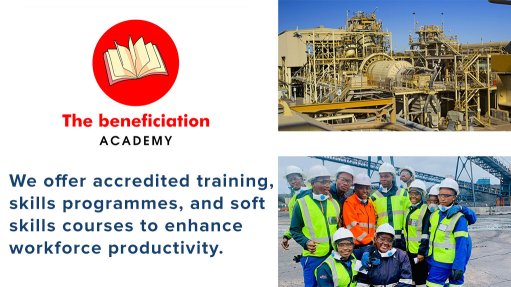
The Beneficiation Academy is a certified training institution that follows all compliance legislation and is accredited with various Sector...
VISIT SHOWROOM
Virtual Gas Network supplies compressed natural gas via a virtual gas distribution network.
VISIT SHOWROOM
Press Office
Announcements
What's On
Subscribe to improve your user experience...
Option 1 (equivalent of R125 a month):
Receive a weekly copy of Creamer Media's Engineering News & Mining Weekly magazine
(print copy for those in South Africa and e-magazine for those outside of South Africa)
Receive daily email newsletters
Access to full search results
Access archive of magazine back copies
Access to Projects in Progress
Access to ONE Research Report of your choice in PDF format
Option 2 (equivalent of R375 a month):
All benefits from Option 1
PLUS
Access to Creamer Media's Research Channel Africa for ALL Research Reports, in PDF format, on various industrial and mining sectors
including Electricity; Water; Energy Transition; Hydrogen; Roads, Rail and Ports; Coal; Gold; Platinum; Battery Metals; etc.
Already a subscriber?
Forgotten your password?
Receive weekly copy of Creamer Media's Engineering News & Mining Weekly magazine (print copy for those in South Africa and e-magazine for those outside of South Africa)
➕
Recieve daily email newsletters
➕
Access to full search results
➕
Access archive of magazine back copies
➕
Access to Projects in Progress
➕
Access to ONE Research Report of your choice in PDF format
RESEARCH CHANNEL AFRICA
R4500 (equivalent of R375 a month)
SUBSCRIBEAll benefits from Option 1
➕
Access to Creamer Media's Research Channel Africa for ALL Research Reports on various industrial and mining sectors, in PDF format, including on:
Electricity
➕
Water
➕
Energy Transition
➕
Hydrogen
➕
Roads, Rail and Ports
➕
Coal
➕
Gold
➕
Platinum
➕
Battery Metals
➕
etc.
Receive all benefits from Option 1 or Option 2 delivered to numerous people at your company
➕
Multiple User names and Passwords for simultaneous log-ins
➕
Intranet integration access to all in your organisation