Creamer Media’s Engineering News Online
Advanced Search


We have detected that the browser you are using is no longer supported. As a result, some content may not display correctly.
We suggest that you upgrade to the latest version of any of the following browsers:
         
close notification
powered by
GOLD 1386.60 $/ozChange: -0.70
PLATINUM 1452.50 $/ozChange: -1.00
R/$ exchange 9.58Change: -0.03
R/€ exchange 12.38Change: -0.05
 
E-Learning
 
Information technology set to play a bigger role in education
 
16th March 2012
TEXT SIZE
Text Smaller Disabled Text Bigger
 

Information technology (IT) will increasingly be used in schools to improve the effectiveness of teaching and the avail- ability of materials, says Department of Basic Education (DBE) Curriculum Innovation and e-Learning director Phil Mnisi.

“Teachers must understand the importance of using technology to make teaching easier, for their own professional development and for the development of the nation,” he said, speaking at the handover of matric IT learning materials developed by education materials development company Mindset and funded by social investment programme CoZa Cares, at the Wanderers Golf Club, in Johannesburg, in February. CoZa Cares is the social investment arm of South African domain name admini- strator Uniforum SA.

Further, pupils must understand the importance of using technology in class and that schools provide information and communication technology (ICT) equipment as part of school stationery, as learners from Grade 3 upwards become computer literate, he explained.

“Teachers must understand the importance of ICT in making their work easier and for the development of the nation, and must do their utmost to give learners a good educational start in life,” Mnisi emphasised.

The plans to integrate IT into every aspect of teaching emerged from the DBE’s vision for schooling for 2025. South Africa urgently needs to ensure that every young South African receives good-quality schooling, he said. Mnisi praised Mindset and CoZa Cares for developing learning materials for Grades 10, Grade 11 and Grade 12.

A US study of 300 000 pupils from preschool to graduation from high school found that communication tools, digital media, mobile computers, online textbooks and the use of games or simulations were the most important issues for students when envisioning a school of the future, learning organisation Edunova Education Technology director and CoZa Cares steering committee member John Thöle noted at the event.

“This makes the creation of new con- tent a priority to bridge the gap between teachers and students regarding the use of technology,” he said.

Mindset, which has a dedicated education broadcast channel on Digital Satellite Television and on TopTV, has developed multimedia and video lessons for pupils and teachers to use, said Mindset CEO Roith Rajpal.

The nonprofit company uses multiple platforms to distribute its content and has installed technology infrastructure at a number of schools and trained teachers in the use of technology.

Mindset developed Grade 10 and Grade 11 IT materials in 2011 for CoZa Cares, which will distribute the newly created Grade 12 IT materials to schools by the end of March at no cost to the schools, he said.

All the content is available for down- load from mindset.co.za free of charge and can be used in class as learning material, or as formative assessment material, revi- sion material or supplementary information for teachers and learners.

Meanwhile, the DBE 2025 vision aims to produce pupils able to identify and solve problems, make clear decisions, use critical and creative thinking, and collect, critically analyse and evaluate information, which is why IT literacy and training are important, Mnisi explained.

“Society cannot function effectively or efficiently without IT and ICT. It is an integral part of our lives and ICT devices and their applications are ubiquitous, from inside the home to complex corporate environments,” he emphasised.

“It is therefore clear that, as a country, we should aim at an ideal scenario where every learner in the general and further education band of our educational system should take either IT or computer application technology (CAT) as a compulsory subject, owing to their capabilities to ease or facili- tate the learning process of other learning areas or subjects,” Mnisi said.

The reason governments around the world, and in South Africa, are mainstreaming the use of IT and ICT in education and service delivery is to remain competitive and effective, he said.

“There is no doubt that, through the development of IT content materials, coupled with teacher professional development, we can [look forward to] a drastic change,” concludes Mnisi.

Edited by: Martin Zhuwakinyu


To subscribe to Engineering News's print magazine email subscriptions@creamermedia.co.za or buy now.

FULL Access to Mining Weekly and Engineering News - Subscribe Now!
Subscribe Now Login


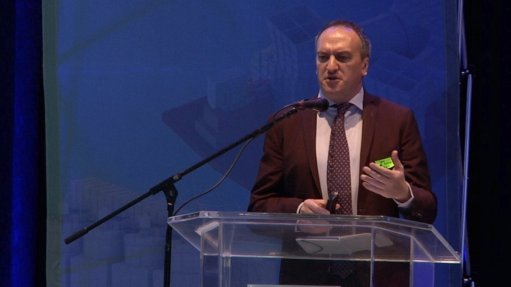
Department of Basic Education Curriculum Innovation and e-Learning director Phil Mnisi discusses the need for private companies to help ensure sufficient IT teachers for the education system. Camerawork: Nicholas Boyd. Editing: Darlene Creamer.
This video is licensed under a Creative Commons License
GET SELECTED VIDEO
Embed
Selected Video Download (3.91mb)


Facts
The Matric IT materials comprise about 50 multimedia and video lessons, constituting about 25 notional hours of learning. The multimedia materials enable pupils to navigate between sections or they can follow logical, step-by-step tutorials to develop understanding of core concepts. The material also constantly refers to real-world applications of the topics being discussed. Incorrect answers to questions are not merely marked as incorrect, but the program highlights concepts that students may not have taken into account and which will lead to the correct answer. The content also contains embedded simulations to demonstrate and give practical steps to pupils on how different programs are used, providing visual reinforcement of the lessons. The materials contain multiple streams, such as programming in Delphi or Java, and students can select one, but can also investigate the other streams. There are multiple pathways through the materials that students can use to navigate their studies. A step-by-step guide to writing a piece of code aims to explain the logic behind the code, to enable students to learn other coding languages more easily, and also shows what the code will result in of done correctly.