Creamer Media’s Engineering News Online
Advanced Search


We have detected that the browser you are using is no longer supported. As a result, some content may not display correctly.
We suggest that you upgrade to the latest version of any of the following browsers:
         
close notification
powered by
GOLD 1384.38 $/ozChange: 18.56
PLATINUM 1485.50 $/ozChange: 23.80
R/$ exchange 9.43Change: -0.12
R/€ exchange 12.15Change: -0.15
 
FREIGHT LOGISTICS
 
Transnet’s R300bn capex plan shifts focus from maintenance to expansion
 
10th April 2012
TEXT SIZE
Text Smaller Disabled Text Bigger
 

State freight logistics group Transnet says it will shift its capital expenditure (capex) focus over the coming seven years from maintenance expenditure to expansionary investments and spend R300-billion on rail and ports projects across South Africa over the period.

During the previous seven-year investment cycle the group spent R180-billion, with the lion’s share of that capex directed towards dealing with serious maintenance backlogs. In fact, even during 2011/12, 63% of the R25-billion invested was directed towards maintenance activities.

But in officially unveiling the State-owned company’s (SoC’s) new investment thrust, dubbed the Market Demand Strategy (MDS), CE Brian Molefe stressed that the balance would change between 2012/13 and 2018/19, with 58% of the R31-billion to be invested in 2012/13 to be directed towards asset and infrastructure expansion programmes.

Over the full seven-year period, around 60% of the R300-billion would be directed towards expansion projects, including a plan to procure an additional 1 000 locomotives, the tender for which would be issued later this year.

The bulk of the capex, R205-billion, would be directed towards railways projects, which had been designed to raise volumes moved to 350-million tons a year from the 202-million tons achieved in the year to March 31, 2012 –the first time in the group’s history that Transnet Freight Rail (TFR) had breach the 200-million-ton mark.

COMMODITY SPIN-OFFS

Undergirding the rail volume growth aspiration was a plan to materially raise the capacity of TFR’s key commodity lines, including:

- increasing coal volumes by 44% from 68-million tons last year to 98-million tons by 2018/19, which would be above the 92-million-ton-a-year nameplate capacity for the privately owned Richards Bay Coal Terminal, in KwaZulu-Natal;
- raising the capacity of the iron-ore export channel from Sishen, in the Northern Cape, to Saldanha, in the Western Cape, by 57%, from 53-million tons to 83-million tons; and
- increasing the capacity of the general freight business (GFB) by a material 113% from 80-million tons currently to 170-million tons a year by the end of the period.

Should GFB achieve such volume growth, its market share against that of the road hauliers would rise from around 15% currently to 35% by the end of the period, with the group anticipating yearly container growth of 8.4%.

These rail investments, Molefe said, could transform TFR into the fifth-biggest rail utility globally. They could also consolidate South Africa’s position as key thermal coal exporter to China and Europe and as the fourth-largest exporter of iron-ore to China and guarantee its position as the world’s leading exporter of manganese.

The R80-billion to be invested into the port system (R47-billion for the Transnet National Ports Authority and R33-billion for Transnet Port Terminals) should also enable the SoC to increase its container handling capacity by 76%, from 4.3-million twenty-foot equivalent units, or TEUs.

Should the investment programme proceed as planned, group revenue over the period would surge by 178% over the period from R46-billion to R128-billion, while earnings before interests, taxes, depreciation and amortisation could rise by an even larger 258% from R19-billion currently to R68-billion by the end of the period.

It could also facilitate the creation of some 15 000 new direct jobs, raising Transnet headcount from 59 000 to around 74 000 by 2019. By the capex's programme's peak in 2016/17, some 588 000 job opportunities could also be generated directly and/or indirectly.

The MDS will be funded primarily off the SoC’s own balance sheet. However, Molefe stressed that Transnet would still need to raise about R100-billion from the domestic and international debt capital markets, development finance institutions, export credit agencies and in the form of corporate paper between now and 2019.

ABOVE-INFLATION TARIFF INCREASES

He also confirmed that the group was budgeting tariff increases of 2% above consumer price inflation (CPI) over the period to partly fund the capex programme.

While the proposal would offer some certainty, it would again raise debates about whether monopoly businesses should be allowed to effectively prefund their capex using tariffs. The National Energy Regulator of South Africa had resisted previous attempts by Transnet Pipelines to do just that, after potential competitors objected, noting that they were not in a position to do likewise.

Molefe also acknowledged that the suggestion was likely to stimulate economic debate about the wisdom of diverting money from the consumer, which was the current driver of South Africa’s relatively weak economic expansion, to Transnet’s investment programme.

“The debate that we are going to have to have with economists is whether the South African economy can afford to take out of ‘C’ [consumption] the CPI plus 2% and give it to us for ‘I’ [investment],” Molefe mused.

“Our argument is that it should be possible, especially in an economy that does not save. It should be possible without very adverse consequences to the economy,” he added, while accepting that some might view the argument as “cynical”.

An equally interesting spin was presented regarding what appeared to be a relatively paltry the role for the private sector within the R300-billion capex programme.

Molefe argued that one-third, or R100-billion, of the investment was open to private sector participation through its borrowings programme. “They can become part of the action by buying Transnet bonds with their excess cash, rather than taking the risk of the investments directly,” he said, noting that the private sector was currently hoarding more than R520-billion on their balance sheets.


“So, one-third of the R300-billion is, in a round about way, a private sector participation. Because through the bond exchange and participating in bilateral loans, the private sector can put their cash into this programme . . . and we will guarantee the returns on that cash.”

Edited by: Creamer Media Reporter


To subscribe to Engineering News's print magazine email subscriptions@creamermedia.co.za or buy now.

FULL Access to Mining Weekly and Engineering News - Subscribe Now!
Subscribe Now Login


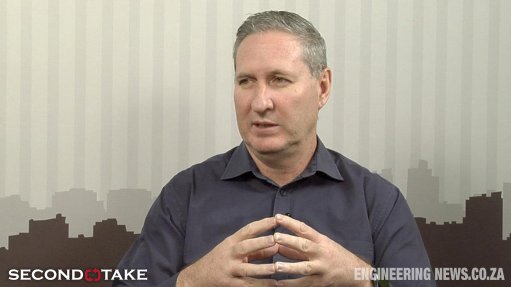
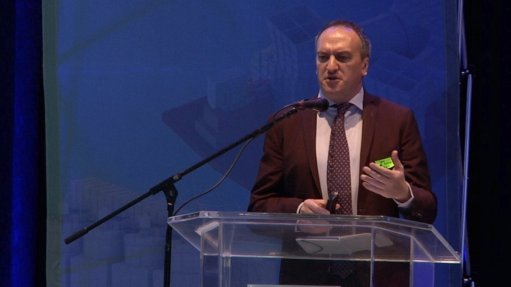
Transnet CE Brian Molefe explains the group's R300-billion Market Demand Strategy in an interview with Engineering News Editor Terence Creamer. Camera Work: Nicholas Boyd & Duane Daws. Editing: Darlene Creamer.
This video is licensed under a Creative Commons License
GET SELECTED VIDEO
Embed
Selected Video Download (33.99mb)
 
Transnet CEO Brian Molefe and Terence Creamer
 

Transnet CEO Brian Molefe and Terence Creamer