State-owned transport utility Transnet has confirmed that the cost of its new multiproduct petroleum pipeline (NMPP) from Durban to Gauteng has escalated by R2,75-billion to R15,42-billion, and that the project will be completed a full year later than initially scheduled.
The new NMPP network, which was initially expected to cost R12,67-billion, would now only be completed by December 20, 2012, instead of December 20, 2011.
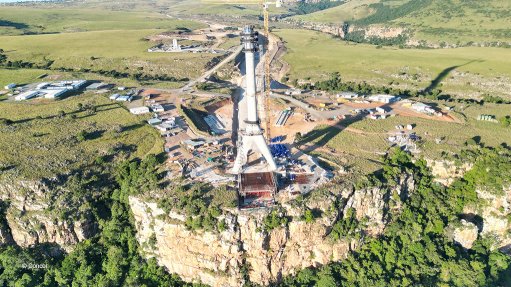
The full network comprises: a 16-inch inland pipeline network involving links from Kendall to Waltloo and from Jameson Park to Langlaagte; a 555-km 24-inch trunk-line from Durban to Jameson Park (crossing rivers, mountains and wetlands as it climbs 1 500 m from KwaZulu-Natal to Gauteng); inland and coastal terminals; and three pump stations.
Transnet Capital Projects head Neville Eve said on Tuesday that the cost escalations and schedule slippages were a function of the fact that the project had proceeded while still in prefeasibility stage in the interests of guaranteeing inland security of supply.
CEO Chris Wells added that the higher costs would be financed through a combination of internally generated resources and debt finance, noting that the company currently had R7-billion cash on hand.
The escalation in the project's cost had also contributed to an overall increase, from R80-billion to R93-billion, in the overall price tag of the State-owned enterprise's five-year capital budget, which would run until 2015.
However, Wells stressed that about two-thirds of the increase in the project pipeline was attributable to the introduction of new projects or scope changes, while the balance was related to escalating project costs.
The scope changes on the NMPP had also been influenced by: the decision to delay an intake terminal at Durban (R280-million); the introduction of backup power generation for the pump stations (R180-million); changes to the construction specifications (R1,15-billion); steel and materials price escalations (R1,06-billion); and costs relating to the securing of servitudes and environmental approvals (R70-million).
MITIGATION PLAN IN PLACE
Transnet Pipelines CEO Charl Moller stressed that a mitigation plan had been created to ensure supply security during 2011 and 2012 without a major surge in tariffs, beyond what would have arisen anyway as a result of new assets being added to the pipeline network.
The plan was base on the simultaneous use of the existing, but aged, Durban-to-Johannesburg pipeline (DJP) at a lower rate of operation than was currently the case, together with the partial introduction of 24-inch NMPP trunk line capacity as a single-product (diesel) line.
The NMPP would operate at a flow rate of 500 m3/h, while the flow rate of the DJP would be decreased from 520 m3/h currently, to 400 m3/h in 2011 and 2012. Road haulage would continue, but should decline markedly in 2011 and 2012 as the NMPP infrastructure was phased in.
Moller noted that the use of road and rail alternatives had already fallen from about 2,5-billion litres in 2006 to around 1,1-billion litres last year on the back of lower demand. It was also unlikely to recover in line with a return to economic growth, owing to the introduction of the new capacity, albeit at a delayed rate.
Once the full NMPP was brought onstream in December 2012, the new network would have a capacity of 1000 m3/h, scalable up to 3 000 m3/h through the addition of new pump stations.
TARIFFS & LEVIES
However, the introduction of new assets into the network between 2010 and 2012 would entitle the group to raise tariffs in line with the revenue requirement formula, set by of the National Energy Regulator of South Africa (Nersa).
This revenue-requirement formula allows pipeline operators to recover operational costs, as well as generate a "fair return".
Transnet had interpreted this to mean that it could apply for a 51,3% increase in tariffs for 2010/11, a year in which it would introduce R1,6-billion in new assets in the form of the 16-inch feeder lines. It had based its return on a weighted average cost of capital of 7,9%, which it said had been benchmarked internationally.
If approved, the pipeline component of the retail price of 93 ULP for the Gauteng tariff levied by Transnet would rise from 2% to about 2,4% and add 4c/l to fuel costs.
Transnet had also applied to Nersa for an amendment to its licence to cater for the delays.
Wells stressed that the 7,5-c/l levy, capped at R4,5-billion, on diesel and petrol sold locally to help fund the project over the next three years was a grant approved by the National Treasury for the security of supply component of the project.
The levy effectively covered the difference in the costs between the 16-inch pipeline initially proposed by Transnet and the 24-inch line demanded by government.
"If the levy was not put in place, future tariffs, adjusted for the time value of money, would have been increased by the same amount," Wells stressed, adding that on a net-present-value basis, Transnet was no better or worse off as a result of the levy.
The main advantage was that it would receive cash flow at the time of the investment for the security of supply component of the pipeline.