Creamer Media’s Engineering News Online
Advanced Search


We have detected that the browser you are using is no longer supported. As a result, some content may not display correctly.
We suggest that you upgrade to the latest version of any of the following browsers:
         
close notification
powered by
GOLD 1360.10 $/ozChange: -5.72
PLATINUM 1455.00 $/ozChange: -6.70
R/$ exchange 9.40Change: -0.09
R/€ exchange 12.07Change: -0.07
 
TRADE
 
South-South trade booming despite high trade barriers
 
16th February 2011
TEXT SIZE
Text Smaller Disabled Text Bigger
 

South-South trade is growing fast, but barriers among developing countries are still up to seven times higher than those imposed by the developed world, a representative from the Organisation for Economic Cooperation and Development (OECD) said on Wednesday.

Speaking at a Frontier Advisory seminar at the JSE, OECD Development Centre director Mario Pezzini said that South-South trade had experienced tremendous growth in recent years, with exports from developing countries now constituting 37% of global trade, of which about 50% related to South-South trade.

“The sharp increase in trade between developing countries, despite barriers remaining, just shows the increasing importance of these trading relationships.

“This leaves lots of opportunity to improve on the flow of trade, just imagine what gain would lie in the further reduction of trade barriers,” said Pezzini.

Historically, developing countries focused on preferential access to developed markets, but Pezzini said that the global economy had dramatically changed over the last two decades with wealth shifting from the developed world to developing countries, necessitating a change in thinking and attitude when it came to trade.

The situation was further exacerbated with the recent economic crisis, where developed economies experienced a recession, while some emerging economies continued showing double-digit growth figures.

Developing countries contributed to about 70% of the world’s growth in the last decade.

Pezzini said that the strong growth was fuelled by the rising demand for resources, especially from the growing Asian giants, which led to a decade of higher commodity prices and also stimulated growth in those countries producing raw materials.

Further, emerging markets started implementing better fiscal and macroeconomic policies, while increased liquidity provided for lower interest rates.

The OECD anticipated that the growth trend would continue, saying that while the developed world contributed about 60% of the world’s gross domestic product (GDP) in the 1990s, the picture would be reversed by 2030, with developing countries contributing 60% to the global GDP numbers.

However, Pezzini pointed out that accelerated growth from these countries had resulted in greater inequalities in society, which could lead to political unrest, like the recent displays in North Africa.

He said that good policy and governance was needed in these countries to build the correct developmental infrastructure, improve education and increase human capital, while continuously diversifying their economies with a strong focus on productivity and innovation.

“A great way to achieve this, is through the exploitation of the power of peer-to-peer learning, where policymakers can come together and share their successes and failures with each other. The OECD Developmental Centre has identified a strong demand for such policy dialogues and we have already arranged a number of opportunities for such interaction in the coming months,” concluded Pazzini.
 

Edited by: Mariaan Webb


To subscribe to Engineering News's print magazine email subscriptions@creamermedia.co.za or buy now.

FULL Access to Mining Weekly and Engineering News - Subscribe Now!
Subscribe Now Login
 
 
Topics in this article
 
 
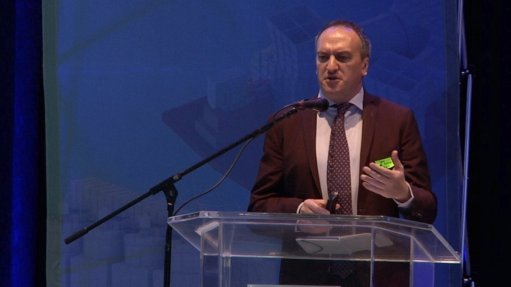
OECD's Mario Pezzini speaks about the high trade barriers prevailing for South-South trade. Camerawork: Nicholas Boyd. Editing: Darlene Creamer.
This video is licensed under a Creative Commons License
GET SELECTED VIDEO
Embed
Selected Video Download (10mb)
 
OECD Development Centre director Mario Pezzini
 
Picture by: Creamer Media
OECD Development Centre director Mario Pezzini