South Africa aims to create a local renewable-energy industry using proven technologies, such as photovoltaic (PV) and wind energy technologies, to catalyse the local renewable-energy market, says Department of Energy chief director for clean energy Mokgadi Mathekgana.
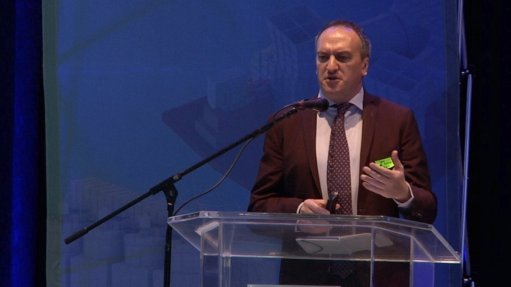
“The strategic objectives are to diversify our energy mix and to improve access to electricity, but it must be of good quality and affordable,” he said, speaking at the Solar Energy Africa conference, in Sandton, last month.
The Integrated Resource Plan was focused on affordable energy, of which localisation was an important aspect, with a focus on local component manufacture, said Mathekgana.
“It is what the department and South Africa need to do. We cannot only import all the equipment, because local beneficiation will help to develop the local skills needed to operate and support the equipment,” he explained.
Renewables must complement fossil fuels. The Southern African Development Community must become increasingly interconnected, because regional integration is key to improving energy security. Further, research on sources of energy must be supported and used to make these fully commercially deployable.
“It is a new technology growth path and is aimed at establishing industries in South Africa. But it needs carbon credit markets, otherwise we cannot pay for it,” said Mathekgana.
“The affordability of the transformation of our energy mix is important and key, and independent power producers have been brought on board to transfer skills to our people,” he said.
The Department of Energy favoured the use of regulatory mechanisms to support the nascent industry and sought to collaborate with government, investors and donors, he said.
International best practices would be drawn from partners, renewable-energy experts in developed countries, such as Spain and Germany, and local standards would be established by the South African Bureau of Standards.
“Africa is rich in potential renewable resources, but the lack of infrastructure investment forms a barrier to their exploitation. Also, resources that cannot be tapped now can be made accessible through the deployment of renewables, which may also drive economic development.
Development partnerships can help to unlock Africa’s renewables and partnerships reduce risks,” he said.
Meanwhile, French electric equipment specialist company Schneider Electric’s Arnaud Allix says that 50% of a solar photovoltaic power plant’s equipment and operation can be done locally, even without local production of the thin-film or crystalline modules.
“The PV business can help with economic development in South Africa and Africa and can provide reliable electricity at a relatively low cost while creating jobs.
“PV is safe, productive, efficient and reliable, and a PV plant in Africa will generate about twice as much as a European plant,” says Allix.
The civil work to build a PV plant can be done locally and the aluminium or steel mountings and brackets, the cabling, switchboards, inverters and step-up transformers can all be manufactured locally, while the PV modules can be imported.
“A PV park has centralised architecture and can be rolled out en masse, owing to its standardised design and equipment.
The cost of the PV modules will be about 22% of the total cost of the plant.”
The performance of a PV plant depends on the quality of the components and the design of the plant, necessitating the use of an experienced partner. However, performance and availability also depend on operation and maintenance.
Engineering procurement and construction companies, such as Schneider Electric, can help to reduce financing costs, if they have a proven record and can guarantee availability levels of between 97% and 98%, he says.
However, the regulatory regime in a country must be stable and purchasing power agreements must have a longer duration than the duration of the financing of a project, notes Allix.
Further, local manufacturing of components will help to reduce prices and will also lead to a reduction in operational costs as the industry begins to be better understood by suppliers and manufacturers, notes Indian energy consulting firm Customised Energy Solutions senior analyst Netra Walawalkar.
For example, solar water heaters help to alleviate poverty and localisation not only helps to sti- mulate jobs and skills creation, but also improves demand management as people become increas- ingly aware of the need to save energy and alternative ways to heat water. However, the financing and costs of these systems remained a barrier in South Africa, said Mathekgana.
Further, the operation and maintenance of solar PV and wind energy plants are similar, and this increases efficiencies across the industry and reduces the levelised cost of electricity produced by these plants, easing implementation, explains Walawalkar.
In the developed world, good performance from installed PV plants buoys the energy market. In developing countries, specifically South Africa and India, the potential development of renewable-energy generation is supported by policy measures, she says.
The financial challenges and capital intensity of renewable-energy projects are compounded by a lack of operational experience in these countries and the fact that their financial insti- tutions, which will be asked to fund some of the projects, are not comfortable with these new technologies – and demonstrations are expensive, she adds.
“The fact that these institutions are uncertain affects the economics of renew- able-energy projects and means that, between the plans and the building, there may be changes,” concludes Walawalkar.
To subscribe to Engineering News's print magazine email subscriptions@creamermedia.co.za or buy now.


lr1_2.gif)