Creamer Media’s Engineering News Online
Advanced Search


We have detected that the browser you are using is no longer supported. As a result, some content may not display correctly.
We suggest that you upgrade to the latest version of any of the following browsers:
         
close notification
powered by
GOLD 1387.59 $/ozChange: -0.66
PLATINUM 1453.50 $/ozChange: -5.00
R/$ exchange 9.59Change: -0.01
R/€ exchange 12.40Change: -0.10
 
 
Internet Economy
 
Opportunities, obstacles for small firms keen on entering Internet economy
 
22nd June 2012
TEXT SIZE
Text Smaller Disabled Text Bigger
 

There is significant potential for South African small, medium-size and micro- enterprises (SMMEs) to harness the Internet to improve productivity and expand their markets. Coordinated efforts are needed, however, to drive Internet access across the country, information and communication technology (ICT) industry experts said at a recent conference on the commercial value of the Internet in South Africa.

The Internet can be a key driver of growth and this is particularly true for SMMEs, with additional socioeconomic benefits accruing owing to improved services and information available, said business advisory firm Boston Consulting Group principal Andreas Lundmark.

“It is important to provide access to the broad population, but the affordability of access and devices is a key driver,” he explained.

However, he emphasised that governments and companies should not build infrastructure in anticipation of an increasingly connected society, but that a parallel approach must be taken instead, which simultaneously considers the affordability of telecommunication devices and access to the Internet.

“India has focused on making devices affordable and, in this way, has boosted connected users, which can, in turn, stimulate its Internet economy. “Further, China and India have benefited from increasing connectivity, as China exports the equipment and devices used for telecommunications, while India has developed a vibrant outsourcing industry owing to the improved connectivity of its population,” highlighted Lundmark.

The Internet contributed R59-billion, or 2%, to South Africa’s gross domestic product in 2011, said Internet research company World Wide Worx MD Arthur Goldstuck.

Significantly, R29.2-billion was spent on Internet presence and access, compared with R13.5-billion spent on data infrastructure.

The Internet has had a significant impact on the emergence and sustainability of SMMEs and a proportional impact on economic growth and job creation, he highlighted.

Internet access can enable SMMEs to access sophisticated business tools, usually the preserve of large companies that can afford the systems, while the pay-as-you-grow nature of virtual and outsourced services, made possible by Internet access, improves the efficiency and productivity of SMMEs, says Lundmark.

Meanwhile, the value that users gain from Internet access in the G20 grouping of indus- trialised countries, which includes South Africa, is more than eight times the costs incurred to access the Internet.

“Internet access can increase an enterprise’s reach to draw customers, create a sustainable customer base for the company, ensure access to business tools and enable online trade and commerce.”

Government broadband projects are aimed at connecting cities and rural areas, and business and government need to promote eco- nomic growth by enabling users to take advantage of information, said Deputy Communications Minister Stella Ndebani.

“Online services and Internet access can help to unlock socio-economic development and can be a low-key driver of economic growth. Communications infrastructure forms part of a systematic approach to create an information society,” she said.

Uptake in especially rural areas remains slow, owing to costs and a lack of infrastructure, content and digital literacy, she added.

Gauteng’s ICT strategy is focused on increasing penetration of Internet access and digital skills-development opportunities, especially in the manufacturing space, said Gauteng member of the executive council for economic development Qedani Mahlangu.

This prompted the provincial government to convert the 2010 Smart City, developed for use during the Soccer World Cup, into an ICT training centre supported by universities in the province, she said.

“The biggest challenge we had identified was the lack of penetration. However, we must work with the private sector to enable an increased level of connectivity and ensure that government invests and participates in the important development of ICT infrastructure.”

Edited by: Martin Zhuwakinyu


To subscribe to Engineering News's print magazine email subscriptions@creamermedia.co.za or buy now.

FULL Access to Mining Weekly and Engineering News - Subscribe Now!
Subscribe Now Login
 
 
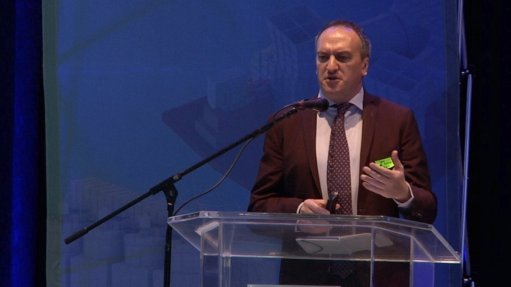
ANDREAS LUNDMARK Internet can be a key growth engine
 

ANDREAS LUNDMARK Internet can be a key growth engine
 
ARTHUR GOLDSTUCK Enabling access to sophisticated tools
 

ARTHUR GOLDSTUCK Enabling access to sophisticated tools
 
 
Previous Play Next