Creamer Media’s Engineering News Online
Advanced Search


We have detected that the browser you are using is no longer supported. As a result, some content may not display correctly.
We suggest that you upgrade to the latest version of any of the following browsers:
         
close notification
powered by
GOLD 1373.30 $/ozChange: 6.21
PLATINUM 1425.00 $/ozChange: -13.00
R/$ exchange 9.96Change: 0.01
R/€ exchange 13.35Change: -0.04


SUPPLY CHAIN & LOGISTICS
 
Skills scarcity is a consistent challenge, logistics survey highlights
 
28th March 2008
TEXT SIZE
Text Smaller Disabled Text Bigger
 

South Africa is experiencing a "serious" skills shortage in the supply-chain industry, according to a study commissioned by supply-chain management company Barloworld Logistics.

The supplychainforesight 2008, undertaken by TerraNova, found the issue of inadequate skills is one of the most consistent challenges experienced by all the 409 companies canvassed.

The companies said that they are experiencing skills shortages in the design and implementation of supply-chain strategy, as well as supply chain management and operational skills.

"I don't think that it is a secret that we face a massive skills crisis in our country, in particular; there is a serious skills shortage in the supply chain industry, not only in South Africa, but throughout the world. There is demand for professional supply chain abilities in every single market," Barloworld Logistics divisional director John van Wyk tells Engineering News.

TerraNova MD Brett Bowes said at the launch of the supplychainforesight 2008 report held earlier this month, that the skills shortage was "likely to worsen."

"There can never be a better time to have supply chain skills, and it is necessary for companies to develop these skills internally or through partnerships," added Bowes.

The survey also found that globalisation is a key challenge facing large South African businesses as they seek to remain competitive. It found that those businesses, which have been able to take their supply chain planning, management and execution capabilities into foreign markets, and cope better with the demands of a globally stretched supply and demand chain, as well as much more diverse customer needs as a consequence, are seeing significant returns in their industry sectors.

Seventy-five per cent of the companies that claimed they had both global complexity in their supply chains, along with the capabilities to deal with this, also claimed to be more successful than their competitors.

"We are faced with a reality that we live in a global village, and, since Africa is emerging from being the ‘sleeping giant', we have some serious opportunities in our midst. If you engineer, manufacture or are procuring from different territories globally, and bringing products into the market or exporting to other markets, there are complexity issues that arise. And if a company or organisation is not able to deal with this complexity, they will not be able to take advantage of what globalisation offers," explains Van Wyk.

The study suggests that where companies acquire the skills and infrastructure to compete in complex environments and develop the requisite sophisticated capabilities, they will do well in both growth and profitability.

While South Africa was rated twenty-fourth (out of 150 countries) by a recent World Bank report in terms of trade logistics, for many South African companies, achieving growth and profitability is a concern given the seeming lack of constructive collaboration between government and private enterprises.

Brett said that South African companies had a "low level of faith" in government's ability to improve key infrastructure, adding that it was necessary that there be active engagement with all relevant stakeholders.

Supplychainforesight 2008 is the fifth study released by Barloworld Logistics and TerraNova since the inception of the project in 2003, providing significant research into South Africa's supply-chain and logistics industry.

For the first time, the University of Stellenbosch was involved in the study to acquire an academic perspective, and the focus of the study was on linking business success to supply chain success "more meaningfully."

There were about 16 industries involving in the study, ranging from food and beverage, automotive, retail, engineering and mining.

To watch a video in which Brett Bowes and John van Wyk discuss the recent findings of supplychainforesight 2008, log on to www.engineeringnews.co.za and click on ‘Video Clips'.

Edited by: Martin Zhuwakinyu


To subscribe to Engineering News's print magazine email subscriptions@creamermedia.co.za or buy now.

FULL Access to Mining Weekly and Engineering News - Subscribe Now!
Subscribe Now Login


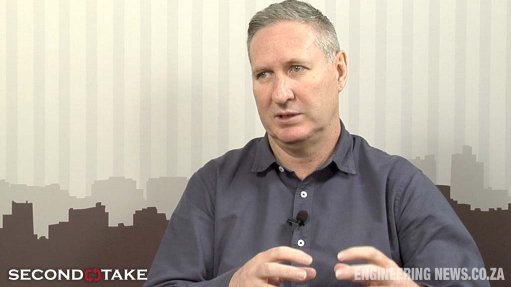
Barloworld Logistics divisional director John van Wyk and TerraNov MD Brett Bowes discuss supplychain foresight report for 2008. 17.03.08. Video courtesy of CorpCinema & Danie de Beer. Editing: Darlene Creamer
This video is licensed under a Creative Commons License
GET SELECTED VIDEO
Embed
Selected Video Download (12.44mb)