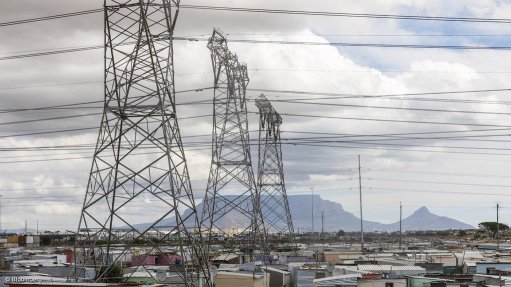
The South African government has set a three-year target having 10% of the country's electricity supply arising from independent power producers (IPPs), Minister in The Presidency for Monitoring and Evaluation Collins Chabane revealed on Friday.
However, the target of having "a minimum of 30%" of South Africa's power being generated from private generators remained intact as a longer-term objective, Department of Energy (DoE) spokesperson Bheki Khumalo told Engineering News Online.
The 70% balance would be supplied by State-owned power utility Eskom, which currently produced about 95% of the country's electricity, mostly from coal-fired power stations.
Briefing the media following President Jacob Zuma's State of the Nation address to Parliament, in which he announced that IPPs would feature in South Africa's future power mix, Chabane said that the development an "efficient, competitive and responsive economic infrastructure network" was one of 12 desired outcomes from the priorities identified for government.
"Key activities of this outcome will be to develop an electricity system operator independent from Eskom Holdings by 2010 and a target 10% of electricity supply from IPPs," Chabane said.
The so-called independent system operator (ISO) was seen as crucial to levelling the playing field for IPPs, which felt that the current model that set Eskom up as the "single buyer" of power generated by private producers to be a constraint to investment.
The DoE had promised progress on the legal framework for such an ISO by March and Khumalo indicated that Energy Minister Dipuo Peters would brief the public on progress in this regard within weeks.
An inter-Ministerial committee on energy has also been created to develop a 20-year integrated resource plan (IRP) for new generation capacity.
Peters would also provide insight into the department's consultation plans for the so-called IRP2, following the release of a disappointing three-page ‘IRP1' in December, which was gazetted on December 31, 2010.
ENERGY PLAN ROAD SHOW
Khumalo indicated that, besides intragovernmental consultation, the IRP process would be consulted widely, but refrained from setting a timeframe for the when the process would begin - in December, Peters promised that the IRP2 would be in place by mid-2010.
He said that the department was considering a national road show on the IRP, during which the views of civil society would be garnered.
South African National Energy Associate chairperson Brian Statham argued earlier in the week that government, business and nongovernmental organisations should "work together to define what is both desirable and achievable in terms of policy and plans".
"Targets must be achievable and measurable," Statham argued, adding that this was no time for "idealistic dreams".
Business Unity South Africa (Busa), meanwhile, welcomed government's moves to deregulate the electricity market, through the establishment of an ISO, which it said, would increase private sector participation in the electricity sector.
"We eagerly expect details around the regulatory changes, which are necessary to ensure progress on this issue," Busa said in a statement.
African National Congress secretary-general Gwede Mantashe argued that the plan for an ISO was a major departure from past policy in the electricity supply sector and would be important in encouraging investment by IPPs, which were currently unhappy with a situation of having to contract with a competitor, in the form of Eskom.
However, the powerful Congress of South African Trade Unions (Cosatu) said it remained "totally opposed to the suggestion that privatisation has a role to play in the electricity generating sector, through the participation of independent power producers and an independent system operator".
"Cosatu remains convinced that moves towards privatisation will ultimately wreck a crucial public national service and we shall continue to campaign vigorously to prevent the sell-off of a vital public asset," the union said in a statement.
To subscribe to Engineering News's print magazine email subscriptions@creamermedia.co.za or buy now.