Creamer Media’s Engineering News Online
Magazine in Store Now!
Advanced Search
 
 
powered by
GOLD 1102.75 $/ozChange: -3.47
PLATINUM 1608.00 $/ozChange: 5.50
R/$ exchange 7.41Change: 0.03
R/€ exchange 10.19Change: -0.02
 
 
ELECTRICITY GENERATION
Russian-made floating nuclear power plants could be offered to ease SA tightness
0 COMMENTS  |  
ADD A COMMENT PRINT
 
 
1st February 2008
TEXT SIZE
Text Smaller Disabled Text Bigger
 

Russian technology could help South Africa to meet its medium-term energy needs, roughly in the period 2011 to 2015, by which time new baseload power stations planned by State-owned power utility Eskom should be in full operation.

Russia is in the middle of developing an approach to power generation which could help South Africa to temporarily bridge the generation gap currently afflicting the country. What the Russians are doing is building the world’s first floating nuclear power plant (FNPP) intended to provide power for terrestrial infrastructure.

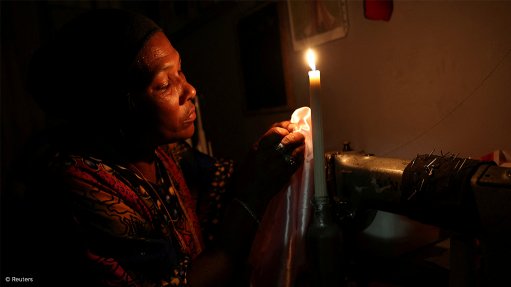
Eskom’s reserve generating margins are near zero and will remain so for until new baseload power stations start come into service from 2013 onwards (although individual units within these new stations are planned to enter operation earlier). The consequence of this lack of reserve capacity is that the country is being afflicted by a rolling black-outs (officially described as “load-shedding”) which are disrupting the economy and the lives of the people. South Africa’s very credibility as a destination for foreign investment is under threat.

There is no way to add to the country’s generation capacity in the short term. Even co-generation projects – joint ventures between Eskom and private sector companies to build smaller, gas-fuelled, power stations to help meet peak power demands – are unlikely to come into service before 2012.

However, in Russia, the first FNPP is currently under construction, a process that was started in 2006 and will be completed in 2010. The builder is Sevmash, the main division of Russia’s State Nuclear Shipbuilding Centre, and the first will actually be moored at Sevmash and will provide power for the company’s facilities, for the local social infrastructure, and will also generate heat and desalinate water.

The second such FNPP will, it is reported, be towed along Russia’s north coast (more navigable these days, probably due to climate change) to a bay in the East Siberian Sea, where it will be moored to provide power to the small town of Pevek, and to other consumers in the district, including gold, tin, and coal mines, mercury producers, and a meteorolgical station.

According to the Russian News and Information Agency Novosti, the country plans to build “many” FNPPs by 2020 and they are, in fact, a “vital element” in Russia’s national energy programme. Each FNPP will comprise two KLT-40S nuclear reactors mounted on a 20 000 t, non-selfpropelled barge with a length of 140 m and a beam of 30 m.

The KLT-40S is reported to be a well-proven design, employed in Russian nuclear-powered icebreakers. Its gross power production is 35 MWe. Two reactors ensure that at least one is always operational. A KLT-40S reactor needs refuelling every three or four years.

Russia is reportedly willing to lease one or more of these FNPPs to South Africa for a few years, to be anchored in harbours and provide power to coastal cities. The Russians recognise that, for a country like South Africa, FNPPs could not be a permanent solution, but believe they could be very helpful gap-fillers. Once the new baseload stations came into service, the FNPPs could be towed back to Russia and redeployed to remote sea- and river-side communities there. It should be noted that, when an FNPP is under tow, its reactors will be empty of nuclear fuel and will be shut down.

South Africa and Russia already have a Joint Coordination Committee on cooperation in the peaceful uses of nuclear energy, so the necessary intergovernmental framework is already in place.


Edited by: Martin Zhuwakinyu


Hide Comments  
 
This article contains no Comments


All comments must be approved by our editors, click here to read the editorial guidelines for comments. Please allow some time for our editors to approve your comment after posting.
 * Required Fields

image
image
 *


image
image
 *
 

image
image
 

Verification Image

image
image
 * Please enter the text you see in the above image.


AN INTERIM OPTION FOR SA? Artist's impression of a floating nuclear power plant at the Sevmash yard.
 
Picture by: Sevmash
AN INTERIM OPTION FOR SA? Artist's impression of a floating nuclear power plant at the Sevmash yard.