Creamer Media’s Engineering News Online
Advanced Search


We have detected that the browser you are using is no longer supported. As a result, some content may not display correctly.
We suggest that you upgrade to the latest version of any of the following browsers:
         
close notification
powered by
GOLD 1722.09 $/ozChange: -1.28
PLATINUM 1623.50 $/ozChange: 2.98
R/$ exchange 7.57Change: -0.02
R/€ exchange 9.92Change: -0.01
 
ENERGY MIX
Reduce carbon by making it dear, energy economist argues
 
16th July 2010
TEXT SIZE
Text Smaller Disabled Text Bigger
 

In the absence of decisive intervention from governments, fossil fuels will remain the dominant energy source for the next 25 years to 30 years, despite strong growth in renewable-energy production and despite the build up of climate-changing carbon dioxide (C02) in the atmosphere, a leading US energy economist and author argues.

Speaking during a recent lecture in South Africa organised by the Fossil Fuel Foundation, professor Carol Dahl of the Colorado School of Mines' Mineral and Energy Programme noted that, in the 100 years from 1900 to 2000, fossil fuels had expanded from 68% of the global energy mix to 83%. Coal had surpassed wood in the 1880s, oil had passed coal in 1950s, while the use of natural gas had risen strongly since the 1950s.

"Renewables are growing really fast, but they will still be a very small part of our overall consumption by 2030," Dahl said.

While renewable energy output was forecast to grow at around 1,5% a year between now and 2030, that was still only slightly ahead of the anticipated average for all primary-energy sources (including oil, gas and coal) of 1,3%.

"Therefore, if we don't have very stringent government policies, fossil fuels will be dominant for much longer than just 2030," she added.

That reality would make it difficult to lower CO2 emissions to the yearly target of 2,9 t a person, as well as to stabilise CO2 stocks at 450 parts per million (ppm) by 2050, which would require a 60% reduction in emissions by then - the current volume was about 390 ppm, increasing by 2 ppm a year.

"By the end of the century, I am sure that we will be using more renewables than fossil fuels. But without fairly strong policy intervention in the next 20 to 30 years, I think we will still be using an awful lot of fossil fuels. Therefore, much of what happens will really depend on what governments do over the next decade," Dahl argued.

She indicated that she favoured the deployment of market-based policies, such as carbon taxes, or cap-and-trade solutions, to send the correct price signals for carbon use.

However, governments were also considering subsidies, or even renewable portfolio standards, whereby minimum thresholds could be placed on the use of renewable energy by certain dates.

"Economists tend not to favour such interventions, as there is scepticism about the ability of government to figure out what the best technologies are. On the other hand, if you send the right price signal, on the true cost and benefits of a certain fuel type, then, we as economists believe, the market will figure out the best way to make the change," she argued.

"In other words, if your aim is to reduce carbon, make carbon expensive."

Dahl is also working on a project for the US Department of Energy to discern historical price elasticity patterns in the global energy market, which could guide the eventual incentives and disincentives that might be deployed to change consumption behaviour.

"The idea is to try and understand that effect that an instrument like a carbon tax might have over 20 to 30 years. At the moment, some patterns are emerging, but that work still needs to be finalised."

But Dahl argued against the notion that there was no price elasticity in the energy market. "The elasticity may not be huge, but I still think that people do respond to price," she concluded.


Edited by: Creamer Media Reporter
FULL Access to Mining Weekly and Engineering News - Subscribe Now!
Subscribe Now Login


Hide Comments  
 
Readers Comments
 
image image
Granted, leaving it to governments to run command economies and decide what to subsidise smacks of paternalism and we must question if they really know what is best. But increasing the price in line with what economists think fit is just as arbitrary. Or have I missed something and the economists are really the all-knowing elite - the ultimate Big Brother? Even technologists are deeply divided on the complex cause effect chain regarding carbon emissions and climate. So what makes us think that technologically challenged economists know any better? Dare we allow them to jeopardise the economies of countless countries by forcing them to adopt cripplingly expensive alternate technologies at the whim of cavalier economists who have just demonstrated their credentials by driving the world economy into disaster? Perhaps they should dig themselves out of that hole before presuming to start on the next one.
image image 
image
Chris Herold on 19 Jul 10
image image
This is not a comment from an energy economist, but from an environmental activist. The use of fossil fuels has brought untold wealth to the world's nations. It has reduced poverty, almost wiped out famine. The concept that the emission of CO2 is harming the world is NOT proven, nor is it conclusively demonstrable. The world has been warming for 150 years, and we still don't know if humans have any part in this warming - it is still within natural ranges. There has been no increase in tropical storms, no increase in the rate of sea level rise (the rate of sea level rise has been slowing over the past 5000 years, having been 20 times higher than it is today soon after the end of the last ice age) no increase in the spread of malaria, and very little change in the extent of ice cover. So why should we doanything as stupid as reducing carbon emissions - the use of fossil fuels correlates directly with GNP - ask the Chinese. And why no mention of nuclear? This alone shows Dahl's political agenda - and why her views should be ignored.
image image 
image
The Iceman Cometh on 17 Jul 10
 
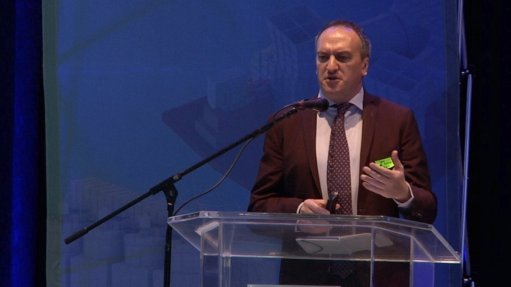
Professor Carol Dahl of the Colorado School of Mines' Mineral and Energy Programme.
 
Picture by: Duane Daws
Professor Carol Dahl of the Colorado School of Mines' Mineral and Energy Programme.