Creamer Media’s Engineering News Online
Advanced Search


We have detected that the browser you are using is no longer supported. As a result, some content may not display correctly.
We suggest that you upgrade to the latest version of any of the following browsers:
         
close notification
powered by
GOLD 1387.93 $/ozChange: 22.11
PLATINUM 1487.20 $/ozChange: 25.50
R/$ exchange 9.44Change: -0.12
R/€ exchange 12.17Change: -0.17
 
CEMENT
 
PPC aims to generate half of its revenue from rest of Africa by 2016
 
8th November 2011
TEXT SIZE
Text Smaller Disabled Text Bigger
 

Cement producer Pretoria Portland Cement (PPC) plans to boost the revenue contribution from its African business, outside South Africa, to 50% in the next five years, CEO Paul Stuiver said on Tuesday.

The company increased its revenue contribution from the rest of the continent to 20% in the past financial year, which Stuiver said was in line with PPC’s strategic growth objectives, with Africa being “the growth story of the moment”.

“We would like our earnings from Africa to increase to between 40% and 50% in the next five years. We understand Africa better than most other players; it is on our doorstep and we believe it is an opportunity begging, especially for a cement player finding it difficult to grow in its home territory,” he told Engineering News Online.

The group looked at eight significant expansion opportunities into other African regions during the financial year ended September 30, four of which were abandoned due to either a lack of potential for value creation, unacceptable levels of risk or a combination of both.

Of the remaining four, one project has resulted in a $44-million conditional offer for a 58% stake in a government-owned cement producer in the Democratic Republic of Congo, Cimenterie Nationale. “We await the outcome of our bid. The remaining opportunities are being pursued and we expect that further opportunities will arise in due course,” Stuiver said.

In Botswana, PPC recently bought Quarries of Botswana for $6.8-million, which it said would benefit its aggregates operations in that country, and in South Africa, the group is buying Gauteng-based readymix and fly ash supplier Pronto Holdings for R280-million.

Stuiver said PPC was optimistic about the Zimbabwean cement market. Domestic sales in that country improved by more than half during the year,owing to a combination of increased demand and operational problems suffered by PPC’s competitors. The operating performance at the Colleen Bawn factory improved during the second half of the year and equipment at its Bulawayo grinding depot, that had been mothballed for 15 years, was recommissioned to meet increased demand.

However, Stuiver pointed out that significant input price inflation on key items such as electricity, continued to be a concern for the Zimbabwean operations.

While growth remained slow in South Africa, Stuiver stated that the group was confident in the long-term recovery of the domestic cement industry. “We have seen the worst. The cyclic trend is coming up again, after hitting the bottom in 2010.”

Stuiver cautioned, however, that the eurozone crisis could result in another general slowdown in business.

PPC said that overcapacity in the South African cement industry continued to drive competitive market conditions and was putting prices under pressure. “A weighted average increase of 4% in selling prices during the year was insufficient to recover rising input costs,” he said.

Costs rose 11% in the financial year on the back of above-inflation electricity prices and diesel price increases, accompanied by higher logistics costs as inadequate rail transport had to be supplemented by more expensive road transport.

PPC’s cement volumes in South Africa fell by 4% in the financial year ended September, while overall cement sales were 3% lower.

The group’s revenue was almost flat at R6.83-billion, compared with R6.81-billion in the previous financial year. Earnings a share declined by 22% to R16.40 a share.

PPC reduced headcount by 6%, or 180 people, over the past financial year, with 35 employees from head office and 45 employees from its Port Elizabeth plant taking voluntary retirement packages. Stuiver said this was necessary to align the Port Elizabeth factory to production capacity.

PPC also slowed its capital investment programme in line with depressed trading conditions. Capital investment of R483-million was incurred, compared with R613-million in the previous financial year.

ENERGY

Meanwhile, Stuiver said that PPC has completed a feasibility study into a cogeneration facility at one of its plants, but concluded that it would not be worth its while.

“The capital cost of setting electricity cogeneration units at our plants, versus the energy costs we would save does not make it worthwhile. We would rather take the capital and put it towards a cement plant,” he said.

However, the company was investigating a wind power joint venture. “We have an exciting prospect and would like to tender in the next round of government’s renewable-energy procurement scheme in March 2012,” he said.

PPC is aiming to generate about 30 MW, or 10% of its total energy needs.
 

Edited by: Mariaan Webb


To subscribe to Engineering News's print magazine email subscriptions@creamermedia.co.za or buy now.

FULL Access to Mining Weekly and Engineering News - Subscribe Now!
Subscribe Now Login
 
 
PPC
 
Picture by: Duane Daws
PPC
 
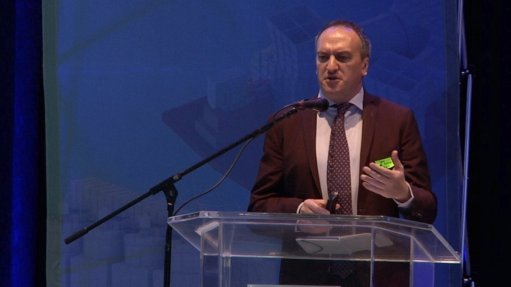
Paul Stuiver
 

Paul Stuiver
 
 
Previous Play Next