Civil engineering and construction company Trenchless Technologies, which focuses mainly on municipal water and sewer rehabilitation, has felt the effects of a decline in construction following the 2010 FIFA World Cup.
“The big investments made by municipalities that hosted World Cup games have resulted in them spending most of their budget and they are still recovering,” says Trenchless Technologies MD Sam Efrat.
“A lack of recovery of municipal rates and taxes has put additional pressure on municipal budgets and this has resulted in a decline in municipal infrastructure spending,” he adds.
Efrat notes that companies that service the municipal infrastructure sector, such as Trenchless Technologies, have seen a decline in the projects put out to tender since 2010.
He points out that the company was involved in seven rehabilitation projects in 2010, five projects in 2011, and three projects in the first half of this year.
“Fortunately, we have seen an increase in the amount of tendered work available this year and are looking forward to a steady increase in projects in the second half of the year,” says Efrat.
He notes that the future outlook is very promising, as it is estimated that around R60-billion a year has to be spent over the next ten years to cope with the infrastructure required to secure South Africa’s water supplies, and much of this work will involve rehabilitation of our ageing municipal sewer and water pipes.
Drilling
Efrat points out that there has been, since March, an increase in the demand for directional drilling services, which comprises 30% of Trenchless Technologies’ business.
The company makes use of the directional drilling method to install fibre-optic infrastructure, as well as water and sewer pipes. As a result of the fibre optic roll-out and the increased rate of urbanisation in South Africa, demand has increased for directional drilling services.
Efrat says there has been an increase in the number of tenders involving directional drilling, particularly on the long-haul fibre-optic networks between South Africa’s major cities.
The drilling process involves three main stages: drilling a pilot hole, pilot-hole enlargement, and pullback installation of the carrier pipe. The technique can be used in various ground conditions. The borehole is supported by a bentonite drilling fluid, which prevents the borehole from collapsing.
Current Projects
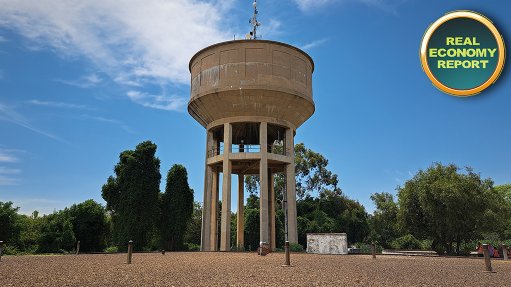
“We’re currently working on the Parktown water reservoir, where 300 m of 30-year-old steel piping was corroded and leaking.
“We are involved as a subcontractor to specialist contractors in the rehabilitation of concrete structures Con-Solve Civils. Con-Solve Civils is responsible for relining the reservoir, as the concrete has cracked and requires maintenance. A portion of Con-Solve Civils’ contract also requires the rehabilitation of the old 600 NB steel feeder pipes from one reservoir to another and the (bulk) pipe delivering water from the reservoir to the network.
Our work entailed cleaning the pipes, conducting closed-circuit television inspections and sliplining and grouting in place a new 560 PE 100 PN 10 pipe into the old 600 NB steel pipe and the installation of numerous new valves and chambers,” says Efrat.
The new high-density polyethylene pipe (HDPE) has a smaller diameter than the old steel pipe, but as it has a much smoother bore with a low coefficient of friction and better flow properties and this allows the replacement of the larger steel pipe with the smaller HDPE pipe while still maintaining the same amount of flow down the pipe.
Further, in July, Trenchless Technologies started work on Phase 5 of the Barberton asbes- tos cement pipe replacement project, using the trenchless technique of pipe bursting, where hydraulic rod pullers, as well as percussive hammers, are used to crack old pipe, which is pushed into the surrounding soil and simultaneously replaced with a new HDPE pipe that is pulled into position,” he says.
In urban areas where there are more pavements, roadways and housing, trenchless technology is more cost efficient and results in fewer disruptions than the conventional excavation method previously used.
“A lot of townships employ midblock sewers and it is also difficult to gain access to people’s properties to undertake the replacement by excavation – it is also extremely disruptive,” says Efrat.
He adds that trenchless technology mitigates many health and safety issues experienced when excavating in busy roadways, emits less carbon emissions and has less of an impact on the environment than traditional pipe-laying methods.
To subscribe to Engineering News's print magazine email subscriptions@creamermedia.co.za or buy now.