Creamer Media’s Engineering News Online
Advanced Search


We have detected that the browser you are using is no longer supported. As a result, some content may not display correctly.
We suggest that you upgrade to the latest version of any of the following browsers:
         
close notification
powered by
GOLD 1745.93 $/ozChange: 9.16
PLATINUM 1651.00 $/ozChange: 5.00
R/$ exchange 7.58Change: -0.02
R/€ exchange 10.03Change: -0.12
 
Nuclear
PBMR calm about its future, despite limited funding
 
19th February 2009
TEXT SIZE
Text Smaller Disabled Text Bigger
 

South African nuclear reactor company PBMR feels assured that it will secure additional investment during the course of this year.

"We have a good concept. We are making sure that our business case is as attractive as possible," highlights PBMR company communications consultant Tom Ferreira, "and we are confident we will get extra funding this year, whether from the government, our other shareholders, or new shareholders. If we don't get any additional money, then the reality is that we will run out of money next year, around March. This does, however, allow us sufficient time to present a sustainable business case to the government, based on a commercial business model."

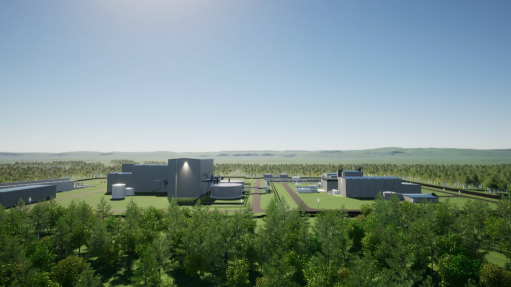
The company is developing the fourth-generation, high-temperature, gas-cooled, pebble bed modular reactor (PBMR).

The PBMR company is currently examining the possibility of developing a dual-role reactor, instead of the dedicated electricity-generating unit originally planned. Under consideration, is a system that can service both the electricity and process heat markets.

There are a large number of industrial processes that require superheated gases or steam. A gas-cooled PBMR will have outlet temperatures of up to 950˚ C and so will be able to produce the necessary superheated gases.

Ferreira points out, however, that high-pressure steam and cogeneration applications can be achieved with temperatures of less than 800˚ C. Process steam delivery is the near-term market entry application, with hydrogen production as the follow-on.

"Process heat applications for the PBMR only began to surface about two or three years ago," he explains. "First, there appeared the New Generation Nuclear Plant project in the US. Then [South African coal-to-liquids and petrochemical group] Sasol approached us, and then Canadian oil sands companies."

If the PBMR company does go ahead with the idea of developing the reactor as a dual-purpose machine from the start, it will do so in collaboration with its potential customers, including South African electricity utility Eskom.


Edited by: Creamer Media Reporter
FULL Access to Mining Weekly and Engineering News - Subscribe Now!
Subscribe Now Login
 
 
Topics in this article


Hide Comments  
 
Readers Comments
 
image image
It really is time that the PBMR project updated the public (who are in effect bank rolling it) as to the state of progress on the project, particularly about the pilot plant that it was understood would already have commenced at the Koeberg site. The proof of progress is seen only when the planned commitments are met. We may just get a wake-up call and find that a competitor country has beaten us to the mark. It is going around town that the project and the regulator could not even agree on the nuclear standards to be used for licencing ie American or European. Why at this late stage? How much time and money has been lost on this exercise? Overall an apparent poor show so far that does not do the nuclear movement much good.
image image 
image
Anonymous on 20 Feb 09
image image
Just one question ... what level do you have to enrich uranium to for PBMR to work? If it is over 5%, you will NEVER get a license for the IAEA ... I repeat NEVER. We all know PBMR needs enrichment well beyond 10% to work. Come clean guys, you have wasted billions and the party is over.
image image 
image
Anonymous on 19 Feb 09
image image
Stop flogging a horse with our tax payers wip. The concept of PBMR is great but it is not the tax payers burden to fund this as yet untested, unlicensed and unecessary technology. We have adquate renewable resources, solar and wind , that are clean and proven, why were these tax payers funds not spent on these rapid to market technologies?
image image 
image
User not found. on 19 Feb 09