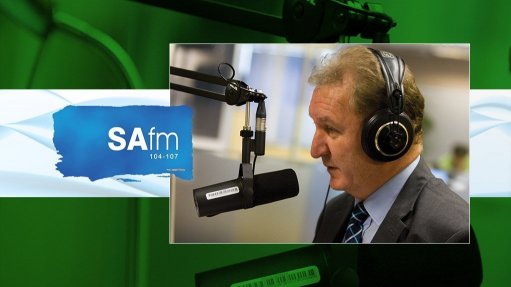
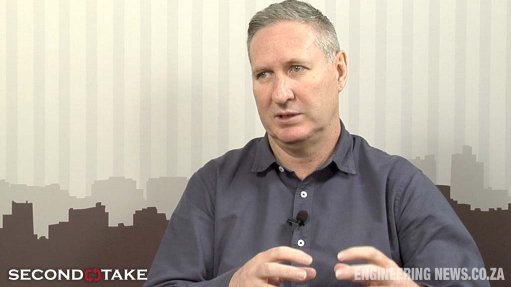
Every Friday morning, SAfm’s AMLive’s radio anchor Tsepiso Makwetla speaks to Martin Creamer, publishing editor of Engineering News and Mining Weekly. Reported here is this Friday’s At the Coalface transcript:
Makwetla: Here is something, I’m sure, that is definitely going to grab people in Sandton, Africa’s richest square mile – where each step is worth a million rand – and which is expected to double in size over the next ten years.
Creamer: Tour guides who take you through Sandton proudly say that every step you take is worth a million rand, because it is Africa’s richest square mile, likened to Manhattan, the New York annex, and it’s still growing. Even though we have had so many interest rate hikes, we can still see that our national bird over Sandton, unlike our national bird which is the Blue Crane, the national bird of Sandton is the yellow construction crane and still going up with a lot of development ahead of 2010.
Particularly some hotels still being developed there, residences still being developed there and offices. They believe it could double in size in ten years, quite easily. One of the big infusions of activity there is the Gautrain and the largest of the ten stations will be the Gautrain station. It will have the capacity to handle 9 200 commuters an hour and it will be 48 m underground.
Herein lies the rub, because an important quote about Sandton is the way property development interacts with public spaces will make or break Sandton. We don’t want this to be another Dubai where you just have high-rise buildings all over the place. The Gautrain opportunity is a huge one, because Gautrain will be 48 m below the ground. What do you do with that area on surface?
It is now open and owned by the Johannesburg City Council, it will be a shame if they were tempted to sell that off for high-rise buildings, because this could be the green lung of Sandton. Already there is a lot of activity around the Sandton Central Management District wanting to make sure that we have these open areas and benches and trees within that precinct. We see that they even have 50 public safety ambassadors and 27 cleaners and maintenance people going around that area continuously.
Makwetla: Speaking about injecting millions, Martin, South Africa’s state-owned Industrial Development Corporation doing just that. R500-million into the Cape Town-to-London ‘super cable’ telecoms project.
Creamer: This super cable telecoms project is very important for our future in terms of internet use and broadband activity. We are not competitive globally in this issue of telecommunications and this is an effort by the youngest of our state-owned enterprises, that is broadband Infraco.
They are involved in putting in a super cable between Cape Town and London and now the Industrial Development Corporation has decided to put its weight behind this with a big investment that they are prepared to infuse into it at R500-million.
We are looking for more participants in this super cable, which will link Cape Town to London and the idea is that at least five or more participants own this, because this is the way that you get the competitive juices flowing. A recent Harvard study said at least five, but Infraco are looking for ten participants.
So, still in negotiations now with other telecoms both in South Africa and Europe to come in as participants and there will be branches going off on the west coast of Africa to involve Africa also in this broadband activity, but the big thing is to get this fibre-optic super cable in between Cape Town and London before FIFA’s 2010 World Cup in South Africa.
Makwetla: Finally, South Africa and Australia have settled on an amicable divorce, so to speak, to their short-lived billion-dollar radio telescope marriage, citing irreconcilable software differences.
Creamer: Yes, irreconcilable software differences, amicable divorce. South Africa and Australia have decided to terminate their collaborative radio astronomy software development programme, designated Convergent Radio Astronomy Demonstrator, or Conrad for short.
Conrad has been the offspring and there will be access to Conrad and also visitation rights to Conrad. Conrad being the kid that has been developed out of this short-lived marriage. Other then that, there will be diversion, both of them going their different ways and probably just as well, because South Africa and Australia are now short-listed to win this very big prize, the R12-billion prize to set-up the world’s biggest ever radio telescope.
By 2010 we will know where the site is going to be. Is it going to be in South Africa’s Karoo or is it going to be in Australia. Hopefully it will be in South Africa and now they have parted ways technologically so that they can get down to the business of winning this. Already we have the MeerKAT which will be here whether we win the SKA or not, but the SKA is an important development globally.
The decision on the site must be taken by 2010. This SKA will be a huge telescope which probes the mysteries of the universe and even finds out if there is life elsewhere in the universe, so it is going to be a very important radio telescope and the Karoo seems to be the ideal Southern Africa point for it.
Clear skies, not interfered by cellphone and radio. The big thing also is that the core will be in South Africa, but there will also be stations in Africa, remote stations in Africa and African islands, to involve Africa in this very big mega radio telescope project.
Makwetla: So not all separation is bad. Thanks very much. Martin Creamer is publishing editor of Engineering News and Mining Weekly, he’ll be back with us at the same time next week.
To subscribe to Engineering News's print magazine email subscriptions@creamermedia.co.za or buy now.


lr1_2.gif)