Creamer Media’s Engineering News Online
Advanced Search


We have detected that the browser you are using is no longer supported. As a result, some content may not display correctly.
We suggest that you upgrade to the latest version of any of the following browsers:
         
close notification
powered by
GOLD 1390.27 $/ozChange: 2.02
PLATINUM 1456.50 $/ozChange: -2.00
R/$ exchange 9.54Change: 0.04
R/€ exchange 12.33Change: -0.03


On-The-Air (07/11/2008)
 
7th November 2008
TEXT SIZE
Text Smaller Disabled Text Bigger
 

Every Friday morning, SAfm’s AMLive’s radio anchor Tsepiso Makwetla speaks to Martin Creamer, publishing editor of Engineering News and Mining Weekly. Reported here is this Friday’s At the Coalface transcript:

Makwetla: South Africa, India and Brazil have agreed to collaborate on the development of renewable energy technology. Tell us a bit more about that.

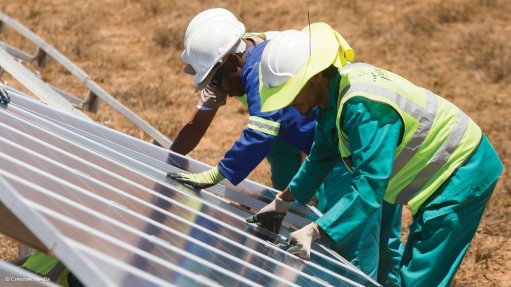
Creamer: South Africa, India and Brazil working together to try and get a bigger share of the clean energy market. They are going to collaborate on solar power, particularly for electrification for outlying areas, biofuels and then also the whole issue of wind power.

Each country will focus on an area and then migrate their knowledge out to the others. South Africa’s focus is going to be solar power. South Africans will be putting out a memorandum of understanding for solar power. This is particularly for electrification of rural areas.

India will concentrate mainly on wind power and they will also have training sessions and impart ideas on equipment innovation. Brazil is really big in biofuels and experts in ethanol production from sugar cane, and also production biodiesel.

Brazil’s concept is that Africa could really do well if we promoted this idea of biofuels and obviously not going into competition with food. So, steering away from maize, grain and non-edibles. We see India also steering away from non-edibles when it comes to producing fuel.

Sugar is something that should be considered, because there is no shortage of sugar. The actual flex-fuel engines that you use now, they will also cooperate on that because Brazil have already been working on these, so that when you go to the pumps to fill up with biodiesel or conventional fuel or a mix of the two, you don’t have to modify your engines.

Trade between the countries, hoping to lift, they see the existing trade at about US$11-billion currently. They want to move that to $15-billion by 2010 and they feel that there is a capacity to do a lot more.

Makwetla: The Canadian company building the Gautrain says South Africans are world-class at train building.

Creamer: Yes, it is nice when foreigners come in to a country, look at its manufacturing facilities and pass nice comments and not nasty comments. This is what is happening with the Canadians.

Bombardier coming into South Africa, building our Gautrain, having a look around and seeing that our manufacturing facilities here, Union Carriage & Wagon of Nigel. They are giving it a great imprimatur, saying it is at least as good, if not better, than where they have their trains built in Derby in the UK.

They are quite keen on doing more in South Africa with their Electrostar range. The 96 Gautrain rail cars will be based on the Electrostar and they have never built this range outside of England before. They are looking around in South Africa and saying that there is not just the Gautrain here, but there is a lot of potential to do a lot more.

They are looking at the Moloto project, which will hopefully be a rail between Pretoria and Mpumalanga to try and avoid people over-using the ‘Road of Death’, as they are calling it. They feel they could possibly get involved there.

Then also, Cape Town, itself wanting to have a rail between the airport and the city centre. Several other plans from South African Rail Commuter Corporation and Bombardier are hoping to be part of that.

Makwetla: Despite the global meltdown, the Mercedes-Benz factory in South Africa will produce a record number of vehicles this year, many of them for export.

Creamer: This is quite an ironic message to get, because all we are hearing is that the car market has been decimated, and that nobody can sell any cars.

Yet, we hear from East London Mercedes-Benz where they have a factory there where they are churning out the C-Class, they say that they are going to have a record number of cars, 64 300 produced this year. Last year there were 38 200, talking about cars, busses, bakkies and trucks, the total lot.

This figure of 64 300 is way over 60% higher. They say that it looks like being sustainable. They are not talking about retrenchments at all. In fact, they are talking about having taken on additional people this year and maybe taking on more people.

They have also got a lot of demand for their commercial vehicles, because of South Africa’s big boost in expenditure on energy and transport infrastructure. This has a spin-off on the commercial vehicles, so they are doing quite well there.

They’ve also introduced the new Mitsubishi Triton. Not talking of any cut-backs at Mercedes-Benz East London, in South Africa, courtesy, in many respects, of the exports of the US. They are exporting about 2 000 to the US a month.

You might say the US market is going down, but many of the US people are moving away to more fuel-efficient cars, away from the big sports utility vehicles that use a lot of fuel. We also have a weak rand at the moment, which favours exports.

So, who is to say, perhaps some of our exporters will keep up their production rates and continue their export levels and local production.

Makwetla: Thanks very much. Martin Creamer is publishing editor of Engineering News and Mining Weekly, he’ll be back with us at the same time next week.


Edited by: Creamer Media Reporter


To subscribe to Engineering News's print magazine email subscriptions@creamermedia.co.za or buy now.

FULL Access to Mining Weekly and Engineering News - Subscribe Now!
Subscribe Now Login


7 November 2008
GET SELECTED AUDIOCLIP
Embed
This article's audio Download (6.17mb)