Creamer Media’s Engineering News Online
Advanced Search


We have detected that the browser you are using is no longer supported. As a result, some content may not display correctly.
We suggest that you upgrade to the latest version of any of the following browsers:
         
close notification
powered by
GOLD 1386.60 $/ozChange: -0.70
PLATINUM 1452.50 $/ozChange: -1.00
R/$ exchange 9.58Change: -0.03
R/€ exchange 12.38Change: -0.05


On-The-Air (04/04/2008)
 
4th April 2008
TEXT SIZE
Text Smaller Disabled Text Bigger
 

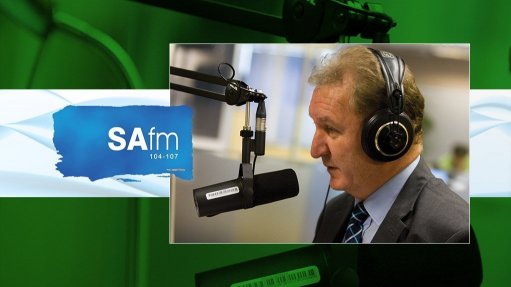
Every Friday morning, SAfm’s AMLive’s radio anchor Ike Phaahla speaks to Martin Creamer, publishing editor of Engineering News and Mining Weekly. Reported here is this Friday’s At the Coalface transcript:

Phaahla: New Chamber of Mines president Sipho Nkosi this week declared South Africa to be in the midst of a “national skills crisis” of alarming proportions.

Creamer: Yes, the new Chamber of Mines president Sipho Nkosi has said that we must put a very big spotlight on our skills and he has declared this a national crisis. Of course, Nkosi is also big, he is head of the biggest coal producing company in South Africa Exxaro. It is also the biggest black controlled company in South Africa and he says the problems are real.

People are emigrating. It has got so bad that a Canadian company even put a stall right outside the gate of Exxaro’s flagship coal mine, Grootegeluk, and was actually recruiting their staff in front of their very eyes. We have seen Sunday newspapers of people queuing up to go to Australian expos.

We have even seen a feature on emigration. This is hammering South Africa’s mining industry and also our whole economy. Nkosi is wanting to put a very big spotlight on it and he is wanting action, because he says the time for talk is over and there is a time now to start linking the dots that we haven’t been doing and coordinating.

We see that we can dip into our big talent pool and I’m calling it a talent pool because we have many people unemployed in South Africa. We have to turn that talent into skill and we need to see how it has been done in other countries. We saw how China could convert 80 000 in a very coordinated scheme into skilled people.

They brought in 3 000 professors from outside and they put these technical skills into people in six-week blocks and over a three year period they produced 80 000 skilled people. That is what we need to do in South Africa, because we have a mining boom, but we don’t have the skills.

Phaahla: Metals mined in the Democratic Republic of Congo (DRC) in the spot light.

Creamer: We are talking about ‘blood metals’ here. We have known about ‘blood diamonds’, there is even a film on ‘blood diamonds’ and we have seen that the diamond industry has come in and stamped that out with the Kimberley Process.

Now we have a similar need in the Congo and the Germans are stepping in firmly to stop ‘blood metals’ and in particular ‘blood’ coltan. Coltan is the columbite-tantalite rare metal that we find in the chips of our cellphones and iPods. It can be the cause of death and destruction because of the patchwork of war zones that still exist in the northeast of the DRC.

The Germans have come in and they have said that they need to certify coltan in the same that they have certified diamonds, to ensure that people with ill intentions do not get their hands on this metal.

So, they moved in to the DRC this week and started doing their recce in order to ensure that we have ‘clean’ metal, particularly clean coltan, coming out of the DRC.

Phaahla: Namibia has a new status.

Creamer: We are talking about Namibia stamping itself as South Africa’s uranium Mecca. It now has five uranium companies listed on the Namibian Stock Exchange with a market capitalisation of nearly N$8-billion in this trillion dollar stock exchange. These are coming in at a fairly early stage.

A lot of them in an exploration stage, but it has given the people of Namibia an opportunity to buy in now at the right level, because we know that uranium has got an incredible future because of the nuclear power demand. We know that even South Africa is looking at many more nuclear power stations besides its Koeberg.

Eskom is talking about using ten times more uranium and right on our door step now we have got Namibia, which is stamping itself as the uranium Mecca. Very justifiably so we saw the Australians going in where South Africans were fast asleep and snapping up assets, particularly Paladin, which has secured the old Langer Heinrich mine for next to nothing and is now developing uranium there.

This week Bannerman of Australia become the fifth company to lists its company on the Namibian Stock Exchange as a uranium exploration play. In South Africa we have not had such good fortune and we have seen that AngloGold Ashanti, as a supplier of uranium, has had to declare a force majeure and we have seen Uranium One’s shares plummet after they had mining problems at the Dominion mine in Klerksdorp, but in Namibia, there is far more stability, and the country is positioning itself well on the uranium front.

Phaahla: Thanks very much. Martin Creamer is publishing editor of Engineering News and Mining Weekly, he’ll be back with us at the same time next week.

Edited by: Creamer Media Reporter


To subscribe to Engineering News's print magazine email subscriptions@creamermedia.co.za or buy now.

FULL Access to Mining Weekly and Engineering News - Subscribe Now!
Subscribe Now Login


On-The-Air 04 April 2008
GET SELECTED AUDIOCLIP
Embed
This article's audio Download (6.14mb)