Creamer Media’s Engineering News Online
Advanced Search


We have detected that the browser you are using is no longer supported. As a result, some content may not display correctly.
We suggest that you upgrade to the latest version of any of the following browsers:
         
close notification
powered by
GOLD 1369.78 $/ozChange: 2.69
PLATINUM 1441.00 $/ozChange: 3.00
R/$ exchange 10.00Change: -0.04
R/€ exchange 13.39Change: -0.08
 
Green infrastructure
 
All government tiers must prepare for green infrastructure future
 
9th December 2011
TEXT SIZE
Text Smaller Disabled Text Bigger
 

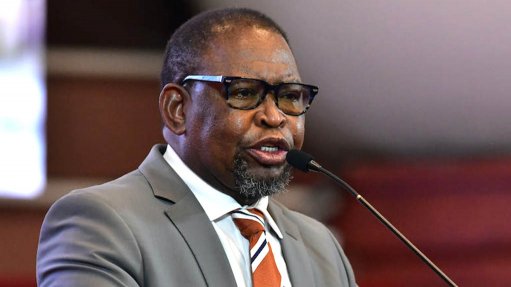
Rural Development and Land Reform Deputy Minister Lechesa Tsenoli has urged academic institutions, researchers, business intelligence organisations and governmental structures at all levels to work together to start detailed and long-term planning for green infrastructure, including renewable energy, and likely infrastructure use in 2040.

The national and provincial governments pro- vided the proper budgetary and legislative environment to enable all tiers of government to start planning around a transition to a green economy decoupled from the inflationary pressures of carbon and fossil fuels, he noted at the November Infrastructure Dialogue, jointly hosted by the Development Bank of Southern Africa and South African Cities Network.

“Around coal, for example, the long-term objectives and strategies adopted must be based on the realistic assessment and likely long-term outcome of decisions around the investment of resources. This is the significance of the research done and why it is important to inform policymakers,” he said.

“We need such decisions across the board and it will not always happen because there is agreement. However, the budgetary and legis- lative environment enables different tiers of government to take decisions in line with what is generally agreed upon,” he explained.

Tsenoli further encouraged academics and research bodies to present their findings, models and conclusions to the National Planning Commission within the six months’ timeframe for comment on the New Growth Path document.

“We would really like you to have the courage of your views and feed them into this commission, specifically providing guidance around issues discussed here today, such as the framework model and long-term relations, which would be greatly appreciated,” he noted.

He further encouraged scientists to seek specific answers to rural-urban divide questions, including linkages to, and implications of, urbanisation for rural and urban areas.

Tsenoli also raised the issue of northern hemis- phere consumptive lifestyles compared with what is possible for people in Africa and South Africa to achieve, noting that the issue of development without the same resources-heavy lifestyle was at the heart of the transition to a green economy and a decarbonised future.

He spoke as an attendee and declined a seat on the panel. He said he had listened as scientists and researchers presented their findings around the economic and sociopolitical imperatives of green infrastructure development, specifically around long-term planning and efficient use of resources, whether financial, human or environmental.


At the event, research body Trade & Industrial Policy Studies Centre senior researcher and combustion engineer Peet du Plooy defined a green economy as one which enables a country to use less energy to achieve the same growth per capita as other countries.

“A green economy needs three things: decoupling growth from environmental impact, including the use of finite resources and the pollu- tion, depletion or degradation of resources over time, which is an economywide challenge, natural resources management, including ecological infrastructure, and green industries that supply the first two parts,” he said.

Infrastructure to support the economy was needed, especially green infrastructure designed to promote green industries and the long-lived benefits of resource investments and to reduce negative impacts on the environment, he added.

“There are economic drivers for green infra- structure and they will revolve around how we use financial planning, economic innovation and policy tools to encourage the transition to green infrastructure.”

Consumption and debt had grown South Africa’s economy over the past but were not sustainable, he said.

“Worldwide, growth of an economy’s income per capita is always associated with a growth in energy consumption. [In terms of] energy use compared to per capita income, we must be as efficient as Brazil, India and China and use less energy to achieve the same income per capita growth compared with industrialised countries,” said Du Plooy.

Recently, South Africa increased its energy consumption but without matching growth in per capita income, he said.

One of the reasons this was happening was that inputs into the economy were becoming increasingly expensive and financial institutions and business performed poorly at predicting future costs, said Du Plooy.

“The International Energy Agency has consistently underpredicted the price of oil. However, it also admits that, unless we move into the green infrastructure paradigm, we face, effectively, increasing oil prices.

“That is why it is critical to switch to green infrastructure – to decouple the infrastructure from prices that are drivers of inflation.”

However, this would depend on internalising some of the social costs, such as the cost of carbon, for example, to change the economy to one decoupled from inflationary pressures.

Further, mechanisms such as Botswana’s sovereign wealth fund can play a significant role in intergenerational equity, funding infrastructure projects and the concept of the social wage, or how a country invests in its people.

Du Plooy warned, however, that a focus on macroeconomic movements and inflation must remain, because inflation eats wealth.


The economic motivation for a transition to green infrastructure was intricately tied to long-term inflation control, he said.

“If we do not manage our land, food price infla- tion becomes an issue over time; if we do not manage to move our electricity systems away from finite resources, we know that inflation will come back in the form of petrol and electricity bills,” he explained.

Building green infrastructure was a critical component of long-term inflation control. To enable this, a suite of instruments was available, including internalising the social costs and reduc- ing the financial costs through planning.

These included taxes based on finite common resources and resource rent taxes, while carbon taxes were potential sources of revenue that could be reinvested.

“The private sector, however, questions whether governments can work well with the money from, for example, a carbon tax. The use of a sovereign wealth fund, which has governmental mandates but is privately run, can provide a useful tool.

“If we tax carbon, we have to direct the funds to investments and this can have a net positive impact on gross domestic product. This is one of the significant findings from the modelling plan,” he noted.

Du Plooy urged debate around a sovereign wealth fund and also mooted a harmonised tax regime around the exports of minerals from Africa, as well as using some of the funds that the continent gains from its mineral wealth to establish a development fund that would build infrastructure that would continue to provide benefits after the resources had been mined out.

Edited by: Martin Zhuwakinyu


To subscribe to Engineering News's print magazine email subscriptions@creamermedia.co.za or buy now.

FULL Access to Mining Weekly and Engineering News - Subscribe Now!
Subscribe Now Login


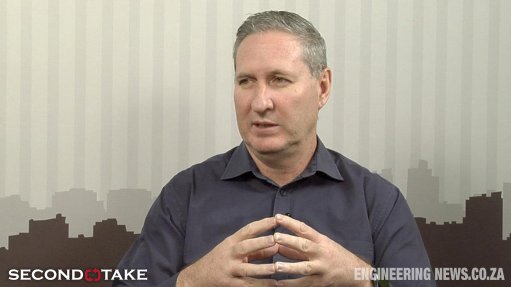
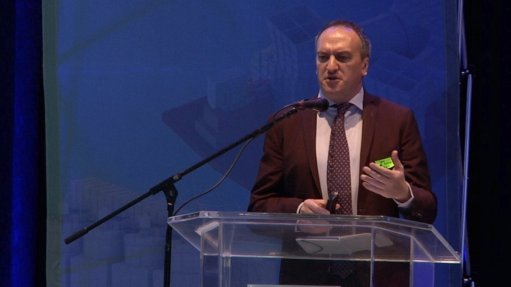
Development Bank of Southern Africa environmental finance head Chantal Naidoo discusses environmental development finance. Camerawork: Nicholas Boyd. Editing: Darlene Creamer.
This video is licensed under a Creative Commons License
GET SELECTED VIDEO
Embed
Selected Video Download (3.5mb)