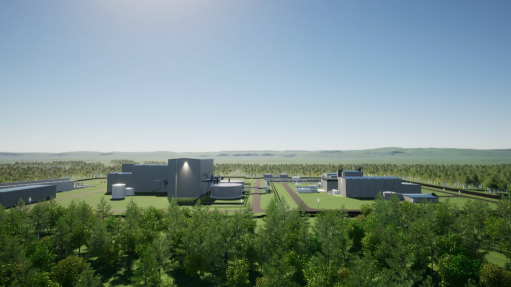
Independent power producer (IPP) Lesedi Biogas Project (LBP) is planning to build one of the world’s largest open-air feedlot manure-to-power projects in the world, in Heidelberg, near Johannesburg, it said this week.
The proposed power generation station, which would have a midmerit output rate of about 5,3 MW, would be completed within 18 months of the financial drawdown of the project and would likely be operational by about mid-2011.
LBP representative Nunda Naidoo said that the project would cost about R150-million to develop, assuming a R10/$ exchange rate.
He noted that the capital structure for funding the project would be finalised shortly, adding that this would involve the Central Energy Fund (CEF), the Industrial Development Corporation, the Development Bank of Southern Africa and LBP.
The project would be situated at the Karan Beef feedlot, with the beef and beef product supplier supplying all the manure from its feedlot to the IPP.
Karan Beef had initially agreed to supply LBP with 110 000 t/y of manure, which would result in the production of 3,8 MW of base-load power and 6,2 MW of peaking power.
However, the number of cattle at the beef supplier’s feedlot in Heidelberg has increased to 130 000 in recent months, which would result in additional manure.
The two parties were also negotiating for the procurement of tallow and paunch from the supplier’s abattoir, in Balfour.
The manure supply could increase to 140 000 t/y, with the overall supply increasing to 150 000 t/y if the tallow was included.
This would lead to an increase in the project’s size of between 30% and 80%, as tallow and paunch had higher gas contents than open-air feedlot manure, explained Naidoo.
A 30% increase in the project’s size would lead to 5 MW of base-load power and 8 MW of peaking power, with a 6,9 MW midmerit rate, while an 80% increase would allow for the production of 6,8 MW of base-load power and 11,2 MW of peaking power, with a 9,6 MW midmerit rate.
Naidoo said that the company intended to sell the power to State-owned power utility Eskom under the renewable energy feed-in tariff (Refit) agreement with the National Energy Regulator of South Africa (Nersa).
The regulator, in March, announced the Refit tariffs for wind, minihydro, landfill gas and concentrated solar power projects, with 20-year power purchase agreements (PPAs) to be signed with Eskom.
In July, Nersa had initiated a process to look into the inclusion of other renewable energy technologies, including solid biomass and biogas projects, as phase two of the Refit programme.
“Discussions are under way with Nersa and Eskom about the tariff and basis of sale,” commented Naidoo.
He added that LBP would prefer to supply the power utility with replacement peaking power for 15 hours a day and base-load power for nine hours a day.
LBP has already applied for a licence to operate the power plant and was expecting this to be approved in the next month or two, said Naidoo.
A feasibility study, partly funded by the CEF, had already been concluded, while an environmental-impact assessment (EIA) had also been completed.
The company was still awaiting a record of decision from the Department of Environmental Affairs regarding the EIA.
The generation plant had an estimated life of 30 years, with Naidoo explaining that, “The project will use a mesophyllic covered lagoon technology for the digester and a low-revving internal combustion engine with long-cycle times of 24 000 hours coupled to alternators."
Operating and maintenance costs would likely amount to between R15-million and R20-million a year, which would include provision for the overall maintenance of the engines every three years.
Meanwhile, LBP was also considering potential future expansions of the project, while additional future fuel sources could include municipal sewage and other vegetation.
Naidoo said that the timing and scale of future expansions would depend on certainty around the Refit and the signing of a PPA with Eskom.
He emphasised that funding remained one of the key challenges to the development of the renewable energy sector.
“Unless a clear and enforceable mechanism of cost recovery and tariffs are addressed, we as a country have no effective renewable energy policy to speak of. This is of concern to investors, technology suppliers and project developers,” he noted.
Naidoo added that, in LBP’s view, the renewable energy sector remained a “feel good” sector, rather than a sector that had to be developed with focus and priority to reduce the country’s carbon footprint.