Creamer Media’s Engineering News Online
Advanced Search


We have detected that the browser you are using is no longer supported. As a result, some content may not display correctly.
We suggest that you upgrade to the latest version of any of the following browsers:
         
close notification
powered by
GOLD 1386.89 $/ozChange: 0.96
PLATINUM 1470.50 $/ozChange: -16.00
R/$ exchange 9.47Change: -0.07
R/€ exchange 12.21Change: -0.13
 
 
Lack of capacity leads to wastewater treatment plant upgrades
 
30th March 2012
TEXT SIZE
Text Smaller Disabled Text Bigger
 

Multidisciplinary engineering firm SSI is responsible for the project design and management in the upgrade and extension of a number of existing wastewater treatment works (WWTWs) in South Africa.

The firm points out that the country’s WWTW infrastructure is heavily undercapacitated, leading, in some cases, to sewage being discharged into sensitive bodies of water, such as streams.

SSI notes that the City of Johannesburg is one of only a few municipalities with full Green Drop certification, as outlined by the Department of Water Affairs, while many municipalities in the rest of Gauteng and other provinces are struggling to meet these standards.

Green Drop certification is an indication of the state of sewage and effluent treatment in South Africa, says SSI Western Cape water sector area manager Japie van Eeden.

“The practical skills shortage among new municipal engineers has influenced this problem. Many of the new graduates have qualifications but lack practical skills to fully perform their duties,” he adds.

Further, local government is faced with having to balance new infrastructure development and maintain service delivery, which is challenging as a result of the lack of skills.

SSI plans on improving this situation by looking at the infrastructure and service delivery task as a complete cycle from planning to the provision of adequate services to enable sustainable development.

By focusing on the income that the development will raise, in relation to the development cost, the company will develop a sustainable plan to manage infrastructure development.

Projects
SSI is currently working on the R1.9-billion refurbishment, expansion and sludge management project for the Rooiwal WWTW that will be carried out over the next ten years.

The undercapacitated WWTW serves the central and northern areas of Tshwane.

SSI is undertaking the preliminary design of the project, which includes two 40 M/d plant extensions at the north works and a 60 M/d plant extension at the east works.

The deficient plant is negatively impacting on the Apies river, as well as on the downsteam Themba water treatment plant, which also supplies the City of Tshwane with water.

SSI will also be involved in the project management, civil works and mechanical workings of the project.

The company points out that fast-tracking the project, while managing the client’s expectations as well as managing risk, might prove challenging.

Automation
Meanwhile, SSI says a recent trend that has emerged in the WWTW sector is the implementation of automation and control systems, mainly as a result of the skills shortages faced by municipalities.

In addition, the systems improve operational efficiency, safety of equipment and personnel and offer long-term data logging and trending at otherwise unattended installations, says SSI Western Cape automation sector consultant Alfred Schröder.

The City of Cape Town’s new Fisantekraal WWTW is an automated plant, along with the Nereda plant at Gansbaai, which has been operating virtually trouble free for more than two years since commissioning.

A second Nereda automated plant is currently under construction at Wemmershoek, in Stellenbosh.

The Nereda plant is controlled using a conventional supervisory control and data acquisition system, a programmable logic controller, and an SSI/DHV Aquasuite Nereda Controller.

Schröder, however, warns against falling prey to illusory simplicity when automating a system, and advises that the upgrade be done in a multidisciplinary, planned and professional manner.

The company’s knowledge in indirect effluent reuse and desalination projects is being used by the Overstrand municipality’s Hermanus WWTW, where designs have been completed for a future upgrade project.

Edited by: Chanel de Bruyn


To subscribe to Engineering News's print magazine email subscriptions@creamermedia.co.za or buy now.

FULL Access to Mining Weekly and Engineering News - Subscribe Now!
Subscribe Now Login
 
 
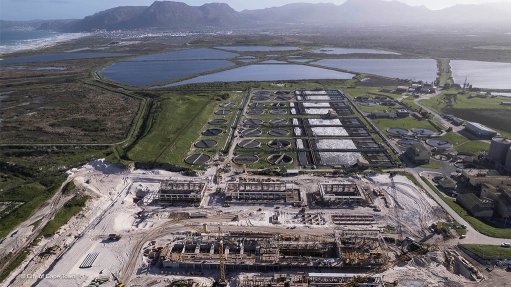
EXISTING ROOIWAL WWTW The R1.9-billion refurbishment, expansion and sludge management project will be carried out over the next ten years on the existing treatment works
 

EXISTING ROOIWAL WWTW The R1.9-billion refurbishment, expansion and sludge management project will be carried out over the next ten years on the existing treatment works