South Africa's Kusile power station will be phased in one year later than initially planned to help accommodate Eskom's lower requested tariff increases of 35% a year between 2010 and 2013, the utility confirmed on Tuesday.
The group's initial application, submitted on September 30, 2009, sought increases of 45% a year.
The State-owned power utility would also seek to secure a private equity partner for as much as 30% of the R142-billion coal-fired Kusile project, which is being built in Mpumalanga. The 4 800-MW project was initially scheduled to have the first of its six units commissioned in June 2013, and its last in October 2016.
The utility, which submitted a revised tariff application to the National Energy Regulator of South Africa (Nersa) at 22:00 on Monday night, would also delay the Sere wind project by 12 months, while the so-called 'Coal 3' project had been scrapped and would be replaced by independent power producer (IPP) projects.
Further, Eskom had recommended that the nuclear project be delayed by two years along with the Department of Energy's peaking power projects.
The utility would seek to bring in between R20-billion and R40-billion in new project-level equity to lower its funding shortfall, which it now estimated at R14-billion. The shortfall under the previous application was R30-billion.
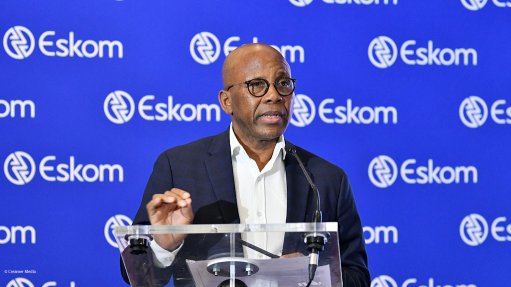
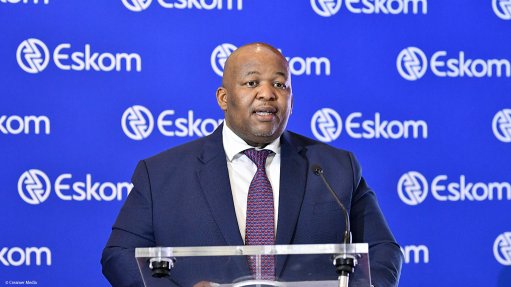
In its consultations since the initial submission to Nersa, Eskom concluded that a "significant strategic shift" was required, acting executive chairperson Mpho Makwana said at a media conference on Tuesday.
But he outlined several risks associated with the new application and said that Eskom would, if forced to do so, seek a tariff reopener should some variables change materially during the determination period.
PLAN COMES WITH RISKS
"The revised funding plan is very finely balanced and is based on best estimates of future trends, including assumptions on interest rates, on inflation, on exchange rates, on economic growth and the cost of primary energy, on commodity prices and such other economic variables.
"Should reality vary from these forecasts, Eskom will not be in a position to fund the planned capital expenditure programme," Makwana warned.
Chief officer for networks and customer service Erica Johnson said that, while there was no short-term threat to security of supply, the system would be vulnerable from 2011 through to 2012, when the first Medupi turbine was scheduled for synchronisation to the grid.
"Therefore, there is no alternative but to have an intensive focus on demand management," Johnson averred.
She explained that this programme would have two components: a power conservation programme, which was designed to reduced demand from large customers by between 8% and 15%; and demand side management at the commercial and residential level, with a strong focus on solar water heating.
Makwana said that Eskom would seek to maintain an 86% plant availability, and would work with stakeholders to sustain demand within a 42 000-MW generation envelope during the three-year period. It would also seek to maintain sales below 242 TWh by 2012/13.
"This would enable an adequate energy balance, without having to resort to additional and expensive supply-side options and, even worse, load-shedding, or rationing," he added.
The new application would translate to a price increase of 70c/kWh over the three-year period, or an increase of 37c/kWh over the period at an average of 12c/kWh a year, as opposed to 99c/kWh in the previous application.
The main features of the revised new application include:
- The securing of at least R20-billion in private equity for Kusile.
- A rephrasing of its project pipeline, primarily the Kusile project, which would be delayed by a year, but also its wind and nuclear projects.
- The elimination from its investment portfolio of the proposed third coal-fired power station.
- An increase in its yearly debt capital raising plan, from an average of R40-billion a year between April 1, 2010, and March 31, 2013, to around R47-billion.
- A lower demand-growth forecast (initially set at 3,6% a year), which was underpinned by a scaled-up demand-side management aspiration of 8,5 TWh.
- Significant costs reductions, particularly in the area of primary energy. It was looking to save R12,6-billion over the period.
- And, a far greater immediate and intermediate role for IPPs.
Under Nersa's approved timelines, public hearings were scheduled to take place across all provinces from January 11, 2010, to January 22, 2010, with a final decision to be made on February 24.