By: renay de
23rd April 2004
These are nonrenewable, meaning they draw on finite resources that will eventually dwindle or become too expensive or environmentally damaging to retrieve.
In contrast, renewable energy resources, such as wind and solar energy, are constantly being replenished and will never run out.
Renewable-energy technologies are clean sources of energy that have fewer environmental consequences than conventional energy technologies.
Eskom has a long association with the implementation of renewable-energy technologies.
Thousands of rural schools, clinics and houses have been supplied with electricity from solar power, while extensive research has been conducted to diversify Eskom’s grid-connected supply. This is achieved through the cost-effective implementation of renewable energies such as wind, solar energy and hydroelectric power.
Wind turbines, like windmills, are mounted on a tower to capture the most energy. The kinetic energy of wind is used to turn a wind turbine to generate electricity.
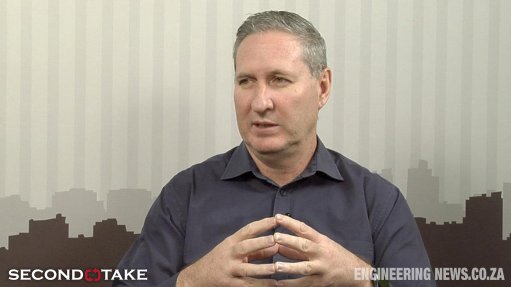
The most advanced programme that Eskom’s research development and demonstration division is currently involved in is the R42-million Klipheuwel wind-farm research facility, near Cape Town, reports its research operations manager Dr Louis van Heerden He tells Engineering News that it is a 3,16 MW facility that is built around three different types of turbines. The Klipheuwel research station houses two Danish Vestas and one French Jeumont unit.
According to Van Heerden, the Danish units incorporate conventional induction generators with gearboxes, whereas the French unit has a permanent magnet synchronous generator without a gearbox.
Research on the potential of wind energy as an electricity-generating option is being conducted, as well as an evaluation of different wind-based technologies, and their economic viability.
“The aim of this demonstration facility is to introduce and expose the technology to the country, making people aware of how the facility works and what benefits it could provide if the plant is commercialised.
“Since the facility was commissioned in February last year, it has had 803 escorted visitors at the plant,” comments Van Heerden.
Eskom is currently analysing how the different types of technologies perform under South African conditions.
The research programme at the plant will run for three years. To date, it has noted that the two Danish units at the plant are more commercial and, as a result of this, they have experienced fewer teething problems than the French unit, he explains. The ongoing research at the plant is looking into turbine operational and maintenance issues, which are critical to understand when looking at any future forecasts or future planning for this technology.
Other ongoing research topics include looking at the vibration in the structure, the conditioning monitoring and the voltage control of the plant.
The Klipheuwel wind-farm has a total capacity of 3,16 MW and is expected to generate at a load factor of 20% to 26%.
Wind generators have an expected lifetime of at least 20 years, and the largest wind turbine at the plant, the Vestas V66, has the capacity to supply about 200 First World homes, or as many as 1 000 homes in deep rural areas, explains Van Heerden.
He says that, because the unit generator creates power from wind pressure, the voltage generated is not always constant and, therefore, it is not a stable supply of energy.
In an attempt to overcome this problem, Eskom installed a power quality device system, that was developed by the utility, which regulates some of the output generated by the turbines. This system is currently being tested at Klipheuwel.
After the three-year research has come to an end, the plant will either be handed over to Eskom Generation, which is currently the operator of the plant, to be operated as a commercial facility, it could be decommissioned or moved, Eskom could run it in partnership with another party, or it could be sold, acknowledges Van Heerden. These are all options; the final decision will be made based on the findings of the research.
Meanwhile, ocean waves are one of the world’s most abundant sources of renewable energy, essentially comprising a concentrated form of solar energy.
Ocean energy is energy that could be derived from waves, tides, currents or varying thermal layers in the ocean.
The ocean covers more than 70% of the earth’s surface, making it the world’s largest solar collector. Van Heerden notes that Eskom completed an ocean-energy-resource assessment in 2002.
“The study concluded that South Africa has a sufficient ocean resource available to explore this option further.
“Currently, a technoeconomic study and a technology evaluation are being performed. This study aims to identify those ocean energy conversion technologies that should be researched further for possible application in South Africa,” says Van Heerden.
Most renewable energy comes either directly or indirectly from the sun. Sunlight, or solar power, can be used for heating and lighting buildings, generating electricity and a variety of other commercial and industrial uses.
Van Heerden explains that there are currently about five solar-power technologies being researched around the world.
These include photovoltaic systems, concentrating solar systems, passive solar heating and daylighting, solar hot water and solar process heat, as well as space heating and cooling. He says Eskom is investigating two main groups of systems, namely solar and solar-thermal technology options.
Edited by: renay de
To subscribe to Engineering News's print magazine email subscriptions@creamermedia.co.za or buy now.


lr1_2.gif)