The Absa Towers West project is not only transforming the Johannesburg inner city skyline, it is taking green building in the city centre to a new level, as the financial giant has committed to design and construct its new offices incorporating green building elements.
The R1,2-billion project in Marshalltown covers three city blocks, includes new buildings and building upgrades involving eight buildings, as well as the development of the surrounding built environment.
An initial sustainability review was carried out in 2007 by a consortium consisting of PJC Carew Consulting, Green by Design, and the CSIR. This study reviewed the design and suggested changes to improve the sustainability performance of the campus.
From early 2008 Absa contracted the services of WSP Green by design to assist in achieving a Green Star Rating. The professional team on the Absa Towers West project includes five Green Star accredited professionals, and the project will soon be registered with the Green Building Council of South Africa (GBCSA) for a Green Star Office version 1 (as built) rating.
“The submission process follows three months after practical completion in March 2011. The project is aiming at a four star rating,” says WSP Green by Design sustainable building consultant Marloes Reinink.
The GBCSA launched the Green Star rating tool for offices in South Africa in November 2008. “During the development of the Green Star tool for South Africa, Absa Towers West was used as one of the case studies that the tool was tested on. WSP Green by Design has been involved in the project and kept track of the Green Star requirements during the pilot phase of the tool, since its release,” says Reinink.
The building is currently being modeled in terms of its energy performance, and a team of engineers is doing this with DesignBuilder Software.
The building is modeled according to the Green Star SA Energy modeling protocol, where after the modeled Absa Towers West will be compared with a notional building modeled according to the SANS 204 (energy efficiency in buildings standards) “deemed to satisfy” criteria. Based on the percentage improvement of the Absa building over the SANS 204 building, this gives the number of points towards the Green Star rating.
Green Elements Incorporated
A green building is one which reduces environmental impact in terms of energy consumption, water consumption, material sources, and emissions. It provides improved indoor environmental quality, which has been proven to improve the productivity of employees in the building.
The Absa Towers West project makes all of these a priority.
In terms of location, the building is in the central business district, therefore close to many amenities and public transport for staff working in the office. It also contributes to urban regeneration and making the city a safer place.
With regard to water, the project has a grey water system which will be the largest system installed in South Africa. The system has a capacity of recycling 43 000 litres (43 m3) of water a day. The water is collected from the showers in the gym and is reused to flush the toilets and urinals.
The hot water required for the showers and the wash hand basins is heated through heat recovery at the chiller plant.
For lighting, a digital addressable lighting interface system will be installed in the building, and combined with very efficient light fittings. All light fittings are fitted with motion sensors and daylight dimmers. Motion sensors are also installed in the parkade to keep the energy for lighting to a minimum.
Reinink states that the project also has a very well designed façade built up. The building has double glazing with thermal breaks, and sufficient thermal insulation in the walls.
The heating ventilation and cooling system has incorporated an economy cycle, which uses outside air to provide free cooling when outside conditions are favorable. This reduces the energy consumption associated with mechanical cooling of the air. The system also allows for night-time flushing of the building to cool down the building structure at night.
Initiatives involving construction materials are polyvinyl chloride minimisation, promoting the use of sustainable timber, promoting the use of local products, the use of low volatile organic compound paints and carpets to improve the indoor air quality, and the contractor is ISO 14001 accredited.
Energy Centre
The gas powered energy centre, located at the campus, is provided to serve the office’s needs, and has four gas engines each of 3MW capacity with space provision for a further two duty, and two reserve sets, in future.
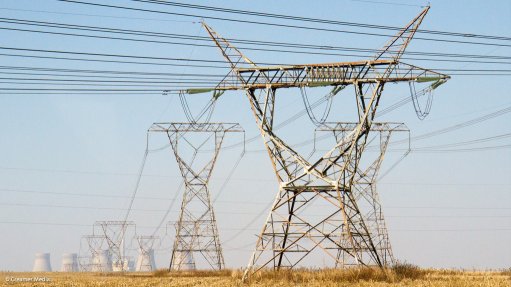
The energy centre will supply the majority of the campus electricity consumption from 07:00 to 20:00 on weekdays. This provides additional security of supply to the campus in addition to relieving load on the City Power electricity grid during peak times.
Gas powered generation is a cleaner form of generation with about half of the emissions of the coal fired generation which it displaces.
This is expected to save about 17 136 tons of carbon dioxide equivalent a year, and Absa is in the process of applying for carbon credits for this initiative.