Creamer Media’s Engineering News Online
Advanced Search


We have detected that the browser you are using is no longer supported. As a result, some content may not display correctly.
We suggest that you upgrade to the latest version of any of the following browsers:
         
close notification
powered by
GOLD 1388.25 $/ozChange: 13.16
PLATINUM 1458.50 $/ozChange: -14.00
R/$ exchange 9.54Change: 0.00
R/€ exchange 12.35Change: -0.01
 
 
Indigenous wastewater system a hit in Oz
 
28th June 2002
TEXT SIZE
Text Smaller Disabled Text Bigger
 
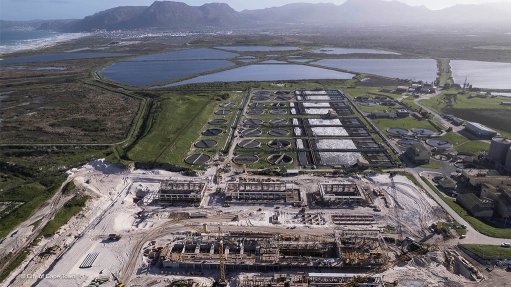
South Africa's home-grown wastewater technology has been chosen as the technology to be used in the upgrading of Australia's largest wastewater treatment plant, in Melbourne.

This is the first foreign application of the technology.

Melbourne had to find a way to upgrade its multi-kilometre stretch of ponds to comply with tougher regulations expected in 2005.

The local pond enhanced treatment and operation (Petro) system was chosen above California's advanced integrated wastewater system, to decrease nitrogen discharge into Port Philip Bay, which lies next to many Melbourne suburbs.

The upgrade, which is currently under way, will take place in three stages.

The first stage, which was completed six months ago, involved the upgrading of the first series of ten giant ponds.

The project is currently budgeted at some A$32-million, saving the country hundreds of millions of dollars as opposed to using other costly conventional technologies.

Once complete, the upgraded system will service 1,6-million people, or about half of the population of Melbourne, processing some 500-megalitres a day.

The second and third phase will depend on the performance of the first, which currently produces final effluent of the required discharge standard.

The project is scheduled for completion by 2004.

In other new developments, the local technology received a R6-million boost when Bioventures agreed to invest in the Johannesburg-based company Amandla Water.

Amandla Water has secured the exclusive global marketing rights to the Petro wastewater treatment technology.

"There are currently 18 Petro systems in operation in the world today, most of them are located in South Africa, and the Bioventures investment will enable us to actively promote the technology in the international market," says Amandla Water's director of operations Charles Polson.

Amandla Water was established last year to specifically market sustainable technologies to respond to the growing challenges of the global water sector.

The company is jointly owned by Bioventures – a consortium of Gensec Bank, Genbel Securities, Real Africa Holdings, the Industrial Development Corporation and the International Finance Council – together with an international investor and the company's management team.

"Professionals the world over are being called on to provide technology that will contribute to the challenge of sustainability. "It is our commitment to continuously seek out innovation and to advocate, promote and market technologies that will add value to the planet rather than deplete its resources, and we believe that Petro is such a technology," says Polson.

Petro technology was developed by Pieter Meiring of Meiring Turner and Hoffmann, together with the South African Water Research Commission, and extensively researched by Dr Oleg Shipin.

"The attractiveness of the Petro system is that it bridges gaps between the developed and developing worlds.

"The simplicity, low cost and ease of operation as well as the capacity to produce an effluent matching the standards of far more expensive 'First World' solutions," explains Polson.

The concept is based on using stabilisation ponds as a first stage of treatment, to tackle the bulk of the organic load.

However, these ponds have a serious drawback in that, while reducing the wastewater organic load, they produce large quantities of microalgae which are difficult to remove from the final effluent, at low cost.

For this reason a polishing facility is used as the secondary stage, in the form of either a rock-trickling filter or an activated sludge process, says Shipin.

"This second stage forms the heart of the Petro technology.

That is where all the magic happens," says Shipin.

Under stress, algae autoflocculate and remove themselves through the rock filter or activated sludge process, he says.

The system is highly suitable for phased development or retrofitting, and easily incorporates present treatment infrastructure, making it cost effective.
Edited by: Joanne Delaurentis


To subscribe to Engineering News's print magazine email subscriptions@creamermedia.co.za or buy now.

FULL Access to Mining Weekly and Engineering News - Subscribe Now!
Subscribe Now Login