Creamer Media’s Engineering News Online
Advanced Search


We have detected that the browser you are using is no longer supported. As a result, some content may not display correctly.
We suggest that you upgrade to the latest version of any of the following browsers:
         
close notification
powered by
GOLD 1366.80 $/ozChange: -0.29
PLATINUM 1442.50 $/ozChange: 4.50
R/$ exchange 10.00Change: -0.04
R/€ exchange 13.39Change: -0.08


INDUSTRIAL FINANCE
 
IDC looks to raise R65bn as dividend payments take strain
 
3rd September 2012
TEXT SIZE
Text Smaller Disabled Text Bigger
 

South Africa’s State-owned Industrial Development Corporation (IDC), which is aiming to approve project and business funding of R102-billion between 2012 and 2016, indicated on Monday that it would probably need to borrow some R65-billion over the period to fund that aspiration.

These borrowings would be raised primarily on the domestic bond market and from other development finance institutions (DFIs). But the IDC was also considering other international sources, including the offshore capital markets.

CEO Geoffrey Qhena remained adamant that the R102-billion “stretch target”, which was reaffirmed by Economic Development Minister Ebrahim Patel, remained realistic. This, notwithstanding weaker-than-expected economic activity and approval levels, as well as growing pressure on its main current source of funding, which are currently dividends from companies listed on the JSE.

The IDC received R2.9-billion in dividends from companies such as ArcelorMittal South Africa, BHP Billiton, Kumba Iron Ore, Sasol and other listed entities in the year to March 31, 2012, as well as a further R781-million from unlisted holdings, such as Foskor. But in light of the prevailing downturn in the commodity cycle, dividend flows were expected to decline materially during the current financial year.

Therefore, CFO Gert Gouws confirmed that the group would rely increasingly on borrowings to fund its State-backed mandate. He stressed that the group’s balance sheet, with a debt-to-equity ratio of 11%, had borrowing capacity and indicated that the ratio was likely to rise to around 30% by 2016.

FUNDING PLAN

Given the lag between approvals and disbursements, the IDC was budgeting to disburse about R90-billion between 2012 and 2016, of which about R25-billion would be recovered through interest payments.

About R40-billion of the R65-billion shortfall would, therefore, be met through borrowings, with the R25-billion balance arising from profits associated with the sale of listed and unlisted shares – these sales would only be pursued once the commodity cycle recovered and would probably be timed towards the end of the five-year cycle.

About half the borrowings would be raised through bonds, with the IDC having already listed a R15-billion Domestic Medium-Term Note Programme, which it would start tapping in October.

A further 25% could be secured from international DFIs, as well as from local entities such as the Unemployment Insurance Fund and the Compensation Fund. The balance would be sourced from commercial banks.

Patel said that the proposed DFI involving the Brics-bloc countries of Brazil, Russia, India and China, could offer a new source of funding to domestic DFIs, such as the IDC and the Development Bank of Southern Africa.

Qhena was also not overly concerned about the group’s capacity to materially increase the level of approvals over the remaining four-year period, but acknowledged that it would require a major push from the bank’s staff.

In 2012/13, IDC approved a record R13.5-billion to fund start-ups, business expansions, ownership changes and to support firms in distress. The approvals were well up from the R8.7-billion approved in 2010/11, but fell well short of the yearly approval levels of around R20-billion that would be required to meet the outlined budget.

About 30% of the approvals were directed towards so-called ‘green economy’ investments, with the IDC participating in 12 of the 28 preferred projects selected during the first bid window of the Department of Energy’s renewable energy procurement programme.
It would also participate in subsequent bidding rounds.

The fact that only R8.4-billion of the R13.5-billion in IDC approvals was actually disbursed during the year was partly attributed to the well-publicised delay in closing the first wind and solar bids. These are expected to reach financial closure in the coming weeks.

Besides further green-economy-related investments, Qhena saw significant potential in supporting the localisation component of the capital programmes being pursued by State-owned companies such as Eskom and Transnet. All told, South Africa was expected to invest some R860-billion on infrastructure programmes until around 2015.

Edited by: Creamer Media Reporter


To subscribe to Engineering News's print magazine email subscriptions@creamermedia.co.za or buy now.

FULL Access to Mining Weekly and Engineering News - Subscribe Now!
Subscribe Now Login


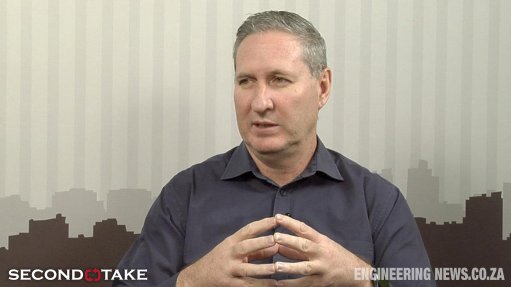
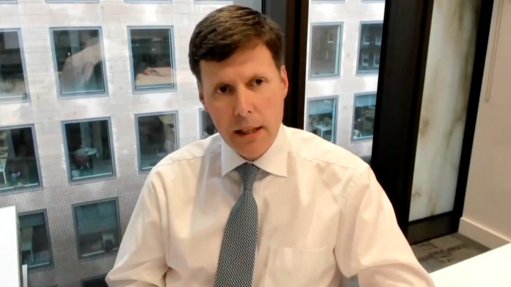
Industrial Development Corporation CFO Gert Gouws outlines the group's plans for closing a R65-billion funding gap between 2012 and 2016. Camera Work: Nicholas Boyd. Editing: Darlene Creamer. Recorded: 3.9.2012.
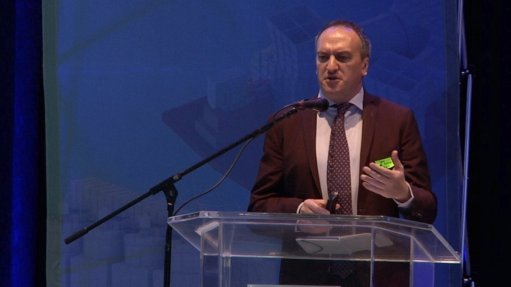
Economic Development Minister Ebrahim Patel on the potential virtues of a Bric-level development bank. Camera Work: Nicholas Boyd. Editing: Darlene Creamer. Recorded: 3.9.2012.
This video is licensed under a Creative Commons License
GET SELECTED VIDEO
Embed
Selected Video Download (5.99mb)
Selected Video Download (9.41mb)
 
Geoffrey Qhena and Gert Gouws
 
Picture by: Duane Daws
Geoffrey Qhena and Gert Gouws