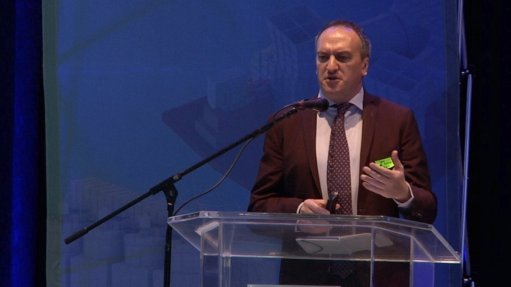
Many infrastructure projects in South Africa have a social and commercial component, and therefore required a hybrid financing approach, Deputy Finance Minister Nhlanhla Nene said at the third Banking Summit, held in Johannesburg on Tuesday.
“The optimal financing structure needs to be tailored on a case-by-case basis to fit the specific nature of the infrastructure project,” he stated, adding that the same applied to the repayment model.
Nene said that although infrastructure projects would remain heavily reliant on public funding, government had limited capacity to pay for everything, necessitating the role of the private sector.
“Government expenditure is limited by how much tax revenue it can collect without hurting economic growth, and how much debt we can borrow.”
He explained that these abilities were being constrained by the weak global economic conditions.
“We need to think out of the box, the potential exists for equity finance, mezzanine finance, ‘build-operate-transfer’,” Nene noted.
Further, he told the summit that South Africa’s R3.3-trillion infrastructure plan, announced by President Jacob Zuma in his February State of the Nation address, created significant opportunities for banks, which would have to take on a long-term vision by offering long-term lending.
Government has identified 17 strategic integrated projects in sectors such as energy, transport and logistics to schools, hospitals and nursing colleges to be constructed between now and 2020.
Nene said a conversation between banks and government would have to be initiated. “We should talk constructively and openly about the challenges of growth and what we should do to build the kind of South Africa that is envisioned in the National Development Plan [NDP].”
Last week, the National Planning Commission handed over its final report to the President in Parliament.
Nene emphasised that infrastructure development was important in raising South Africa’s potential growth rate. By some estimates a one percentage-point increase in infrastructure investment would raise long-run gross domestic product (GDP) by about 1.3% and employment by about 0.7%.
Further, the Minister said that projects of which the costs could be covered equitably, and those that were implementable, would have to be prioritised, as resources were limited.
“For social infrastructure, this would mean prioritising backlogs, for example housing, basic services, over-crowded classrooms. For economic infrastructure, it means unblocking the largest supply constraints, of which the symptoms include traffic congestion, rising property prices, increasing input prices and inability to fulfil export orders,” Nene stated.
Also addressing delegates, Banking Association South Africa MD Cas Coovadia warned that without significant intervention, infrastructure spent as a percentage of South Africa’s GDP would drop from the current 9.1% to 8.1% by 2013.
He said government’s lack of capacity to implement projects, as identified by the NDP and the New Growth Path, would have to be overcome.
Coovadia pointed out that spatial mapping and cost determination, carried out by the Presidential Infrastructure Coordinating Commission, reiterated the need for private sector equity in project funding.
However, he expressed concern that real engagement between public and private sectors was lacking.
Coovadia said the financial sector would have to be considered as a strategic partner in enabling the sustainability of infrastructure projects.
“We need sustainable funding models for these projects…engagement must take place earlier, before the costing and funding models are determined.”
He added that the financing parties would have to compile combined hybrid (public and private) financing models before approaching the government.
Meanwhile, Coovadia was optimistic about the adoption of a regional infrastructure master plan by Southern African Development Community (SADC) leaders, which was approved during a summit in Mozambique’s capital, Maputo, at the weekend.
The plan, which will be implemented over a 15-year period, is aimed at advancing regional trade through the construction of cross-border infrastructure that will connect all SADC states in areas of energy, water, information and communication technology, as well as transport.
To subscribe to Engineering News's print magazine email subscriptions@creamermedia.co.za or buy now.