Creamer Media’s Engineering News Online
Advanced Search


We have detected that the browser you are using is no longer supported. As a result, some content may not display correctly.
We suggest that you upgrade to the latest version of any of the following browsers:
         
close notification
powered by
GOLD 1773.68 $/ozChange: 16.78
PLATINUM 1719.00 $/ozChange: 0.00
R/$ exchange 7.73Change: 0.00
R/€ exchange 10.25Change: 0.00
 
RENEWABLE ENERGY
Grid tying and net metering for systems under 1 MW
 
22nd October 2010
TEXT SIZE
Text Smaller Disabled Text Bigger
 

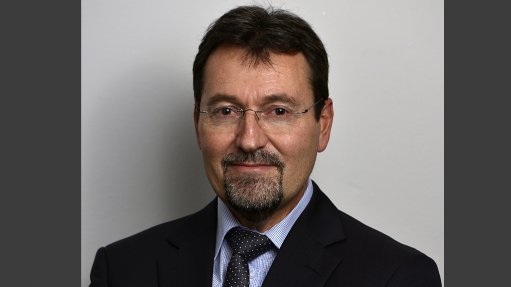
By: David Lipschitz

Most people and businesses, both small and big, are waiting for government to do something to get renewable-energy adoption going in South Africa.

But a small revolution is taking place – there are many people who are connecting ‘grid-tie’ systems to the national grid illegally. I use the word ‘illegally’ in quotes, as it is illegal to ‘sell’ electricity to the national grid without a power purchase agreement from power utility Eskom, and it is illegal to ‘reverse-feed’ the grid.

The information I have from Eskom and the City of Cape Town regarding reverse feeding is that Eskom and our cities are concerned because they do not want people supplying electricity to the grid on those occasions when the grid has been switched off on purpose, for example for maintenance. One should note that this problem was resolved in 1999 with the publication of UL1741 and IEEE1547. Grid-tie inverters which meet these standards automatically switch off when they detect that the grid is not stable and only reconnect when the grid’s voltage and frequency have been stable for a certain length of time.

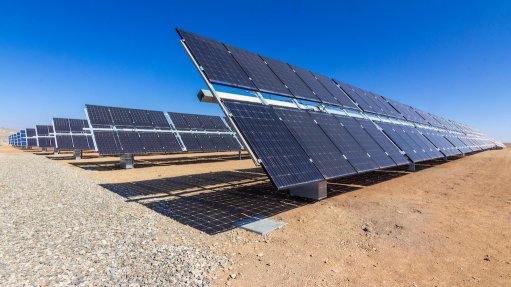
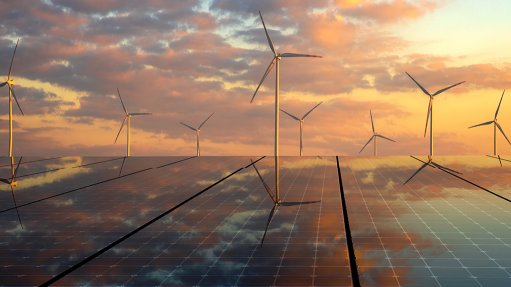
In a grid-tie configuration, people connect solar photovoltaic (PV) panels to a grid-tie inverter that is connected between a house and the grid. This is a very simple configuration and does not require batteries or a solar charge controller to charge the batteries. In the grid-tie configuration, if the house is drawing 1 000 W and the PV panels are supplying 500 W, then 500 W comes from the solar panels and 500 W from the grid. If the solar panels are producing 1 000 W and the house is drawing 200 W only, then 800 W is exported to the grid and, in this case, the old-fashioned circular meters go backwards.

Another configuration is a battery- only configuration, but the grid-tie system can be operated at 93% efficiency, whereas the battery-only configuration typically runs in the order of 30% to 55% efficiency. The reason for this low efficiency is that, once the batteries are full and at times when there is no draw, the electricity from the PV panels is wasted. In these cases, grid-connected systems could simply reduce the total demand on the rest of the system.

Many loads cannot easily be attached to a battery-based system and, in a country like South Africa, it makes sense to have grid-tie systems with battery backup for those times when the grid is either unstable or down, thus providing security of supply. In most cases, four hours of battery backup for critical loads is more than enough, examples being running computers, lighting, TV sets, and so on, during a power failure.

It has been this writer’s experience that government does not want to allow this kind of connectivity because the feed-in-tariff regulations have not been finalised and also because of potential electricity income loss. The problem is that we have a feed-in tariff without a power purchase agreement. But government would receive a much bigger income from corporate tax, employee tax, value-added tax and lower unemployment than the electricity income that may be lost.

Net metering would solve this problem and maximise the amount of electricity generated and saved by private individuals. Excess electricity simply turns our meters backwards at the same speed they go forwards. For example, if one pays R1,04/kWh when one is drawing electricity from the grid, then, when one is supplying the grid, one would like to be paid R1,04/kWh.

This makes installing photovoltaic systems at private households and businesses where the total production is going to be less than 1 MW viable. It means that no government subsidies or rebates are required and no feed-in tariff is required. Many hundreds of systems could be installed very quickly if net metering and grid tie were legal in South Africa. There are competent and qualified installers who can do these installations.

Lipschitz runs a business called MyPowerStation, which sells products that help people reduce their carbon footprint and cost of living and designs and installs renewable-energy power stations.  He is chairperson of nongovernmental organisation Free Life on Earth - david@mypowerstation.biz

FULL Access to Mining Weekly and Engineering News - Subscribe Now!
Subscribe Now Login


Hide Comments  
 
Readers Comments
 
image image
It is now more apparent to me than ever before that South Africans must push for Net Metering as the answer to our energy provision problems. Waiting for the first FITs to appear in 2016 is way to long! http://www.engineeringnews.co.za/article/eskom-to-complete-csp-design-by-2013-commission-plant-in-2016-2011-06-22/al_id:171787
image image 
image
David Lipschitz on 23 Jun 11
image image
Two links with further information about Net Metering in South Africa: www.pmg.org.za/node/21512 Search "regional regulatory action plan for the western cape" in Google (with the quotes) and download the PDF.
image image 
image
David Lipschitz on 18 May 11