Creamer Media’s Engineering News Online
Advanced Search


We have detected that the browser you are using is no longer supported. As a result, some content may not display correctly.
We suggest that you upgrade to the latest version of any of the following browsers:
         
close notification
powered by
GOLD 1732.21 $/ozChange: -4.56
PLATINUM 1657.00 $/ozChange: 11.00
R/$ exchange 7.59Change: -0.04
R/€ exchange 10.07Change: -0.16
 
RENEWABLE ENERGY
Eskom’s new-look rebate hinges on tariff approval
 
19th January 2010
TEXT SIZE
Text Smaller Disabled Text Bigger
 

Funding for the increased rebate through Eskom's solar water heater (SWH) programme would be derived from the electricity tariff, as was the case with all projects under the utility's demand-side management (DSM) programme, the utility has confirmed.

The Eskom SWH rebate was aimed at incentivising the roll-out of SWHs across the country, and was also aligned with the greater national SWH strategy of installing one-million solar water heaters by 2014, endorsed by the Department of Energy (DoE).

The utility announced on January 13 that it would be increasing the rebates for purchasers of systems that were registered under Eskom's SWH programme, and that the increases were in the order of double the previous subsidies.

"We are confident that the regulatory support that we have had for our DSM programme over the last six years will continue," Andrew Etzinger told Engineering News Online, when explaining that the subsidy for consumers was derived from the electricity tariff, and that this subsidy could be adjusted from time to time, taking into account changing market factors.

"At this stage, we see that the programme is necessary for the system. And so we believe that it will continue as part of the government aspiration of a million solar water heaters over the next five years," Etzinger added.

However, Eskom is still in the middle of a public hearing process, led by the National Energy Regulator of South Africa (Nersa), regarding an application for tariff increases of 35% a year between 2010 and 2013. The application includes a revenue requirement for DSM, but Nersa will only make a pronouncement late next month as to whether such revenue had indeed been included in the hike.

Should this be the case, the SWH subsidy will be paid for by Eskom customers, as it is a cost item for the utility recovered through the electricity tariff.

Nevertheless, news of the increased rebate from Eskom was greeted with enthusiasm from local SWH suppliers. "This represents a turnaround in the solar water heating industry and can only have a positive effect. We look forward to an excellent year ahead," said Sustainable Energy Society of South Africa's SWH division chairperson Dylan Tudor-Jones.

Other projects funded through the DSM programme include: the compact fluorescent lamp exchange programme; the power alert; the energy-efficient motors replacement programme; and the residential load management programme.

As the utility currently has a tariff increase application before Nersa, the DSM budget has not yet been finalised, and final targets for energy savings under the programme have also not been set.

The utility initially requested a 45% a year tariff increase, but this was later adjusted to a 35% a year increase until 2012. The adjusted application depended on a delay in the construction of the coal-fired power station Kusile, which also hinged on the increased impetus of the DSM programme, to make up for the shortfall in generation capacity from the deferred plant.

CONFLICT OF INTEREST?

Certain critics have suggested that the DSM programme should not be a function of the utility, as its objective was to generate and sell power, not to advocate energy efficiency. This should rather be the function of an independent agency.

The larger one-million SWH target that has been set by the DoE, would be supported by a national strategy and framework. A draft of this strategy was released for comment in November 2009, and the full strategy document was sent to the department on December 11, 2009. The strategy requires approval from the Minister and the department before it can be finalised.

It was initially envisaged that the launch of the mass SWH roll-out would take place in April. The funding for the programme would, similarly to Eskom's DSM programme, be funded through the electricity tariff, although it would also consist of a carbon financing component.

According to the DoE, the discussion on funding from the electricity tariff with Nersa has advanced and would be finalised when the Eskom multi year price determination application decision is made by the regulator.

The carbon financing portion of the project meant that, for example, the programme could leverage funds made available through the Clean Technology Fund.

The Development Bank of Southern Africa's renewable-energy market transformation project, which supports the DoE on the development of the SWH strategic framework, has indicated that the carbon financing component of the programme needs more work.


Edited by: Terence Creamer
FULL Access to Mining Weekly and Engineering News - Subscribe Now!
Subscribe Now Login


Hide Comments  
 
Readers Comments
 
image image
Revenue will now be collected from the tariff paying consumer to fund the others use of energy which will save ESKOM from the responsibility of generating this energy to supply the unpaying portion of consumers. This will cause a further revenue loss for ESKOM by not selling units for heating of water - this will mandate them to further increase their tariffs. A no win situation.
image image 
image
Anonymous on 20 Jan 10
 
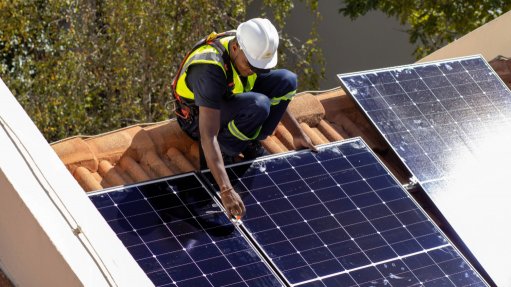
Locally manufactured solar water heaters at the Geosolar facility in Gauteng
 
Picture by: Duane Daws
Locally manufactured solar water heaters at the Geosolar facility in Gauteng