Creamer Media’s Engineering News Online
Advanced Search


We have detected that the browser you are using is no longer supported. As a result, some content may not display correctly.
We suggest that you upgrade to the latest version of any of the following browsers:
         
close notification
powered by
GOLD 1773.93 $/ozChange: 17.03
PLATINUM 1718.00 $/ozChange: -1.00
R/$ exchange 7.73Change: 0.00
R/€ exchange 10.25Change: 0.00
 
RENEWABLE ENERGY
Eskom to complete CSP design by 2013, commission plant in 2016
 
22nd June 2011
TEXT SIZE
Text Smaller Disabled Text Bigger
 

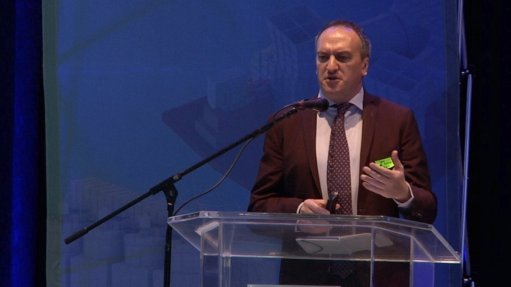
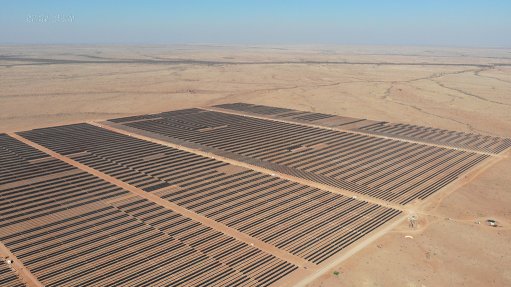
State-owned power utility Eskom is “reasonably confident” that it will commission its 100 MW concentrated solar power (CSP) demonstration plant in the Northern Cape, by 2016, technology and planning manager Barry MacColl said on Monday.

Speaking at the Solar South Africa conference, in Johannesburg, he said that the parastatal wanted to push the technology boundary through the completion of what would be the largest CSP plant in the world.

The design of the plant would have to be finalised by 2013, MacColl said. “We hope to commission the plant by 2016, which gives us two-and-a-half years of build time. By mid-2013, we have to finalise the design for the plant, with molten salt central receiver our preferred option,” he told Engineering News Online.

In line with the environmental-impact assessment (EIA), Eskom hoped to build a 100-MW central receiver demonstration plant with molten salt as a heat transfer fluid. It would appoint an owner's engineer as the first step in the commercial process, to support it in the development and execution of the project.

But, the engineering design, finding a suitable firm to work with Eskom as an owners engineer and preparing the package to go out as an engineering, procurement and construction (EPC) contract to the market, remained a challenge, MacColl said.

The utility was currently assessing a large number of applications, after a request for expressions of interest for the provision of EPC services was put out in April.

It would appoint an EPC contractor and a planning and design contractor by 2012.

Should Eskom not start construction by 2015, and should it change the proposed design from the envisaged central receiver plant, it would have to revise its approved EIA.

Possible plant specifications included capacity factors suitable for base-load operation, and two tank storage systems, with molten salt, designed to operate the power plant as a base-load plant. The plant would have a dry-cooled or hybrid-cooled design to ensure efficient use of water. Further, all auxiliary power would be sourced from the national grid and backup would be sourced from diesel generators, with the life-of-plant being a minimum of 25 years. A water supply contract has also been secured with the Upington municipality.

The land on which the CSP plant would be built was adjacent to the 5 000 MW solar park, in Upington, for which the South African government has committed R18.6-million to complete a feasibility study.

“This is exciting in that we are now collaborating with government to do a conceptual layout that would add value to both solar parks as opposed to treating them as separate entities.

“Eskom is working quite closely with government and their consultants on a design for the park that will share a common ground, servitude and services – this will make  more sense for the country than working as separate entities,” MacColl told Engineering News Online.

Advantages of the land selected for the demonstration site included it being a good solar resource, with a plant capacity factor of 70% and high solar insolation of 8 kWh/m2 a day, and that it had the potential capacity of at least 600 MW, made up of the 100 MW from the CSP demonstration plant and the 500 MW from a commercial plant.

It was also in close proximity to existing transmission lines, national and main roads.

Meanwhile, Eskom is also changing its position on photovoltaic (PV), driven purely by the need to better understand PV, he said. “Eskom is taking progressive, small steps with regard to this technology, which we believe is an emerging and mature technology.”

Two tenders to generate 1 MW of power from PV for the Kendal power station, in Mpumalanga, and the Lethabo power station, in the Free State, were out. The 1 MW would be used internally, for example, to power pumps and compressors.

Eskom is also installing PV at a parking facility at its Megwatt Park offices, in Sandton.

However, he said in line with moving towards cleaner technologies, CSP was the “technology of choice”. But, MacColl said the utility would also look to PV and a combination of other technologies in future.

“Eskom strategic drivers require a large scale diversification into lower carbon technologies, and this diversification will be based on South Africa’s solar resources and the advantages of central receiver with storage, making the choice of the CSP demonstraion plant project an attractive option, ” he concluded.
 

Edited by: Mariaan Webb
FULL Access to Mining Weekly and Engineering News - Subscribe Now!
Subscribe Now Login
 
 
Topics in this article
City Company Continent Country
Facility Industry Term Natural Feature Person
Province Or State Technology  


Hide Comments  
 
Readers Comments
 
image image
No Chris. The diesel backup will only serve to power the auxilaries to start the plant in the case of a grid blackout. It is like the starter and battery of your car. (You need a little 1kW electrical engine to start the large 100 kW internal combustion engine )
image image 
image
Sid on 30 Jan 12
image image
Why is it necessary to have feed in tariffs when their are insufficient numbers of people in South Africa to pick up the tab at a reasonable and sustainable increase in electricity costs per household? This an expensive experiment simply to try and entrench a monopolistic and costly process of electricity generation.
image image 
image
Hugh Hodge on 24 Jun 11
image image
After a huge investment in time and money over the past 3 years and reading between the lines, I've recently been telling investors that they can expect renewable energy to really take off in 2018 in South Africa. In November 2008, government said we'd have feed in tariffs in March 2009. I think they meant March 2019!
image image 
image
David Lipschitz on 23 Jun 11
image image
100 MW is not by any means the largest in the world -California has about 350 MW & Spain about 450MW in different locations, saving transmission costs as well. So Eskom presumably must be planning increasing the 100 MW plant. Still, this is excellent news from Eskom now finally conceding that RE technologies can deliver base load power, often mistakenly only attributed to nuclear & coal. These dirty and potentially deadly forms of energy, in common with most commodities, have shown us that what is claimed to be cheap soon proves to be immensely expensive, in terms of health and lives of citizens and pollution impacts on water, land and air. Renewable technologies deliver hundreds of thousands more much needed sustainable jobs thereby creating a larger tax base, while delivering clean energy with zero fuel input costs. Eskom & government need to scrap the nuclear build sooner rather than later – it is way too expensive and only exists on the back of massive state subsidies for this & all future generations to bear. Highly skilled energy scientists should be redeployed developing new & refining existing renewable technologies to be manufactured in South Africa – creating a clean future in the sun for all!
image image 
image
Christine Garbett on 23 Jun 11
image image
Aaah! It's the challenges that hold us up.
image image 
image
Mo Haarhoff on 23 Jun 11
image image
So 100 MW would be the biggest CSP plant in the world? I wonder why? If it’s such a boon why haven’t other nations wealthier than us and less endowed with abundant coal resources not already invested in bigger plants? By the way, can we take the word “backup” in the statement: “backup would be sourced from diesel generators” in its commonly accepted meaning? Is the intention to replicate the plant capacity with diesel generators just in case? If so, then the provision for backup alone would blow the economic viability out of contention. And diesel is not exactly carbon free, is it?
image image 
image
Chris Herold on 23 Jun 11
 
 
Eskom technology and planning manager Barry MacColl discusses the utility's 100-MW concentrated solar power demonstration plant, in the Northern Cape
GET SELECTED AUDIOCLIP
Embed
This article's audio Download (1.32mb)