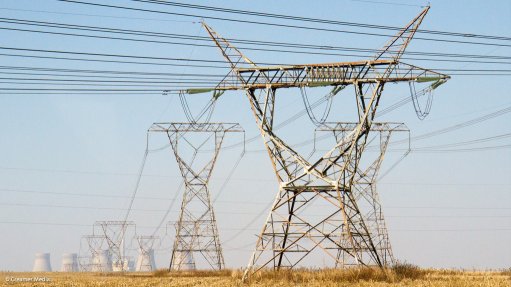
Africa’s leading power utility, which is planning to nearly double its installed base of generation capacity to 77 960 MW by 2025, has confirmed that nuclear energy will constitute about half of those additional megawatts. But Eskom CEO Jacob Maroga tells Engineering News that the State enterprise is also keeping close tabs on generation prospects in the Southern African region, which he believes could be supportive of its aspirations to spread risk, decrease pressure on limited in-house financial and technical resources, as well as in diversifying its primary-energy mix.
The utility has taken a strategic decision not to rely on imports for more than its ‘optimal’ reserve margin of 15% – its reserve margin is likely to remain in the 8% to 10% band until new base-load capacity is added from 2011 through to 2013. Nevertheless, 15% of nearly 80 000 MW is material, standing at almost 12 000 MW, and could unlock a number of regional projects that potentially require offtake agreements with Eskom to proceed to financial closure.
Maroga reports that it is engaged in serious power- purchase agreement (PPA) negotiations with the initiators of the $9-billion Mmamabula coal mine and power station project, in Botswana, and that a deal could be struck within months.
The project, which is being pursued by CIC Energy, of Canada, through its wholly owned Botswana sub- sidiary, Meepong, could involve a 2 250-MW power station (three units of 750 MW each), just across the border from South Africa. It is also only likely to be perceived as a ‘bankable’ project if it is able to secure a material offtake agreement with Eskom, given Botswana’s relatively modest domestic requirements.
Maroga tells Engineering News exclusively that the negotiations should be finalised “in months rather than years”. He says that the talks are being conducted with full cognisance of the fact that the cost of building new power plants has risen significantly and are, therefore, not entirely constrained by the current tariff dispensation.
Indeed, Eskom itself has requested that the three-year multiyear tariff determination, or MYTD, round be reopened to enable a material 18% price increase as from next year, as opposed to the prescribed inflation plus 1%, followed by the inflation plus 2% determination, as set by the National Energy Regulator of South Africa (Nersa) for 2008 and 2009.
TARGET DATE FOR START OF MMAMABULA CONSTRUCTION IS Q2 2008
However, Maroga stresses that the PPA has to be competitive with Eskom’s forward cost curve, adding that its own R200-billion-plus build programme is giving it a good handle on what realistic costs are. This, he adds, is providing the utility with an accurate benchmark for the PPA negotiations with CIC and potentially with other independent power producers (IPPs) at home and in the region.
CIC Energy head of investor relations and media Erica Belling confirms with Engineering News that the talks are under way and should be concluded “this year”. She also confirms that their conclusion is indeed essential for the conclusion of a ‘bankable’ study.
“CIC Energy and Eskom signed a memorandum of understanding (MoU) in May 2006 . . . Eskom also signed a MoU with Botswana Power Corporation regarding transmission of power generated by the Mmamabula energy project in November 2006,” Belling says, adding that CIC hopes to begin construction during the second quarter of 2008.
Belling adds that the company is currently negotiating with engineering, procurement and construction contractors on construction costs.
But what about other regional power projects?
Here, too, Maroga is cautiously optimistic. “We are aware of every serious project in the region, because anybody that wants to make a significant investment knows that we are the biggest candidate for PPAs. Most of these large projects can only really be bankable on the basis that they have a PPA with Eskom,” Maroga says, listing some of these projects as the Western Corridor project linking South Africa to the hydro potential of the Democratic Republic of Congo, the Kudu gas project in Namibia, and the North Bank Cahora Bassa expansion and Mpanda Ncua, in Mozambique.
‘WE WELCOME ALL VIABLE IPPS’
Maroga dismisses the perception that Eskom is resisting IPPs. “We welcome IPPs on the basis that they draw in new skills, new supplier relationships and, potentially, even new technologies. The demand is big and growing and, therefore, any project that is commercially viable, an IPP or our own, we will welcome.”
Maroga’s statement appears to be supported by recent research conducted by independent consultancy Frost & Sullivan, which suggests that South Africa’s current tariff dispensation could be the main constraint to attracting IPPs.
In a recent study, the company projected the IPP market in South Africa to be worth as much as $13,25-billion in 2013, “but only if electricity prices more accurately reflect the cost of production”. Energy and power research analyst Jeannot Boussougouth says that if tariffs are kept low, it will continue to limit the prospects for IPPs.
In its representations to Nersa, Eskom is likely to echo the assertion that South Africa’s tariffs are out of line with global trends. Indeed, Maroga reports that not only does South Africa remain the cheapest producer of industrial power, but also that the gap between it and its nearest rival, Canada, now stands at 74%, according to a report by power consultancy NUS. He says the gap between its nearest rival (Australia) in 2006, had been 30%.
Eskom has submitted a ‘reopener’ proposal to Nersa for a CPIX plus 13,5% (or 18%) increase next year, followed by a CPIX plus 12,5% increase in the following year. Nersa is considering the application and a final decision will be made on December 20.
To subscribe to Engineering News's print magazine email subscriptions@creamermedia.co.za or buy now.


lr1_2.gif)