Creamer Media’s Engineering News Online
Magazine in Store Now!
Advanced Search
 
 
We have detected that the browser you are using is no longer supported. As a result, some content may not display correctly.
We suggest that you upgrade to the latest version of any of the following browsers:
         
close notification
powered by
GOLD 1246.94 $/ozChange: -3.97
PLATINUM 1554.50 $/ozChange: 5.00
R/$ exchange 7.18Change: 0.06
R/€ exchange 9.27Change: 0.01
 
 
NUCLEAR ENERGY
Energy Minister promises ‘emphatic’ decisions on nuclear energy
0 COMMENTS  |  
ADD A COMMENT PRINT
 
 
23rd June 2009
TEXT SIZE
Text Smaller Disabled Text Bigger
 

South Africa’s new energy Minister promised on Tuesday that “emphatic decisions” would be made about the future of Eskom’s nuclear build programme.

Addressing Parliament in her inaugural Budget Vote, Minister Dipuo Peters again stressed government’s intention to deploy nuclear energy as a means of diversifying the country’s coal-heavy energy mix and lowering its greenhouse-gas emissions.

“Our work in this regard, will include intensified engagement within the government system and outside, in order to ensure that we take emphatic decisions with regard to Eskom’s nuclear build programme,” Peters said.

In December, Eskom called a halt to the procurement processes it had initiated with nuclear vendors Areva, of France, and Westinghouse, of the US, for the so-called “Nuclear-1” programme.

The utility refrained from selecting a technology partner owing to serious financial constraints, especially given the high upfront costs associated with the development of soc-called third-generation pressure water reactors (PWRs) – Areva was offering its “EPR” technology, while Westinghouse, which is owned by Toshiba of Japan, had marketed its “AP1000” reactor.

FUNDING STRAIN
Indeed, Peters’ counterpart at Public Enterprises, Barbara Hogan, referred to these financial pressures in her address to the same National Assembly on Tuesday, warning that “any shortfall in funding that is not provided for either by additional government support, or through [Eskom’s] electricity tariffs will result in the curtailment and/or rephasing of build-programme projects”.

But Hogan also stressed, that, despite these stresses, Eskom was pressing ahead with a capacity expansion programme, with particular emphasis being placed on bringing the two new 4 000-MW-plus base-load coal-fired power stations, Medupi and Kusile.

Hogan said the utility was still planning to spend a “nominal” R385-billion in over the five years which began in the 2008/9 financial year, and that the programme in its entirety could double Eskom’s generating capacity to 80 000 MW by 2026, “with a projected spend in excess of R1-trillion”.

She made no reference, though, to any possible restarting of the nuclear programme.

However, it is understood that, since the cancellation of the Nuclear-1 process, the State taken over the lead role in determining the funding options, while Eskom had continued with some preparation processes.

Environmental-impact assessments were also under way at three possible nuclear sites, including Duynefontein (alongside the existing Koeberg nuclear plant, in the Western Cape), Bantamsklip (near Pearly Beach, in the Western Cape) and Thyspunt (near Oyster Bay, in the Eastern Cape).

The South African utility, which initially indicated that nuclear energy could comprise as much as 20 000 MW of a larger 40 000-MW expansion that would be required over the next quarter of a century, had now set an indicative deadline of January 2011 for the start of construction. It was also continuing to refer to a “fleet” deployment model, which indicated that it would not mix technologies once a decision was made.

Meanwhile, it was also busy with the construction of two new coal-fired power stations, at a combined cost of R211-billion, to add to its already coal-heavy fleet – coal comprises more than 90% of Eskom’s energy mix.

The energy department, which was in the process of being separated from the minerals department, confirmed recently that partnerships were being contemplated, to help Eskom fund the programme. But government was also keen on developing technology-transfer and localisation programmes around any possible nuclear-build programme.

In her speech, Peters stressed the following four guiding principles of any nuclear-energy investment programme, including: the public’s right to know; security of nuclear fuel supply; waste management; and nuclear security and non-proliferation.

“Accordingly, we are pressing ahead with the implementation of the Waste Management Policy and Strategy and will, during this calendar year, establish the National Radioactive Waste Disposal Institute in order to manage and regulate radioactive waste material in accordance with international standards,” she said, without indicating whether South Africa would favour recycling or immediate long-term storage.

Edited by: Terence Creamer


Hide Comments  
 
This article contains no Comments


All comments must be approved by our editors, click here to read the editorial guidelines for comments. Please allow some time for our editors to approve your comment after posting.
 * Required Fields

image
image
 *


image
image
 *
 

image
image
 

Verification Image

image
image
 * Please enter the text you see in the above image.


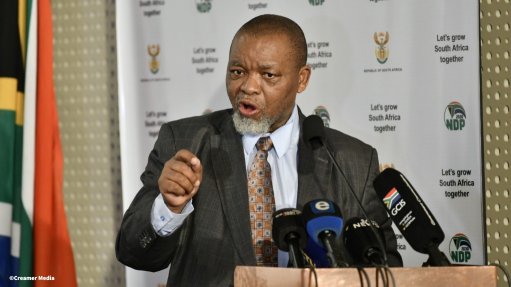
Energy Minister Dipuo Peters
 
Picture by: Duane Daws
Energy Minister Dipuo Peters