Creamer Media’s Engineering News Online
Magazine in Store Now!
Advanced Search
 
 
We have detected that the browser you are using is no longer supported. As a result, some content may not display correctly.
We suggest that you upgrade to the latest version of any of the following browsers:
         
close notification
powered by
GOLD 1252.31 $/ozChange: 6.67
PLATINUM 1556.00 $/ozChange: 24.00
R/$ exchange 7.22Change: 0.08
R/€ exchange 9.27Change: 0.07
 
 
SOLAR WATER HEATING
DoE moves to assess SWH appetite ahead of big roll-out
3 COMMENTS  |  
ADD A COMMENT PRINT
 
 
29th July 2010
TEXT SIZE
Text Smaller Disabled Text Bigger
 

The Department of Energy (DoE) has launched its ‘market sounding exercise' to assess the solar water heating (SWH) appetite in various geographical areas of South Africa.

"This market sounding exercise is meant to ascertain the market capacity, capability, as well as the level of interest before the actual roll-out of the SWH systems," said DoE director general Nelisiwe Magubane.

Some of the services that the DoE would be looking for included: the provision of SWH systems; the installation and maintenance of SWH systems; the independent measurement and verification of achieved savings.

Interested parties could contact the department through its website.

The department has committed to the roll-out of one-million SWH systems by 2014, in an attempt to reduce the use of coal-fired power to increase energy security, as well as for environmental reasons, and also as a way of alleviating poverty and improving service delivery.

The department aimed at incentivising the roll-out of 200 000 SWHs in the current financial year, through its standard offer programme (SOP). Under this SOP, a price would be offered for every kWh of electricity saved, as well as the savings per SWH system (for example, 200 kWh/SWH system/month) - and this money would be paid back to the SWH installer over time.

Thus an installer would install the system for a customer, and get money back through the SOP only after the savings were achieved.

The price per kWh was yet to be determined by the National Energy Regulator of South Africa (Nersa), however, what was certain was that it would be funded through electricity tariffs, and it would be reviewed every year. Currently, the suggested rebate for 2010 was 54c/kWh.

On August 5, public hearings into the Standard Offer Policy and regulations would be held at Nersa. A final pronouncement on the rules of the SOP would be made on September 23.

Nersa published a consultation paper on the SOP in June, wherein it invited written comments from the public.

"The information obtained through the Nersa process will help us to better understand the market before ultimately determining the way forward. Views and suggestions that will be solicited from this exercise will not be disclosed to third parties or used for any other purpose," Magubane said.

She further explained that the standard offer concept was premised on providing financial incentives for the energy savings that were derived from this SWH initiative.

"This will be the case irrespective of the technology that has been applied to achieve these projected savings. This is an intervention that is outcomes based. It is anticipated that the incentives will be offered only after the delivery of the outcome, and the subsequent process of verifying energy that has been saved", she said.


Edited by: Mariaan Webb
 
 
Topics in this article
Continent Country Industry Term


Hide Comments  
 
Readers Comments
 
image image
With regards to the article above, just for interests sake, what type of solar water heating systems will be "rolled out"? Drain back Active Indirect systems (closed loop) Active Direct (open loop) Thermosyphonic (convection heating) Batch Heating or Incorporated Heating Systems I'm pretty confident that there will be energy savings(this will vary according the the area of installation, climate , efficiency of system etc.), but what will the results be if there are no energy savings? Will the incentives fall away? Will this not be a risk to the installers? Thanks for your feedback. Best wishes, Chad
image image 
image
Nathaniel Chad Metzer on 30 Jul 10
image image
An objective of the DoE is to curb electricity demand. Referring to this article it is based on the measured fact that an electric geyser can contribute up to 40% of a household bill at month end. Yet it is unknown as to why the intended solar water heater roll out program will focus on both the low and middle to upper income sectors? The original intention of the Eskom solar water heater rebate program was to curb demand. There is little or no benefit in supplying a solar geyser to a sector that does not currently contribute to demand data (low income). Can South Africa afford to cancel a program (Eskom rebate) that is dedicated to curbing existing demand. Will the rebate program be scrapped for the roll out of standard offer? Should government not consider the merit in proving two models. One for the low income social development perspective and the other that supports the existing Eskom rebate program for the middel to upper income demand sectors? What are we attempting to achieve?
image image 
image
Gareth J Gregory on 31 Jul 10
image image
People like the idea of saving energy, but the barrier they face is the high initial cost of systems. The DOE needs to drop the cost of systems below R10k, preferably nearer R8k then we will install bucketloads of them. Its a well known principle called elasticity of demand. This proposed new scheme has no sound basis for stimulating demand. There will be no risk free way of passing on the "rebate" so fat cat installers will get fatter on the annuity income, DOE will swell its ranks employing hundreds of verification staff, and the consumer will pay more for electricity or taxes or both. Ultimately, this scheme will not incentivise installation of SWH
image image 
image
Alan Bell on 03 Aug 10
 
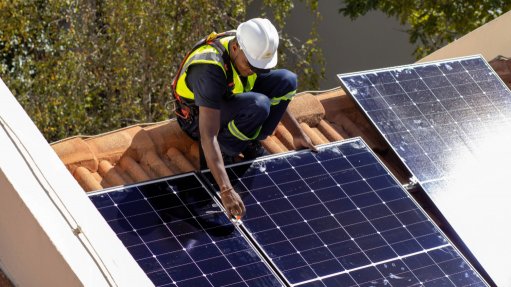
A locally manufactured solar water heater
 
Picture by: Duane Daws
A locally manufactured solar water heater