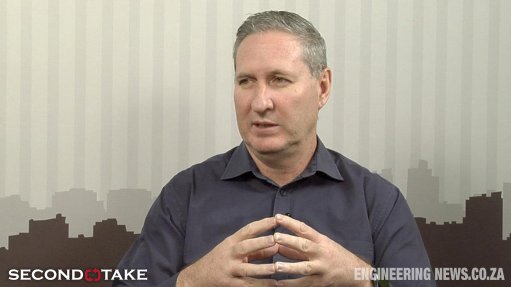
The De Hoop dam on the Steelpoort river, in the Sekhukhune area, in Limpopo, will begin a partial impounding of the river in January next year while construction of the dam wall continues, says Department of Water Affairs contractor advisor Mike Nitzsche.
The dam wall will be around 85 m high after completion, scheduled for October next year, and had reached half its final height in early November. The 1 010-m-long Department of Water Affairs project is under significant environmental monitoring and will pump water past the wall to ensure that the river does not run dry, even for a moment, to preserve downstream ecologies and communities once it seals the river outlet.
The dam wall will contain around 1.125-million cubic metres of concrete of which 90% consists of Roller Compacted Concrete (RCC). The downstream wall rises in 1.2-m-high steps with the upstream side being vertical. The hourly pouring rate of the team is around 230 m3/h, with spurts of around 360 m3/h.
The De Hoop Dam team is currently embarking on an effort to improve the previous South African RCC placing record, which consisted of 103 000 m3 of RCC placed in one month (23 days), also achieved by the De Hoop Dam Team during November 2010.
The wall comprises roller compacted concrete composed of cement, fly ash, 38 mm stones, 19 mm stones and sand, with retarder or plasticiser added as needed and without grout. Further, the faces of the steps are immersion vibrated. This removes the need to use a concrete skin against the shutters, which are oiled instead, providing a smooth finish with high strength, he explains.
Articulated dump trucks (ADTs) transport the concrete onto the dam wall, where it is spread out by a bulldozer into a 300-mm-thick layer and compacted by a 10 t vibratory roller.
Quality control is of high importance and the team continuously tests the compaction of the concrete and also sends samples to be tested in a laboratory.
The dam wall will narrow to a final width of about 10 m at the top and concrete will be delivered to the work site by a conveyor system designed to transport concrete up to 60 m high, when trucking is no longer efficient. The conveyor system will, however, feed the concrete onto an ADT on the wall, which will then place it on the right spot.
Mist sprayers saturate the air over the work site to prevent the concrete from drying out. The addition of a retrader product (additive) to the RCC enables the contractor to place RCC over a large area and continue with a 24-hour, 7-days-a-week placing operation without running the risk of encountering “cold joints”.
Five concrete batching plants work nonstop to provide a total of around 300 m3/h of concrete. Thirty to 35 tanker loads a day (12 hour) of fly ash are transported to the site and fed into silos that act as a supply buffer in case of transportation disruptions. Fly ash products company Ash Resources’ Matla plant in Mpumalanga is about 320 km from the De Hoop site, with Ash Resources Lethabo plant in Free State functioning as back up to manage the high fly ash demand.
The project, with the current RCC placing program, consumes between 15 000 and 20 000 l/day of diesel, costing around R5.5-million each month. A complete maintenance programme of all plant and equipment is being followed to ensure minimum downtime.
Extensive foundation grouting has been completed to ensure the closing off of any fissures and openings in the rock foundation that may cause leaks under 80 m of water pressure.
Quarrying on site is complete and the rising dam will eventually inundate the quarry site, which is around 30 m deep. All of the required aggregate products has been produced and is stored above the partial impoundment level. The aggregate sub-contractor has already de-mobilised and rehabilitation work of the quarry is nearly complete.
The dam outlet structure contains staggered 2-m-diameter outlet pipes to release water at different dam levels and to select required water quality. The pipe inlets are protected with trash racks and fine screens, to prevent debris from entering the pipes. Large butterfly valves are used to regulate the flow of water through the two 2-m-diameter water abstraction pipes.
A section of the provincial road P169-1 (R555) between Middelburg and Burgersfort will be submerged by the dam and requires realignment. The realigned route of about 20 km will pass the new dam on the western side and includes two bridges over the Steelpoort river.
Since work is conducted at heights, great emphasis is placed on safety and the safety of the workers.
Further, once a shift, all the machines are hosed down to remove concrete build-up that could cause a fault or failure when it hardens.
To subscribe to Engineering News's print magazine email subscriptions@creamermedia.co.za or buy now.


lr1_2.gif)