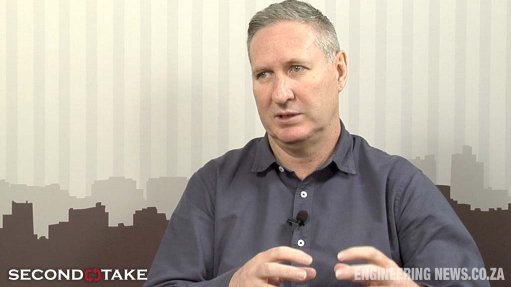
South Africa’s small-scale steel sector, also known as the cottage steel industry, has the potential to develop into a more significant sector, which, if developed, could create downstream benefits for the rest of the steel industry, says International Steel Fabricators of South Africa (ISF) chairperson and MD of local manufacturer Vital Engineering Dodds Pringle.
Since its inception in 1991, one of the primary goals of the ISF has been to drive exports of locally fabricated secondary steel products for the international market. Pringle believes this goal can be achieved by further developing the cottage steel industry, which, in turn, entails encouraging local community members to use raw materials and their own equipment to fabricate steel components and products.
“While we are seeing the bigger picture in trying to secure structural steel mining contracts [for ISF members] in countries like Canada and Australia, as well as the rest of Africa, we are also considering the development of the cottage steel sector, with a possible future for exports in mind,” he says.
He adds that the unregulated environment of a small-scale sector enables local entrepreneurs to manufacture high-quality products at a relatively low cost, which provides endless possibilities for South Africans, such as job creation, wealth creation and new-enterprise developments.
“[The cottage sector] might be relatively small in terms of the [steel] industry as a whole, but we could probably start developing it into a fairly large industry if we start sector by sector, area by area,” says Pringle. He maintains that this could easily lead to a future in exports for previously unemployed individuals, and cites Uganda, Tanzania, Malawi, Angola and Ghana as examples of countries that are successfully promoting their cottage steel industries.
Pringle believes South Africa has many potential entrepreneurs who are artistically inclined. “They work wonders with steel and have the incredible ability to create things of beauty.”
He adds, that, although the ISF has partly achieved its goal to drive exports, there is still a lot of work to be done in terms of understanding the international market, particularly in the secondary steel industry.
This sector of the industry needs to work at developing a higher level of confidence and faith in South African secondary steel supply. “We hope that the secondary steel industry will take more of a pole position in terms of exports,” says Pringle.
Latest Industry Trends
The ISF’s attempt to establish local secondary steel in the international market will be further supported by new secondary steel industries in South Africa. Once established, these industries naturally turn to the international markets to achieve the benefits of mass production.
Pringle cites the recently established local light steel frame (LSF) housing industry as an example of an upcoming secondary steel industry.
He points out that, traditionally, South African steel has always been associated with the industrial environment, but interest in the use of this material is growing in the commercial sector. “[LSF] buildings are fairly easy to transport and erect; they also require a lot less maintenance,” he says, adding that the added benefits of LSF buildings far outweigh those of traditional brick and mortar buildings.
This relatively new industry has already started exporting products to the rest of Africa.
Meanwhile, the ISF has encouraged investment in wind farm technology and promoted partnerships with overseas companies to develop wind towers for the expansion of South Africa’s renewable-energy sector. “A lot of that fabrication will be done in South Africa, rather than importing [the towers],” says Pringle.
The local steel industry is developing new steels that will be able to manage the particular loads on the wind towers, he says. As a result, there are a variety of steel grades that are now being upgraded from traditional standards to 350, 400 and 500 WA materials.
“Improving our grades of steel to international standards enables us to improve on production and design, and to keep up with international design trends,” he notes.
Pringle stresses that, from a strength and performance perspective, the grade of steel that the South African industry is using at the moment is equal to any other steel produced globally. “So, from a downstream competitive perspective, our steel industry can compete fairly favourably with international projects,” he says.
Once the establishment of the wind tower industry in South Africa has been completed, it will be logical for this industry to also start looking north beyond South Africa’s borders for new opportunities in neighbouring countries, he adds.
Government Assistance
The steel industry is currently seeking protection from imports for the local secondary steel sector against dumping from subsidised countries. As a result, it is interacting with government on a regular basis to negotiate local industry protection.
“Government recently announced the new Manufacturing Competitiveness Enhancement Programme, which is very positive,” says Pringle. He adds, however, that if preventive measures for the South African secondary steel industry are not implemented now, steel business could soon start to move offshore, which has happened in other countries, like Australia.
As head of the ISF, Pringle has suggested that government consider placing import duties on all finished steel goods, but not on raw steel. “This would allow us to become a focused converter of internationally competitive raw materials, which will further improve our competitiveness,” he says, adding that it might also meet some of government’s goals for job creation, wealth creation and growth in the industry.
The ISF is also part of a current movement to establish ‘South Africa Incorporated’, also referred to as SA Inc, which would aim to bring together the various South African construction industries as one unit for the export markets. This would provide international customers with a holistic view of the country, compared with viewing local companies as individual entities.
“Traditionally, you find that a particular engineering, procurement and construction management (EPCM) company would secure a portion of a contract for a particular plant or project, but would be isolated,” explains Pringle. However, if that EPCM was part of a corporation like SA Inc, more than one local company could be involved and would benefit from a single project.
Pringle also stresses the importance of international confidence in South Africa and suggests that government do what it can to mitigate any lack of confidence in the local industry, which will, hopefully, boost the state of the industry in the long run.
To subscribe to Engineering News's print magazine email subscriptions@creamermedia.co.za or buy now.