This year should not see a marked difference in the automotive components industry despite the current energy crisis, says the National Association of Automotive Component and Allied Manufacturers (Naacam).
“The automotive market experienced a softening in the middle of 2007, and, at the same time, monthly car sales were lower in relation to figures for the same month the previous year. Commercial vehicles, however, did hold up and sales were better in 2007. This year again, the car market is going to be weaker, as interest rates rose. This has led the National
Association of Automobile Manufacturers of South Africa (Naamsa) to forecast that vehicle sales will be 10% down from last year,” Naacam executive director Roger Pitot says.
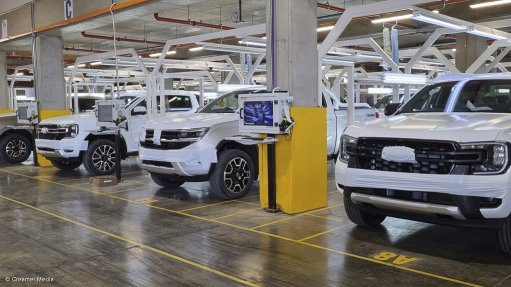
However, he points out that on the local component production side, exports are starting to show substantial growth. This comes after vehicle manufacturer Ford Motor Company of Southern Africa announced an investment of more than R1,5-billion in the local production of a new-generation pick-up, as well as the Puma diesel engine.
“The investment will take about two years to be implemented, but Naacam expects that other vehicle manufacturers will announce their own export programmes in the near future. This means that production numbers should remain unchanged for this year, but will increase substantially from next year,” Pitot says.
He comments that a weaker rand is benefiting the components export industry.
“Exports of component parts have been under pressure over the last year, because of a stronger rand. But with a sudden weakening of the currency, components producers find themselves 10% more competitive with overseas markets than they were a few months ago. While this type of volatility is difficult to manage, it gives the industry two advantages in that it creates a more competitive export market and helps local industry compete against cheaper imports,” Pitot explains.
The component industry currently has a turnover totalling about R50-billion, making it a 2% contributor to South Africa’s gross domestic product.
Meanwhile, South Africa is still under stress from large power outages. Pitot says that this is affecting the components manufacturing industry adversely.
“The first thing to understand is that the automotive components manufacturers comprise companies that span a vast range of sectors, such as the rubber, plastics, glass, and metals sectors. The risk lies in that if only one of the raw-product suppliers is disrupted by the current energy crisis, there could be a ripple effect affecting the vehicle manufacturing industries. The sooner a plan to remediate the situation is found, the better manufacturers can plan and overcome the problem,” Pitot states.
He says one of the ways in which the problem can be resolved is for government to assist manufacturing companies to invest in generators and back-up systems. This can be done either through partial funding of the investment, or allowing the companies to claim accelerated tax depreciation on the investment.
“Bigger companies may be able to afford back-up generators, but smaller companies, which are the lifeblood of the economy, and which government is trying to encourage, are the ones who can least afford it. That is why government needs to become involved and aid these companies,” Pitot explains.
Local companies have also started looking to the African continent for new markets, but Pitot is not convinced that the continent offers a quick solution.
“Africa remains a challenge. Naacam has found that most of its member companies that manu- facture components and do not want to sell directly into the continent, because of smaller volumes demand. This, coupled with the issues surrounding the logistics of getting the parts into Africa, means that they would rather work through trading companies, or through outlets. That is the way in which most business into the continent is done,” Pitot explains.
In a previous interview with Engineering News, (July 27–August 2 2007), Pitot said that black economic empowerment (BEE) was low in the components industry, owing to many manufacturers being multinational companies and unwilling to sell shares in their businesses. However, he says that the situation has substantially improved since then.
“Several Naacam members improved on their BEE scorecards through either attaining black owner-ship or by promoting black management. The companies also buy more parts locally, and are getting involved in local enterprise development,” Pitot says.
It is for this reason that Naacam has established a section 21 company, which is aimed at finding black-owned and black-managed companies on the fringes of the automotive industry that want to get involved in the automotive components supply chain.
“Naacam members will provide money, time and resources for these companies. The association concedes that this is a long-term plan, spanning about two to three years, but at the end of this time, these companies will be able to enter the full supply chain in the automotive industry,” Pitot concludes.
Meanwhile, Naamsa and Response Group Trendline report that the industry’s potential in creating work and business opportunities can be ascribed to many kinds of basic manufacturing activities, including steel and aluminium production, rubber, textiles, plastics, the petrochemicals industries, and components fabrication. Because the industry also provides employment by proxy in many other areas, such as customs, tax and other national government departments, licensing, logistics, and other private-sector services, the industry’s influence is considerable.
The component supplier industry’s investment in plant and equipment in 2006 amounted to R3-billion, which was an increase of 30% on 2005’s figures. With the announcement of investment incentives for South African automotive producers, the component manufacturing industry is expected to increase capital expenditure substantially in the next few years.
Locally assembled vehicles and manufactured automotive components were exported to over 100 countries in 2006. Overall, Europe remains the automotive industry’s main trading partner, followed by Japan, the US, the UK and Australia.
The European Union accounts for almost 70% of component exports in terms of value, while the US, Japan and Australia are the top three destinations for passenger cars. Germany, Spain, the UK, the US, France, and sub-Saharan Africa are the leading destinations for automotive components.
Collective employment in the vehicle manufacturing industry currently amounts to more than 38 500 persons, while employment in the components manufacturing industry is about 78 000 employees. The total employment in the trade area, such as vehicle sales, maintenance, and replacement parts, currently amounts to about 198 000 persons.
To subscribe to Engineering News's print magazine email subscriptions@creamermedia.co.za or buy now.


lr1_2.gif)